2018 Annual Sustainability Report

The Ewing Green Team announces that their 2018 Annual Sustainability Report is now available for viewing on the Green Team’s website www.ewinggreenteam.org.

The Ewing Green Team was established in 2009 to inspire and engage those in our community who are passionate about environmental issues with the goal of fostering sustainable behaviors for the benefit of ourselves and future generations.  The team also has the primary responsibility for pursuing Sustainable Jersey certification for Ewing Township.

This report reflects the accomplishments of the Team in building upon the successes of previous years in fulfilling the community mandates in our 2014/2015 Strategic Plan and working the Sustainable Jersey program.   Since our last Green Team report we have focused our efforts in five key areas:  Community Building, Education and Outreach, Energy Conservation, Natural Resources, and Waste Management (recycling).

In 2018 the Green Team continued its efforts to increase citizen engagement through the publication of its new Welcome Guide and community events promoting sustainability such as the annual Scarecrow Contest (recycled materials and the Arts) and Ewing Fall Spin (health, bike safety and trails).   Education and outreach on sustainability topics remains a high priority for the GT and we held numerous outreach events throughout the year, as well as conducting electronic outreach via regular and frequent updates via Facebook and the web.

Energy generation and consumption is perhaps the most crucial issue to be addressed regarding global climate change and the Green Team worked to assist local businesses in reducing energy consumption through educational programming about grant opportunities available to aid them in making needed energy improvements such as the Direct Install program.  In addition, we have continued our work in recognizing businesses in town that exemplify the best in sustainable business practices.

The Green Team has a particularly robust partnership with the Ewing Environmental Commission to affect changes to the natural environment.  We coordinate actions to protect and increase the tree canopy, promote sustainable landscaping practices to protect biodiversity and vanishing wildlife and beautify our community.  We also support the Ewing Community Gardens.  Finally, our last major area of concentration is Recycling Education.  The GT spent considerable resources in educating and outreach to residents.  Our Trash Toss events enabled one-on-one education.  Flyers, such as Trash Talk and the Recycle Right campaign on plastic bags and pizza boxes were aimed at the two biggest recycling mistakes.  We also continue to update our Ewing Recycles website

We extend our thanks to Mayor Steinmann and Business Administrator McManimon who have been key partners in helping us attain our goals, and Township Council for their support.  We look forward to continuing our work with our partners in the Township and regionally in the coming year and to including more individuals, businesses, and community-based organizations in our efforts and for the future.

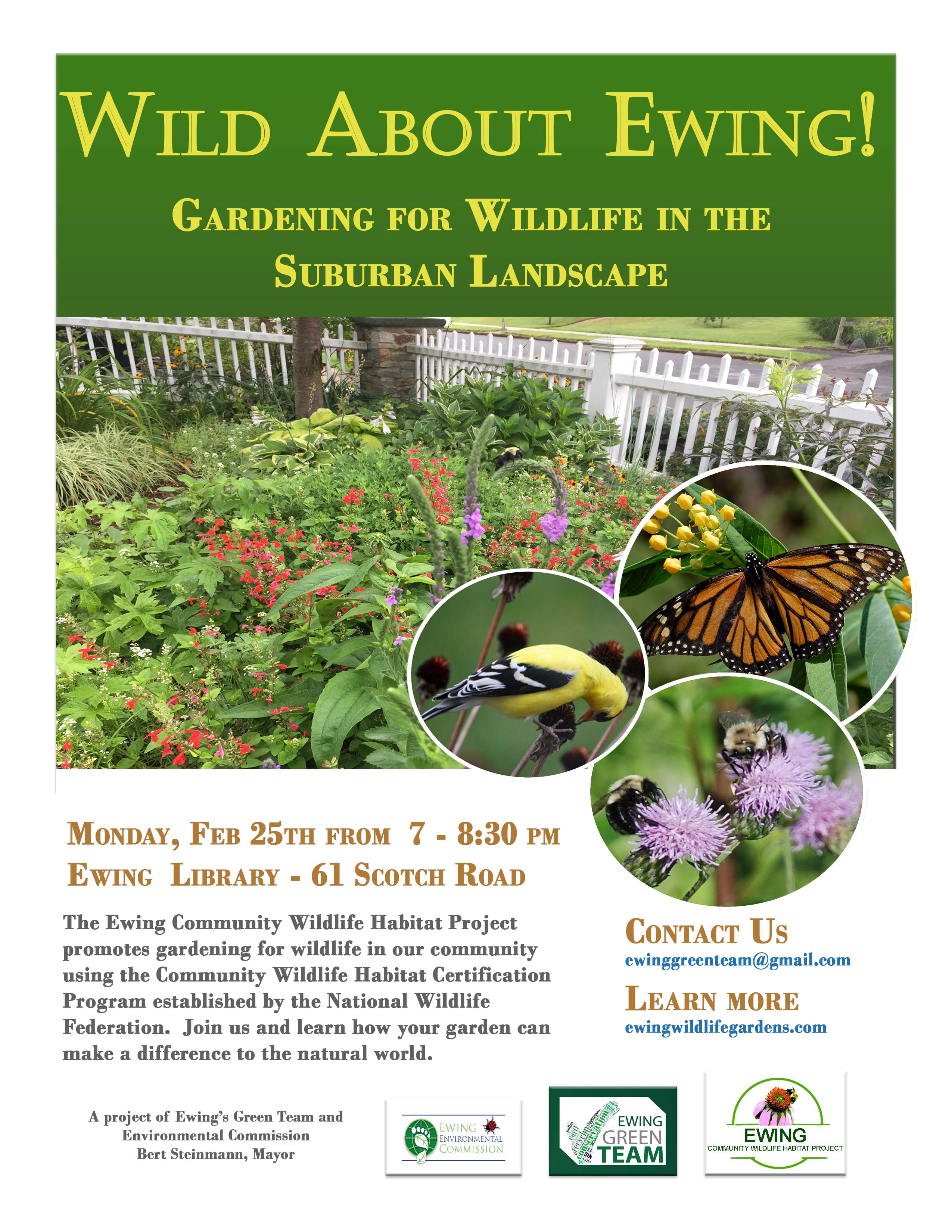
Wild About Ewing! Gardening for Wildlife in the Suburban Landscape

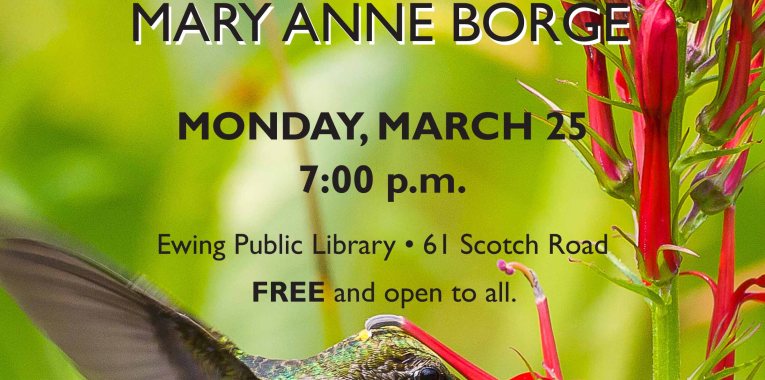
Wild About Ewing! will sponsor an introduction to the National Wildlife Federation’s Community Wildlife Habitat Project and how gardeners in Ewing are providing much needed wildlife habitat while getting credit for both themselves and their community at the Mercer County Library, Ewing Branch, 61 Scotch Road, Ewing on Monday, February 25th at 7 pm.   Joanne Mullowney, Chair of the Ewing Green Team and lifetime gardener, and Glenn Steinberg, Chair of the English Department at TCNJ and long-term wildlife gardener, will introduce the National Wildlife Federation’s program, explain how to work the program to certify your garden, as well as how Ewing as a community is working the program.

Why We Need to Bring Nature Home to Our Own Backyards

Sixty percent of the world’s wildlife populations have been lost in just over the last forty years. SIXTY percent!  That is the estimate from the latest Living Planet Report[1] published recently by the World Wildlife Fund.  We have also personally taken note of the loss of local wildlife. Where are the boundless flocks of migrating birds that filled the autumn skies of our youth, the omnipresent lightning bugs that lit up our backyard summer evenings, the bug-splattered windshields from our driving trips, the butterflies, the bees, the bats…?

Habitat loss from suburban expansion and industrial agriculture are key. Suburban neighborhoods have exchanged healthy native habitats for vast stretches of manicured lawns which contribute little of ecological value.  Industrial agriculture also plays a heavy role in unsustainable loss of habitat while also promoting synthetic chemicals and monocropping. We depend upon wildlife for critical ecosystem services and we wonder if we are destroying our planet’ s ability to support our way of life.

Joanne Mullowney states: “As a life-long gardener, my garden has always brought me a great deal of enjoyment and peace.  Since I’ve started “re-wildling” my garden, I’ve realized what a sterile environment I’ve provided in the past.   Gardening for wildlife has given me a truer enjoyment of the natural world and created a deeper connection to nature.”

How You Can Help

If you too are alarmed about the extent of this crisis and wonder what you can do to ensure that your children and grandchildren will be able enjoy the natural world as we did, we invite you to follow the example of members of Wild About Ewing, volunteers from Ewing’s Green Team and Environmental Commission  who work to promote wider use of native plants and sustainable gardening practices, key components required to certify Ewing as a Community Wildlife Habitat recognized by the National Wildlife Federation.  To become certified in the program, Ewing needs to accumulate 250 points in certified gardens from private properties, public spaces and schools.  Each garden should support our native birds, insects, small mammals… by providing the essential life sustaining requirements of food, water, cover and places to raise young.

Members of Wild About Ewing are taking action for vanishing wildlife species and all Ewing property owners are encouraged to “bring nature home” on their own properties and join them in making a difference.

Wild About Ewing is conducting a public outreach campaign to property owners in Ewing to encourage them and assist them in certifying their properties.  More information is available on the group’s website, http://ewingwildlifegardens.com/ and the Ewing Green Team and Environmental Commission’s Facebook pages.

[1] Living Planet Report – 2018: Aiming Higher. Grooten, M. and Almond, R.E.A.(Eds). World Wildlife Federation, Gland, Switzerland. 2018.

Resolutions to Ring in the New Year

The members of the Ewing’s Green Team want to thank you for all of your hard work in building a greener Ewing during the past year.   Whether at the Green Fest last March, municipal Shred Days, the Garden Tour, National Night Out, our annual Bike Ride and Scarecrow Contest, Community Fest, or one of our Environmental Insights programs, we had many opportunities to chat with you and learn what you are doing to better our community.   We thank you for making a difference!

As the old year ends and the new one begins, we frequently resolve to begin anew, to do something better and be better.  We asked our members and supporters to share their green resolutions for the coming year. We share them to give you some simple ideas on what you can do. What would you add to the list?

Best wishes for a Happy & GREEN 2019!

The Ewing Green Team

Eileen Antolino

I resolve to change all my bills to paperless to save trees, clutter and recycling…and to get my leaky outdoor faucet fixed to save water…  We would add that to better cut down on your junk mail, go to CatalogChoice.org to opt out of the mailed catalogs that are delivered to your mailbox.

Pete Boughton

I resolve to continue advocating with those who share similar views on biking and walking to each speak up to appointed and elected fellow citizens to advance striping of roads for bike safety and to improve and extend the pathways most suitable in town.

Dan Burke

I resolve to: (1) always take my canvas bags when I go shopping; (2) never ever take plastic straws when dining out; (3) carpool whenever possible: and (4) attend as many protests, demonstrations, and rallies as possible (carpooling, of course) to stand against this Administration for a clean environment.

Dorin Ciocostisan

We can all do our part to prevent further damage to our environment and our waterways from plastics! Therefore, I resolve to reduce the amount of plastic waste I produce by consuming less single-use consumer plastics. I will use cloth or reusable shopping bags instead of plastic bags at grocery stores. I will also avoid establishments that don’t offer non-plastic options or opt for “for here” options or regular mugs, dishes and cutlery.

Mary Corrigan

I resolve to continue to grow organically and to do as much for our environment as possible.  I further resolve to tackle the use of plastic and other single-use items and recycle to the best of my ability.

Evan Crumiller

I resolve to pick up litter that’s not my own.  When walking or even driving, I will bring a bag with me to collect litter.  I see litter at many of the places I frequently visit, and I can make an impact on my own by just picking it up and not leaving it for someone else.

Heidi Furman

I am resolved to transform my front lawn from grassy wasteland to flourishing pollinator garden. Green grass looks nice but adds nothing to the environment.  I resolve to increase habitat for all pollinators.

I further resolve to continue to have conversations with my neighbors about proper recycling. We’ve all seen plastic bags, pizza boxes, #3, #4, #5, and #6 plastics in neighborhood buckets because people either don’t know or have forgotten recycling rules in Mercer County.  Every little bit of education can go a long way.

John Hoegl

I resolve to make a list of errands to be completed every day. If they can be done by bicycle, this will be the best in terms of reducing my carbon footprint. If by automobile, the list should minimize the distance between stops, and make the total errands most efficient. The money saved on gasoline usage will be in addition to savings on maintenance and reduced insurance costs.

Kylie King (EHS student representative)

I resolve to continue to educate myself and my peers on how to live a more sustainable life.  We believe that this is critical to enjoying a better future!  We all need to be open to continuing to learn about critical sustainability issues and then taking action upon them.  Future generations depend up it!

Charlie Maack

I resolve to take my car to a car wash instead of washing it at home.  This will prevent soapy/dirty water from going down the driveway to a storm drain that flows into our water ways, or seeping into the ground and getting into our drinking water.  A car wash not only captures the soapy water but recycles the water thereby minimizing the amount of water used.

Jim McManimon

I resolve to continue to turn off lights in empty rooms and to encourage others to do the same.

Joe Mirabella

I resolve to maximize combining car trips to lower CO2 emissions.  I also resolve to convert part of lawn to wildlife habitat for various insects, plants and animals and to see what happens.

Joanne Mullowney

Habitat loss and degradation with its resultant loss of biodiversity is one of the greatest threats to the natural world and is an underappreciated crisis.  I resolve to garden sustainably on my property and promote the same to others.  I will maintain my property as a National Wildlife Federation certified wildlife habitat providing food, cover, shelter, and water for wildlife on my property.  And, when I see holes in the leaves of my plants, I will see them not as imperfections in an unsustainable goal, but rather appreciate them for providing life sustaining support for many creatures in the food web.

Caroline Steward

I resolve to continue to educate myself and my family on proper recycling while at the same time working to reduce the amount of trash we create.

Mark Wetherbee

I resolve to mulch all the fall leaves into my lawn and garden beds to feed my property naturally and reduce the amount of township truck stops to pick them up.

Thank you to all our members for their wonderful suggestions!

We add one final suggestion.  We don’t know what the future holds for us beginning in 2019, but it appears that the roles of the states, local governments and environmental organizations will be more critical than ever in continuing efforts to protect and clean up our environment.  So, resolve to join with us in our work, especially as we strive towards our third Sustainable Jersey recertification.  Come to a meeting and help us influence others to make needed positive changes for a better tomorrow for our town, our state, our country and our world.

Recycle Right: Please Don’t Put Soiled Pizza Boxes in Your Recycling Bucket!

Most people assume that pizza boxes are recyclable.  And, if we were to ask you if you could recycle your pizza boxes, and you answered ‘yes,’ you would be wrong.  Why so?  Most pizza boxes have recycling symbols on them and are made from corrugated cardboard.  These should be recyclable, right?

However, the answer is a bit more complicated than a simple yes or no.  Unused pizza boxes are indeed recyclable.  However, used pizza boxes, with their greasy stains are NOT!  A pizza box is only recyclable if the soiled grease and food parts are removed.

This sounds complicated for the average individual who just needs a simple answer while trying to decide what does or does not go into the recycling bucket.   To understand the whys and the wherefores you need to know how pizza boxes are recycled.

Basically, it comes down to the issue of food contamination.   Grease and oil are the worst contaminants in the paper recycling process.  During this process, paper products are mixed with water and turned into a kind of slurry.  When there is grease or oil contamination in the slurry, the oil forms at the top and the paper fibers cannot separate from the oils and the batch is ruined.  This also explains why other food-related items that are similarly grease/oil stained cannot be recyclable (think used paper plates and towels and napkins.)

We would also like to point out that adhesives such as those that attach coupons and other stickers also contaminate the paper recycling batch.  Ink, however, is generally not petroleum-based so they are not a problem.  Food remains the problem.

Our New Recycling Reality

You may have read about the restrictions placed by China on importing recyclable materials from the United States.  China has closed its doors to many types of recycling materials and is requiring that the material be 99.5% free from contamination.  According to the staff at the Mercer County Improvement Authority (MCIA), the contamination rate for recycling collected from Mercer County communities is 11.4%.  This means that we have significant work to do to make our recycling acceptable for the market.

China was also the largest consumer of US recyclable volume and no longer is purchasing the volumes that it did in the past.  This means that there is a glut of supply in the market which is significantly driving down the value of this materials.  As a result, in many cities across the nation, recyclables are ending up in landfills.

The Pizza Box Answer

You may only recycle the unsoiled portions of your pizza boxes.  Cut out or tear off the soiled portions and throw them in the regular trash.  If you are absolutely sure that the whole box is grease and oil free you can recycle it.  However, if there is any doubt, please throw it out!  You don’t want to contaminate an entire load of recycling.

“What about composting it?” you may ask.  Although the cardboard will break down in your compost pile, the grease is still problematic and may attract rodents and other small critters and bugs.  It may cause odors.  It also is not good for the plants when the compost from your pile is ready to harvest.

Most people think that it is better to err on the side of “over-recycling” rather than “under-recycling” and that more is better.  They don’t realize that one piece of garbage contaminates the whole load and that the whole batch could end up in a landfill.  We encourage all residents to observe the follow rule: One piece of garbage makes it all garbage and when it doubt, throw it out!

Take Action for Vanishing Wildlife: “Bring Nature Home” in Your Own Backyard

Sixty percent of the world’s wildlife populations have been lost in just over the last forty years.  Sixty percent!  That is the estimate from the latest Living Planet Report[1] published recently by the World Wildlife Fund.  Ewing’s Environmental Commissioners and Green Team members have noted their alarm about the loss of biodiversity and vanishing wildlife in numerous published materials and posts.  We have read reports that inform us that the “current massive degradation of habitat and extinction of many of the Earth’s biota is unprecedented and is taking place on a catastrophically short timescale.”[2]  We have also personally taken note of the loss of local wildlife.  Where are the boundless flocks of migrating birds that filled the autumn skies of our youth, the omnipresent lightning bugs that lit up our backyard summer evenings, the butterflies, the bees, the bats…?

Habitat loss is key.  Suburban neighborhoods have exchanged healthy native habitats for vast stretches of manicured lawns which contribute little of ecological value.  Industrial agriculture also plays a heavy role in unsustainable loss of habitat while also promoting synthetic chemicals and monocropping.  We depend upon wildlife for critical ecosystem services and again, we wonder if we are destroying our planet’ s ability to support our way of life.

If you too are alarmed about the extent of this crisis and wonder what you can do to ensure that your children and grandchildren will be able enjoy the natural world as we did, we invite you to follow the example of two of Ewing’s Environmental Commissioners, both wildlife champions, who work to promote and protect wildlife habitat and diversity on their own properties.  Ewing Environmental Commissioner, former chair, and avid birder Lee Farnham participates in Project FeederWatch, a citizen science program run by the Cornell Lab of Ornithology that counts birds and species at local feeders from November through April each year.  This project helps scientists quantify the health of bird populations around the nation.  And Environmental Commissioner and Green Team Chair Joanne Mullowney comes at the problem from her long-term gardening experience and now gardens for wildlife on her National Wildlife Federation certified property.  They are taking action for vanishing wildlife species and we encourage you to read on to learn how you can do the same.

National Wildlife Federation’s Garden for Wildlife Program

The goal of the National Wildlife Federation’s Garden for Wildlife Program is to encourage all land owners to live more sustainably and harmoniously with nature on their own properties.  This means changing landscape management practices to support wildlife by (1) gardening organically and eliminating the application of synthetic chemicals to the landscape, (2) removing some of your lawn to provide food, cover and shelter for wildlife thru the establishment of native plant communities, and (3) providing the water sources, however small, that wildlife needs to survive.

Lest you think that gardening for wildlife does not fit the suburban landscape ethic, we strongly disagree.  A well-maintained habitat garden will not only be a refuge for our vanishing wildlife; but can be structured and beautiful.  Joanne participates in the Green Team’s Annual Garden Tour and is proud to invite people to visit her gardens during the Tour each year.

If you would like to learn more about how to provide habitat in your own yard and gardening for wildlife, we have enrolled Ewing in the National Wildlife Federation’s Community Gardening for Wildlife Program. See our new website, the Ewing Community Wildlife Habitat Project, and join us to protect wildlife in Ewing.   There are currently about 50 certified gardens in and about town.

Project FeederWatch

Project FeederWatch, a program for birders, is a citizen science program run by the Cornell Lab of Ornithology and Bird Studies Canada and is a November-April survey of birds that visit feeders at backyards and common areas in North America.  Participants count the birds they see at their feeders and their species on a regular schedule and send their counts to Project FeederWatch.    Anyone interested in birds can participate.

This fall and winter season, Lee is once again going to pick up his binoculars to count the birds that visit his backyard feeders for project scientists.  His beautiful and wonderfully wooded backyard is ideal for his avian visitors and offers plenty of shelter, cover and food (and really should be NWF certified).

Lee’s observations will be added to those of thousands of others across North America to help understand the distribution and abundance of birds that visit American feeders.  This data also helps scientists to understand:

  • Changes in the winter ranges of feeder birds
  • The kinds of foods and environmental factors that attract birds
  • How disease is spread among birds that visit feeders

His data can help scientists show how climate change and decreased habitat are impacting winter bird communities.

In the coming months we will be posting the results of his weekly backyard observations.  If you feed the birds in your backyard, you too can take on the role of citizen scientist while enjoying avian backyard wildlife up close this coming FeederWatch season.  All you need to do is to install a feeder, count the birds that visit, and report your results to FeederWatch scientists.  For more information about how you can participate go to https://feederwatch.org/about/how-to-participate/.

You may not be a birder, but there are other ways people participate in citizen science activities to help scientists around the country monitor and manage wildlife populations.  From the Monarch Larva Monitoring Project, to the North American Amphibian Monitoring Program, to the annual Horseshoe Crab Count during spawning season, and the spring and fall seasonal butterfly counts for the North American Butterfly Association, there are many opportunities to contribute and provide data on scales previously unattainable for most research teams.   We also believe that anyone can plant native plants in their yards and learn to garden more sustainably.

Join us.  You will reap a truer enjoyment of the natural world and a deeper connection to nature.   Do it because wildlife matters and is worth protecting.

[1] Living Planet Report – 2018: Aiming Higher.  Grooten, M. and Almond, R.E.A.(Eds). World Wildlife Federation, Gland, Switzerland. 2018.
[2] The Current Biodiversity Extinction Event: Scenarios for Mitigation and Recovery.  Michael J. Novacek and Elsa E. Cleland.  PNAS 2001 May, 98 (10) 5466-5470.