Tips for a More Sustainable Thanksgiving

Tomorrow is one of our favorite holidays when we all look forward to the annual American ritual of the traditional Thanksgiving dinner complete with turkey and all of the trimmings, surrounded by family and friends.  It is a day free from the commercialism of other holidays and a day to give thanks for all of our blessings.

Thanksgiving is also a great time to thank Mother Nature for all her bounty and blessings by practicing more sustainable Thanksgiving rituals.  Here are a number of tips to help achieve that aim.

  • Minimize waste
    Use reusable dinnerware, glasses and napkins to reduce the amount of materials that end up in landfills.
  • Buy local and organic
    Local food is fresher, cuts down on food miles and support local farmers. Choosing organic foods not only is more humane for the animal but free range and naturally fed animals taste better and are healthier.
  • BYO Bags
    Don’t forget your reusable bags when shopping.  Let’s work to keep plastic out of the waste stream.
  • Create a Natural Centerpiece
    Mother Nature can supply leaves, acorns, pine cones … that will make a beautiful centerpiece. Use your creativity and if you are not feeling especially creative, look online for ideas that you can copy.
  • Eat less
    Thanksgiving is a day that we tend to associate with eating to excess. Be healthy.  Slow down to enjoy your food.  While you’re at it, eat less meat.   We’re not suggesting that you eschew the turkey, but the meat industry is the number one source of methane gas which is a major contributor to climate change.  Try filling your plate with a little less meat and more of the green healthy sides.
  • Drink Local Water
    Eschew the bottled water and drink local water. If you are concerned about its quality, get a filter. Americans spend billions on bottled water each year which, not only is wasteful, but leaches toxic chemicals from the plastic into the water.   It also creates mountains of plastic waste that needs to be disposed of.
  • Leftovers
    Try to get more out of your leftovers. Use the leftover turkey carcass for a soup base and leftover meat and vegetables in stews or salads.  Try to use up all of the food that you purchased to reduce waste.
  • Compost
    Don’t forget to add the vegetative foods that cannot be reused to your compost pile.
  • Enjoy the Outdoors
    Tomorrow’s weather in our area if forecast to be cool, but sunny. It is perfect for squeezing in a walk and connecting with nature.   It not only makes you feel better, it is good for your health!
  • Give Thanks.
    Remember to give back to others as you are thankful for all of your own blessings. Make a donation to a good cause.  Meals on Wheels, Mercer Street Friends, the Trenton Area Soup Kitchen and other organizations all work to end hunger in America and are a good place to give back.

We at the Ewing Green Team wish all of you a very happy (and sustainable) Thanksgiving.

2017 Autumn Festival a Treat for Ewing Families

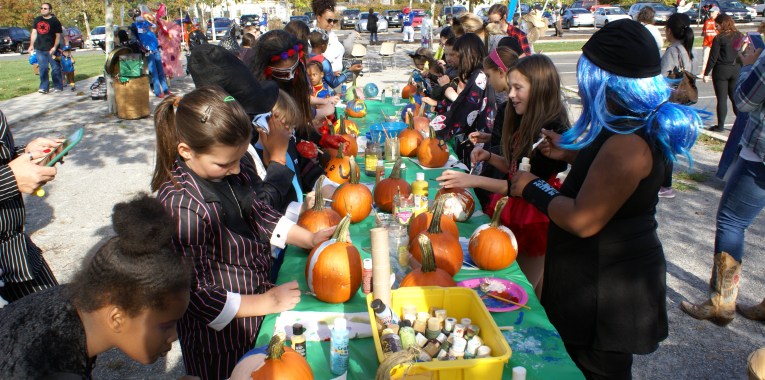
A good time was had by all last Saturday, October 28th at Ewing’s annual Halloween celebration featuring the popular ‘Trunk-or-Treat’, the Ewing Green Team’s award-winning 4th Annual Scarecrow Contest, pumpkin painting, and build-your-own scarecrow crafting with refreshments and music.

The sun was shining and it was unusually warm for a late October day.  It was a glorious day for trick or treating.  Hundreds of Township kids arrived at the Ewing Senior and Community Center costumed in their scariest, spookiest, most entertaining and colorful Halloween duds for the Recreation Department’s annual Trunk or Treat event.  About 30 individuals and groups opened their trunks to display their creative talents to the treaters.  From Jurassic Park, to pirates, to graveyards, the themed trunks brought smiles to the faces of the adults and treaters alike.  Once through the candy-collecting parade, it was on to Halloween crafts of pumpkin-painting and scarecrow building led by the Ewing Green Team with assistance from Ewing High School student volunteers.

With music playing and goodies in hand, it was also time to check-out the Scarecrows being judged for cash prizes of $100, $50 and $25.00. These had to be made of 80% recycled materials in order to qualify.  Event goers ambled down the Alley of Scarecrows in front of the ESCC to admire the skills and creativity of the 25 participants who submitted entries in this year’s contest.  There were football players, soccer goalies, brownies, witches and more composed of used plastic jugs, soda cans, paper towel rolls, old clothes and curbside castoffs to fasten innovative masterpieces.

Judging for the Scarecrow Contest was graciously done by local officials and artists. They were: Councilwomen Jennifer Keyes-Maloney and Sarah Steward, member of the Ewing Arts Commission – Jennifer Winn, and local artists Joy Kreves and Robin Keyes.

Emceeing the event were Ewing’s Town Councilwomen Sarah Steward and Jennifer Keyes-Maloney.  And the winners were:

1st prize: Samantha and Cora Dupee for their creation ‘Mary, Mary Quite Contrary.’ This unique entry was constructed from a curbside castoff garden umbrella, garden tools and plant materials.

2nd Prize: Ella Lloyd for ‘Amanda-Pan-da,’ which was created using metal pans and other recyclables.

3rd Prize: Charlotte Kaplan-Piepszak and Caleb Kaplan-Phillips for ‘Rubbish Rosie.’  Rosie was a singular entry dressed in a pleated skirt fashioned from the paper wrapping from toilet paper rolls.

Contestant Billyann Stark received an honorable mention prize for her entry of ‘Granny and Elly May’ on a bicycle with a live chicken.

This slideshow requires JavaScript.

As the event drew to a close, lots of people were still hanging out painting the last couple of pumpkins, finishing scarecrows to take home and admiring the scarecrows on display – sure signs of a successful event!  For more photos from the day go to the Ewing Green Team Facebook page.


Dispose of Your Unused Medications Safely on National Take Back Day This Saturday, October 28th

If your medicine cabinet is filled with expired drugs or medications that you no longer use, and you are concerned about detrimental environmental effects from improper disposal or eliminating the potential for abuse of medications, here is the information that you need to properly dispose of them.

The Ewing Police Department will be participating in the DEA’s twice yearly National Prescription Drug Take-Back Day which will take place on Saturday, October 28, 2017, from 10:00 a.m. to 2:00 p.m. This is a great opportunity for those who missed the previous events, or who have subsequently accumulated unwanted, unused prescription drugs, to safely dispose of those medications.  Just go to Ewing Municipal Building, 2 Jake Garzio Drive and use the upper level entrance to go downstairs to the Police Department during the Zabitosky Memorial Dedication.  Ewing Police will have an officer between 10 and 2 to take the items.

All medications are accepted, prescription and over-the-counter, as well as liquids.  Liquids are accepted in their original prescription bottle only and with the cap tightly secured. Syringes and other sharp instruments should not be turned in at this event.  Hypodermic needles are not accepted.  The disposal is handled completely securely; all accepted medications with any labels that you leave on the containers are placed in a large cardboard box, lined with plastic.  At the end of the day the contents are taken to the prosecutor’s office.  The DEA will pick up and incinerate.

Guidelines for Drug Disposal

Follow any specific disposal instructions on the drug label or patient information that accompanies the medication. Do not flush prescription drugs down the toilet unless this information specifically instructs you to do so.

If no instructions are given on the drug label and no take-back program is available in your area, take them out of their original containers and mix them with an undesirable substance, such as used coffee grounds or kitty litter — to make the medication less appealing and unrecognizable — then put them in a sealable bag, empty can, or other container to prevent the medication from leaking or breaking out of a garbage bag.

You should also remove any identifying information on the label to protect your identity and privacy.

Despite the safety reasons for flushing drugs, some people are questioning the practice because of concerns about trace levels of drug residues found in surface water, such as rivers and lakes, and in some community drinking water supplies. However, the main way drug residues enter water systems is by people taking medications and then naturally passing them through their bodies.  That said, the FDA does not want to add drug residues into water systems unnecessarily. The agency reviewed its drug labels to identify products with disposal directions recommending flushing or disposal down the sink. This continuously revised listing can be found at FDA’s Web page on Disposal of Unused Medicines.

National Take Back Day Information

Date: October 28, 2017
Time: 10 a.m. – 2 p.m.
Location: Ewing Municipal Building, 2 Jake Garzio Drive Don’t forget to use the upper level entrance during the Zabitosky Memorial Dedication.

If you are unable to participate in the National Take Back Day event there is a Project Medicine Drop Box outside of Police headquarters where you may drop off medications 24/7.  For more information see the Project Medicine Drop Box page on the Township’s website.

Shred Day – October 21st

Dispose of your sensitive documents safely and securely at Ewing’s last Shred Day of the year, Saturday, October 21st from 9 – 1 at the municipal building.  Document shredding will be done on site.  This service is for Ewing residents only and proof of residency is required.

The Ewing Green Team will be on hand to assist.

Date: Saturday, October 21st
Time: 9 a.m. – 1 p.m.
Location: Municipal Building

The next Shred Day will be announced early next year.

The Ecological Benefits of the Not So Perfect Yard 2017

recommendations for sustainable fall landscaping care…

by Joanne Mullowney

We love autumn.  Not only are we leaving the hot, sticky days of summer behind for the cooler, more breathable days of fall, but soon the brown gold from the neighborhood trees will blanket the ground with the last gift of the growing season.  This seasonal leaf drop can recharge your landscape and create habitat for wildlife if you let it.  So don’t treat your leaf litter as trash, but rather as the gift that it truly is to the millions of tiny creatures that are a part of our gardens’ ecosystems.

The Benefits of Leaf Litter

Raking up and disposing of our leaves, chopping down dead flower stalks and grasses all contribute to a manicured appearance which we have been conditioned to think of as the norm.  However, in nature, trees don’t drop their bounty at the curb for pick up.   The benefits of leaf cycling, or hoarding your autumn leaf drop for use in your landscape, are many.

Leaves provide an insulating winter cover in  the garden for plants and those tiny creatures that sustain life in the garden.   Don’t buy expensive mulch.  Mulch with fallen leaves.  Wherever possible, leave them to decompose where they fall in your garden beds.  Or settle the leaves under the branches of your shrubs. Give it a year and your leaf litter will have broken down while providing mulch and increasing the soil’s water retention abilities (moisture retention).

You can also rake out some of the leaves from the beds that are simply too much and might smother tender plants and cause them to rot over the winter. Add them to the compost pile or the leaf pile on the lawn while the rest remain in the beds. Then take your mulching mower and chop them up into small pieces. (Yes, using gas mowers is considered an unsustainable gardening practice, but consider the greater good.)

Rake up most of the chopped leaves and place them back in the garden around shrubs and plants .   Not surprisingly, they are greatly reduced in volume and contribute to a more manicured look. The remainder can stay on your lawn and decompose there. Do this as needed until the end of the season and the leaves will break down over the winter providing your soil with valuable nutrients (soil building) all the while enhancing wildlife habitat.  One incidental benefit is that of reduction of Township resources allotted to fall cleanup, saving taxpayer dollars.

While you might think that this leaves the yard looking a little less than perfect, you are nourishing the landscape and providing valuable resources and habitat for wildlife.

The Benefit of Providing Habitat

This somewhat messy yard contributes yet another important benefit – habitat, not a traditional concern of the average gardener.  Did you know that despite its not so perfect look, leaf litter provides an important foraging space for a wide variety of birds, small mammals and insects?  Also providing benefit is the untrimmed garden where ladybugs and lacewings reside in native grasses and pollinating bees settle in hollow plant stems.  Butterflies and moths winter in chrysalides on the ground and baby spiders hide out amid the decaying plant stems. Birds feed from dried seed heads in winter.

Some wildlife use the leaf litter and other dead vegetation to insulate them from winter’s chill, while others, such as earthworms feed on the litter, breaking it into smaller pieces. Bacteria and fungi in turn convert theses smaller pieces into nutrients which then sustain neighboring plants. They in turn help support biodiversity by becoming food themselves. Toads, beetles, ladybugs and much more also live in your backyard’s leaf litter. Each is an integral part of the food web.
Support Wildlife Thru Your Not So Perfect Yard

We recommend the following practices from the Habitat Network to help you in your quest to provide habitat and reduce your ecological impact.  Adopting good practices in the fall also leaves you well set for spring in the garden.

  • Leave your leaves on the property (Leaves are too valuable a resource to dispose of!)
    Leave them in the garden beds when you can, mow them or compost them.
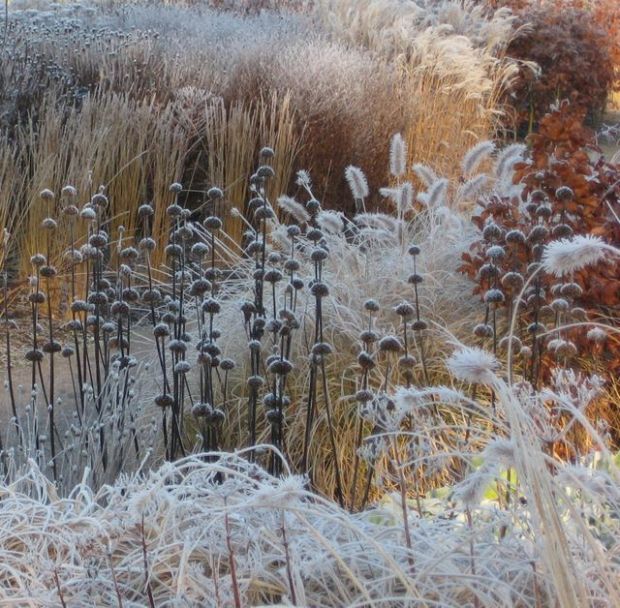
  • Allow dried flower heads of some of your garden favorites to stay standing in your garden.
    ­The dark stems and flower heads of some of our native flowers look gorgeous against the snow and nothing is more exciting than seeing our small winged friends feasting upon the seed heads.
  • Let your ornamental grasses grow tall and seed.
    Don’t cut down your ornamental grasses. They provide shelter for the insects that pollinate our gardens and feed fledgling birds and other wildlife.  Not to mention that they also look fabulous swaying in the wind.  They make a fabulous addition to the fall (and winter) landscape.
  • Build a brush pile with fallen branches instead of removing them.
    If you build it they will come. This author no sooner established a small brush pile in a back corner in the yard and it was inhabited. 
  • Leave snags on your property as nesting places.
    This one is hard in a small yard.  But you don’t have leave the whole tree.  You can leave a small part as part of the garden ornament and wildlife will take up residence.
  • Forget the chemicals.
    This one is not hard. Just do it! 
  • Don’t be in a rush to begin your garden cleanup in the spring.  Wait until after several 50℉ days to begin, when spring has really arrived, allowing overwintering pollinators to move on first.
    You gave them a home all winter; don’t yank it away from them too soon.

Vanishing Habitat

As habitat for wildlife is decreasing, so too is wildlife, and at an alarming rate.  A recent National Wildlife Federation newsletter states:  More than half the world’s wildlife has vanished since 1970.1  This includes  mammals, birds, reptiles, amphibians, and fish.  Quite simply, we’re destroying our planet’s ability to support our way of life.

Wildlife needs habitat to survive and we need to do a better job balancing the need to provide habitat for animals’ survival against commercial forces.  Habitat requires food, water and shelter and even a small yard can support birds, butterflies, beneficial insects, and small animals thru proper landscaping and landscaping habits.  They need more than lawn and it is important to provide trees, shrubs, and other plants (particularly native varieties and a topic for another post) that shelter and feed wildlife.

We ask you to adopt a somewhat messy yard and eschew the leaf disposal.  Keep your leaves  so that they can decompose naturally in your own yard and support the butterflies and other small insects that live in the leaf litter.  Take the Habitat Network pledge to Garden Messy and Pledge to be  a Lazy Gardener.  Then put your feet up and enjoy the season.

Printable brochure of sustainable fall landscaping tips.

1.  Source:  Living Planet Report 2016 by World Wildlife Fund http://awsassets.panda.org/downloads/lpr_living_planet_report_2016.pdf