Be Water Smart and Learn Strategies for Water Efficient Living

The EGT invites you to save the date and join us for the next session of our Environmental Insights Series at the June meeting on Wednesday, the 28th when we will have a presentation about water conservation  and protection issues and how to become a better steward of nature on your property.  Stony Brook-Millstone Watershed Association representatives Ed DiFiglia, a Municipal Policy Specialist, and Brittany Musolino, the River-Friendly Coordinator, will provide background on the issues and speak about the Watershed’s River Friendly Program

“Water is our most fragile and precious resource. Essential to all forms of life and to our economies, our water supplies face a myriad of threats from pollution to climate change. Keeping our water clean, safe and healthy in the face of these challenges is the heart of the Stony Brook-Millstone Watershed Association’s mission.”1

While much has been done since the passage of the Clean Water Act in 1972 which reduced direct discharges of untreated sewage and industrial pollution into our water bodies to improve the health of our nation’s rivers, the problems facing our waterways are still challenging.  Threats such as pesticides and fertilizers, automobile waste products, pet waste, road salt are just a few sources of pollution.   Too much impervious surface contributes to groundwater run off.  The twin threats of climate change,  deluges or droughts contribute additional stresses on management of our water resources.

The presentation will provide an overview of the following:

  • Overview of current state and local drought conditions
  • How to convert a home landscape to be water smart
  • Plants for water smart landscapes
  • River Friendly program

The Watershed‘s River-Friendly Certification Program is designed to help individuals, businesses, schools and golf courses contribute to a clean water and a healthy environment thru education and improvement of land stewardship practices. The four cornerstone goals of the program are to reduce pollution, conserve water, restore habitat for wildlife and educate the public about becoming better environmental stewards. Please be sure to join us for an evening that will galvanize all into action!

Presenters

Brittany Musolino Biography

Brittany Musolino runs the River-Friendly Certification Programs for the Stony Brook-Millstone Watershed Association, which involves working with landowners to improve their landscape practices and stormwater management. Brittany earned her B.S. in Human Ecology from Rutgers University and completed a term in the AmeriCorps Watershed Ambassador Program before joining the Watershed Association’s Science & Stewardship Department.

Date: Wednesday, June 28
Time: 6:30 pm
Location: ESCC, Community Room, 999 Lower Ferry Road, Ewing

  1. https://thewatershed.org/water/

Save Water and Money at the EGT’s Build Your Own Rain Barrel Workshop

Learn more about water conservation and how to harvest rainwater from your roof and divert it for on-site usage in the landscape.  The Ewing Green Team, in partnership with the AmeriCorps NJ Watershed Ambassador program, will teach area residents how to build a rain barrel at a workshop this spring.  The fee for the program is $10.  We have obtained 30 free food grade barrels and have costed out the hardware for each barrel at $10.  Registration is limited so be sure to register early.    Each workshop will run approximately 2 hours.  Sign up today.

Event: Rain Barrel Workshop
Dates:  Saturday, June 3rd
Time: 9 a.m. – Noon
Location: Ewing Senior and Community Center, Community Room
Cost: $10 per rain barrel

Installation of rain barrels in your yard will enable you to take an active role in reducing flooding and pollution in local waterways.  Install rain barrels under your gutter’s downspout to harvest rain water from your roof. Each rain barrel holds approximately 50 gallons. You can install them singly on hook them up in tandem to reserve even more water. Use the water to save money and save water when you irrigate your gardens with it during times of low rain.  In case you miss the workshop or are unable to attend, rain barrels are also for sale at local garden centers for approximately $100 give or take.

Dispose of Your Unused Medications Safely on National Take Back Day This Saturday, April 29th

If your medicine cabinet is filled with expired drugs or medications that you no longer use, and you are concerned about detrimental environmental effects from improper disposal or eliminating the potential for abuse of medications, here is the information that you need to properly dispose of them.

The Ewing Police Department will be participating in the DEA’s twice yearly National Prescription Drug Take-Back Day which will take place on Saturday, April 29, 2017, from 10:00 a.m. to 2:00 p.m. This is a great opportunity for those who missed the previous events, or who have subsequently accumulated unwanted, unused prescription drugs, to safely dispose of those medications.  Just go to the Pennington Road Fire Company, 1660 Pennington Road.  Ewing Police will have an officer between 10 and 2 to take the items.

All medications are accepted, prescription and over-the-counter, as well as liquids.  Hypodermic needles are not accepted.  The disposal is handled completely securely; all accepted medications with any labels that you leave on the containers are placed in a large cardboard box, lined with plastic.  At the end of the day the contents are taken to the prosecutor’s office.  The DEA will pick up and incinerate.

Guidelines for Drug Disposal

Follow any specific disposal instructions on the drug label or patient information that accompanies the medication. Do not flush prescription drugs down the toilet unless this information specifically instructs you to do so.

If no instructions are given on the drug label and no take-back program is available in your area, take them out of their original containers and mix them with an undesirable substance, such as used coffee grounds or kitty litter — to make the medication less appealing and unrecognizable — then put them in a sealable bag, empty can, or other container to prevent the medication from leaking or breaking out of a garbage bag.

You should also remove any identifying information on the label to protect your identity and privacy.

Despite the safety reasons for flushing drugs, some people are questioning the practice because of concerns about trace levels of drug residues found in surface water, such as rivers and lakes, and in some community drinking water supplies. However, the main way drug residues enter water systems is by people taking medications and then naturally passing them through their bodies.  That said, the FDA does not want to add drug residues into water systems unnecessarily. The agency reviewed its drug labels to identify products with disposal directions recommending flushing or disposal down the sink. This continuously revised listing can be found at FDA’s Web page on Disposal of Unused Medicines.

National Take Back Day Information

Date: April 29, 2017
Time: 10 a.m. – 2 p.m.
Location: Pennington Road Fire Company, 1660 Pennington Road

If you are unable to participate in the National Take Back Day event there is a Project Medicine Drop Box outside of Police headquarters where you may drop off medications 24/7.  For more information see the Project Medicine Drop Box page on the Township’s website.

Shred Day – Saturday, April 22nd

Dispose of your sensitive documents safely and securely at Ewing’s first Shred Day of the year, Saturday, April 22nd from 9 – 1 at the municipal building.  Document shredding will be done on site.  This service is for Ewing residents only and proof of residency is required.

The Ewing Green Team will be on hand to assist.

Date: Saturday, April 22nd
Time: 9 a.m. – 1 p.m.
Location: Municipal Building

The next Shred Day will be Saturday, October 21st.

More Bad News About Non-native Plants from the EEC

Our thanks to Ann Farnham of the Ewing Environmental Commission for sharing this article with us about our continued use of non-native plants in the landscape.

We continue to hammer away on the disadvantages of using non-native plants. Remember, a good definition of a native plant is one that existed in any specific region before the European settlement in this country. Ewing is in the Mid-Atlantic region and our natives are well adapted to our particular soils, precipitation, temperatures, elevations and exposures. Our native wildlife – insects, mammals, birds, reptiles – developed along with them.

Many people believe that if a plant is sold at a local nursery or garden center that it is all right to use. Unfortunately, that is not correct. Because we have no laws or ordinances that prohibit the sale of introduced or invasive plants (some states do), they are widely available. What we can do at this point is to be informed and avoid buying them.

What are some of the popular, non-native plants sold in local nurseries and garden centers?

In March, 2016 we wrote about Bradford Callery Pear, (Pyrus calleryana); In June, 2016 it was Acer platanoides, Norway Maple; in July, 2016, we wrote about Burning Bush, (Euonymus alatus); and in August, 2016, Winter Creeper, (Euonymus fortunei).  Unfortunately, these are all available at local nurseries and garden centers. A few more garden center boarders – invasives and aggressors – are listed below; most, having few natural predators, form un-challenged thickets at the expense of our native plants.

  • Butterfly Bush (Buddleia davidii): This vigorous, nectar-producing butterfly attractor is an attractive shrub with fragrant, colored flower spikes, It self-seeds prolifically, however, and before long your planting bed will be overcome with a Buddleia thicket which crowds out everything else. It is classified as noxious weed in Oregon and Washington.
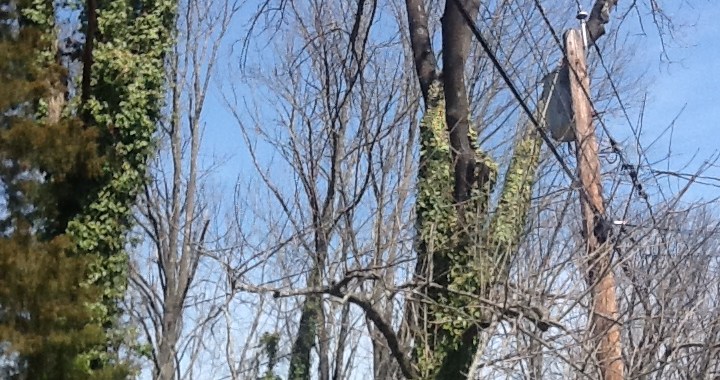
  • English Ivy (Hedera helix): This popular and sometimes very lovely vine easily goes astray, spreading throughout woody areas and gardens, choking out other vegetation. English ivy kills trees and shrubs by smothering them.
  • Heavenly Bamboo (Nandina domestica): This is not a bamboo, in spite of its popular common name. All parts of the plant are toxic, especially to Cedar Waxwings, cats and grazing animals, resulting in many deaths. Heavenly Bamboo crowds out other plants with prolific seeds and underground stems.
  • Japanese Barberry (Berberis thunbergii) : This shrub is banned in Wisconsin and Massachusetts. It displaces native plants with prolific, bird-dispersed seeds, and harbors ticks (due to the high humidity in its dense foliage) mice, and, as a result, lyme disease.
  • Japanese Spirea (Spiraea japonica): this plant harbors many insects and diseases but still outcompetes and replaces native plants. Its seeds, dispersed by birds, form dense thickets which are very tolerant to many conditions. It impedes the germination of native seeds.
  • Japanese Wisteria (Wisteria floribunda): This very adaptable vine shades out other plants and girdles trees and shrubs as it climbs, cutting off nutrients by choking the trunks and producing dense shade.
  • Maiden Grass/Chinese Silver Grass Miscanthus sinensis: More than 50 ornamental varieties of this grass are sold in the United States. The wind-dispersed, viable seed forms thickets which are very adaptable to many conditions, choking out native plants. This is a very popular ornamental grass which is popular to use in a lot of landscaping.
  • Periwinkle Vinca minor: ( not V. major).This groundcover forms dense, extensive mats, choking out other plants. It harbors blights and is allelopathic, meaning that its chemical compounds inhibit the growth of nearby plants.               
  • Privet (Ligustrum sp):  This popular hedge plant is toxic to pets and mildly toxic to humans. Thousands of fruits outcompete and replace natives. The seeds, dispersed by birds, form  very dense thickets. Compounds in the leaves protect the plant from feeding insects, so it is “trouble free” for the hedge-growing home owner.

For more important information about non-native plants, read Plant Invaders of Mid Atlantic Natural Areas by Swearingen, Reshetiloff, Slattery, and Zwicker

Go to www.MAIPC, the Mid Atlantic Invasive Plant Council for additional plant lists.

Native plant alternatives to exotics can be found in the Brooklyn Botanical Garden’s Native Alternatives to Invasive Plants. In addition, be sure to visit the web sites:

  • The Native Plant Society of New Jersey for their
    • Tree recommendations for planting (both large and small)
    • Wild and Native Plants of NJ
    • Trees and Tall Shrubs by County
    • Invasive Species list
    • Wildflowers and Garden Conditions
    • link to the USDA database and
    • Plants by county.