Project FeederWatch

Development of land is the bane of habitat for many species. As open space is lost to housing, industry, roads and “progress,” animals, birds, reptiles, plants, insects, trees and flowers all lose their habitat, unless it’s preserved. That development leads to an increase in emissions which contributes to global warming, posing further threats.

In the past 50 years, according to many studies, the population of Neo-Tropical bird species in the U.S. has plummeted, by up to 75% is some cases. New Jersey, one of the smaller states in size (but high in population density) has more than 500 species of birds, partly because it is on a number of important bird migration flyways. The area around Cape May is known around the world for its spring and fall bird migration.

Twenty-five years ago The Cornell Lab of Ornithology started Project FeederWatch as a way to document the movement of feeder birds around the country, and to see what’s happening to them. Now, more than 15,000 participants in all states (and Canadian provinces) report what species they see weekly, and how many at any one time, from November to April.

The Ewing Environmental Commission participates in FeederWatch because one of its aims is to preserve the natural environment in the Township. Participating in FeederWatch helps do that on a local, state and national basis, by increasing knowledge about what birds are seen at feeders, and with what frequency. Now in its tenth year, more than 160 reports have been filed, and more than 45 different bird species have been seen in that time. If you enjoy looking out your window with your morning cup of coffee ( or any other time of day for that matter) and observing the creatures that visit your own backyard wildlife habitat, why not join members of the Ewing Environmental Commission and add your own observations to the data collection? Find out more on our new Wildlife Protection through Observation and Documentation at Project FeederWatch page.

By Lee Farnham,
Chairman, Ewing Environmental Commission

Tree of the Month – Christmas Trees

Among the pleasures we enjoy in December is choosing a Christmas tree. The choices are many: the firs (Douglas Fir, Fraser Fir, Balsam Fir), pines (Scotch, Eastern White), red cedars, and spruce (Colorado Blue, Norway, Concolor). Throughout the United States there are more than 35 different evergreen species grown for the holidays. They are available either cut, in containers, or balled and burlapped.

If you choose to purchase a cut tree, try to prevent the trunk from being exposed to the air for more than three to six hours; it should be put into a container with water as soon as possible. Next, trim off the lowest branches which might interfere with the tree’s staying upright in a stand, and then remove ragged branch tips or unattractive branches. Saw off an inch of the trunk so the tree can absorb water freely, and fasten it to its stand, which should contain plenty of water. The water, especially at first, should be replenished often.

Artificial Christmas trees are often made of PVC, a dangerous chemical, are not biodegradable, and do not have the wonderful fragrance of a real tree. However, they may be used for many years and are maintenance free.

A live tree, while somewhat more labor intensive to care for, may also be planted in your yard after its holiday use, and enjoyed for years to come. You must do some planning before you take the tree home but it is well worth while.

  1. Determine what spot on your property affords the correct exposure (full sun) and room. Check a good source or the internet to determine how much space your particular species of tree will require when mature.
  2. Dig the hole NOW before the ground freezes. Digging a frozen hole is no fun. Make the hole approximately 2 times the width of what you expect the container or root ball will be. This is important; and do not dig the hole any deeper than the height of the container or root ball. Fill the hole with leaves or mulch as insulation, and cover the hole and the pile of soil with a tarp and more leaves or mulch to avoid freezing. Throw away whatever sod was dug up as you do not want it included in the backfill.

Your live tree should be indoors as briefly as possible; place it at first (in a waterproof tub or container) in a garage or porch to allow it to acclimate to warmer temperatures. You can water it lightly and frequently, or place ice cubes over the root ball to keep the moisture levels up. Spraying the tree with an antidessicant such as Wiltproof will help control moisture loss through the needles.

When the tree is ready for planting, roll it into the hole and orient it so that its best side faces your house or the street. If the hole is too deep, add soil into the bottom and compact it until it is the right depth. Remove as much of the burlap around the root ball as possible; if it is in a container, remove the container. If it is in a wire basket, cut off as much of the basket as you can. Then, begin to backfill with the soil you set aside. Water it thoroughly and slowly as you fill the hole; this will push out air pockets and saturate the sides of the hole as well as the back fill.

It is not necessary to stake or guy the tree. Cover the area – to the drip-line- with 2-3” of double-shredded, hardwood bark mulch, keeping the mulch 2” away from the trunk. Water your Christmas tree every day for a week, twice the second week, and then once a week until the ground freezes and your hose becomes useless.

By Ann Farnham, LLA
December 2014

Best Wishes For The Holidays From Your Ewing Environmental Commission!

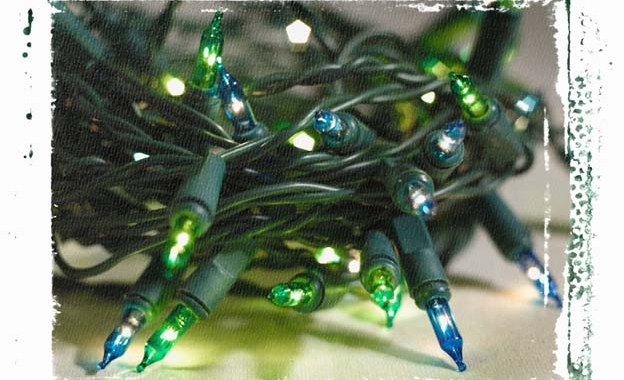
Recycling Your Old Holiday Lights a Bright Idea

Have you just dragged out the Christmas lights again only to find that you have strands that are only working intermittently or not working at all? (sigh)  Are your lights old and outdated?  Or have you been bitten by the little green bug and decided to purchase energy efficient LED lights this year?  Whatever the reason, you may find yourself in the market for new lights this season.  So, once you’ve greened up your holiday display with more energy efficient lighting, what should you do with the old lights?  Whatever you do, don’t throw them away.  Recycle them.  Unfortunately, having googled this extensively, we haven’t found a lot of options.  But there are two holiday light recycling programs that we’ve identified for repurposing your old lights.   They both give you discount coupons towards the purchase of even more energy efficient LED light sets.

Home Depot
Home Depot runs an “Eco Options Christmas Light Trade In” program through all Home Depot stores every year but it is only available during the Christmas holiday season.   It starts in November and concludes in early December.  Bring your old incandescent Christmas light strings to the Home Depot for recycling and you’ll receive $3 -$5 discount coupon toward the purchase of ENERGY STAR qualified LED Christmas lights for each strand.  (some restrictions apply)

HolidayLeds.com
The other program is run by HolidayLEDs.com and you can participate in it anytime throughout the year.   It was responsible for the recycling of 10,000 pounds of holiday lights during the 2009/2010 holiday season.  It’s easy to participate and all you have to do is send them your old Christmas lights for recycling and they’ll send you a discount coupon.

How does the program work? 
Simply pack up your old lights and send them to them via the least expensive method possible.  They ask that you:

  • Don’t include any packing material or anything other than the lights themselves or send the lights in outer packaging such as retail boxes or include any apparatus used to wind up or store the lights.
  • Use cardboard boxes or other packaging that can easily be recycled.
  • Compact your light sets into the smallest space possible in the smallest box possible without any extra packing or plastic bags.

They are located in Wisconsin so there is no way to do this locally.  They recommend that you coordinate with your friends, neighbors, co-works, social groups, church groups, or other organizations when possible to collect lights and send in one bulk shipment.  This will reduce shipping costs for everyone as well as reducing environmental impact of shipping.

Send to:
Holiday LEDS Recycling
13400 Watertown Plank Rd. Suite 34
Elm Grove, WI 53122

What Happens to the Lights?
Once they are received they are removed them from the package and the box is recycled. The lights are processed and any material that cannot be recycled such as loose bulbs is discarded. Once substantial number of sets has been collected they are taken to a third party recycling facility which puts them through a commercial shredder. The resultant little pieces are then further processed and sorted into the various components that make up the lights (PVC, glass, copper.) The materials are separated and transported to a region center for further processing. In some cases, the PVC cannot be recycled.

Pet Safety Essential During Holiday Season

By Jennifer Keyes-Maloney

 The holiday season is a chance to make new memories with my family – and that family includes my furry friends as well (spoiler alert – I have two bulldogs, Maggie and Augie, who I love. We just lost our cat of 19 years, Scrappy).  But, I don’t want one of those memories to include a trip to the vet – particularly where it is preventable.  And since one of my bullies is a puppy, I’m having to retrain not just Augie (the pup) but also the human members of the house or the Do’s and Don’t’s during the holiday.  Here are a couple of tips gleaned from the ASPCA, Petfinder and PetMD.

  • Secure the Tree.
    Make sure you securely anchor your Christmas tree so it doesn’t tip and fall, causing possible injury to your pet (this was particularly true in the case of a climber like my cat Scrappy). This will also prevent the tree water—which may contain fertilizers that can cause stomach upset—from spilling. Stagnant tree water is a breeding ground for bacteria and your pet could end up with nausea or diarrhea should he imbibe.
  • Tinsel-less Town.
    Kitties love this sparkly, light-catching “toy” that’s easy to bat around and carry in their mouths. But a nibble can lead to a swallow, which can lead to an obstructed digestive tract, severe vomiting, dehydration and possible surgery. It’s best to brighten your boughs with something other than tinsel.
  • Forget the Mistletoe & Holly.
    Holly and Poinsettas, when ingested, can cause pets to suffer nausea, vomiting and diarrhea.  Mistletoe can cause gastrointestinal upset and cardiovascular problems. And many varieties of lilies, can cause kidney failure in cats if ingested. Opt for a pet-safe bouquet or make sure the location of these holiday favorites is out of your pet’s reach.
  • Keep a Lid on It.
    By now you know not to feed your pets chocolate (which contains theobromine and caffeine) and anything sweetened with xylitol. But during the holiday season, there is a lot of activity in the kitchen and several new, tasty smells flowing from the garbage can. Ensure your garbage can is covered because goodies found in the trash can present a significant risk for gastritis for pets and can also be a choking hazard for dogs and cats.
  • Leave the Leftovers.
    Fatty, spicy and off limits foods (i.e. raisins, grapes, chocolate, macademia nuts, onions, garlic), as well as bones, are dangerous and should not be fed to your furry friends.
  • Wiring Oh Wiring.
    Wires, batteries and glass or plastic ornaments are an attractive nuisance to your furry friend. A wire can deliver a potentially lethal electrical shock and a punctured battery can cause burns to the mouth and esophagus, while shards of breakable ornaments can damage your pet’s mouth.
  • Careful with Cocktails.
    Finally, if your celebration includes adult holiday beverages, be sure to place your unattended alcoholic drinks where pets cannot get to them. If ingested, your pet could become weak, ill and may even go into a coma, possibly resulting in death from respiratory failure.

A Thought for Festivities

Entertaining? Give your pet their own quiet space to retreat to—complete with fresh water and a place to snuggle.

Help save NJ’s Native Plant Species and Wildlife!

Urge your State Legislator to Support the “DOT Native Plants Bill”

The Ewing Green Team encourages you to contact your local representatives in the State Legislature to urge them to support this important native plants legislation.

S-2004 /A-3305

If enacted, this bill will require the New Jersey Department of Transportation, the NJ Turnpike Authority (which includes the Garden State Parkway), and the South Jersey Transportation Authority to use ONLY NATIVE PLANTS for landscaping, land management, reforestation, or habitat restoration on the 2,800 miles highways they manage in New Jersey.

Please contact your state senator and assembly representative to insure that they know how important native plants and the wildlife that they support are to our environment.  Passage of this legislation will help preserve water quality, provide food and habitat for NJ wildlife and preserve New Jersey’s natural beauty and local character for future generations.

This bill was written for Save Barnegat Bay by Senator Jim Holzapfel and Assemblymen David Wolfe and Greg McGuckin. Senate Minority Leader Tom Kean Jr. and Senator Kip Bateman are co-sponsors.

To Contact Your Representatives:

Ewing is in District 15, (Hunterdon and Mercer) which includes East Amwell, Ewing, Hopewell Borough (Mercer), Hopewell Township (Mercer), Lambertville, Lawrence (Mercer), Pennington, Trenton, West Amwell, and West Windsor

Legislators for District  15

Senate – Shirley Turner – Email at senturner@njleg.org
Assembly – Reed Gusciora – Email at AsmGusciora@njleg.org
Assembly – Bonnie Watson Coleman – Email at AswWatsonColeman@njleg.org