Direct Install – Energy Savings for Small Businesses

Did you know that the State of New Jersey’s Clean Energy Program has a program called Direct Install that allows business owners tap into state funds allocated for improving the environment, while at the same time offering quick investment paybacks?  The program offers grants of up to 70% of the costs for energy saving building upgrades for small and medium size businesses.  The program usually pays for itself and becomes a net revenue generator in 1-3 years, with savings lasting for decades.

Small business owners in Ewing should have received a letter from Mayor Bert Steinmann highlighting the both financial and environmental benefits of your benefits in this program.  Be sure to check it out below if you haven’t received yours.

Letter from Mayor Bert Steinmann about Direct Install program.

The Ewing Green Team also recently ran an energy seminar to educate local businesses about program details which featured Sandra Torres, Outreach Director from the approved Direct Install contractor for Mercer County, Tri-State Light and Energy  and a representative from the BPU, Mike Winka.    Attendees were most impressed with the program – the simplified paperwork, ease of participation and the savings available to fund these important energy upgrades that they did not know were available.  Participation in the program makes it financially easier to not only do your bit to help the environment but also improve your bottom line with long term energy savings.

You may have missed the seminar, but it is not too late to learn more about how to take advantage of this program and improve your bottom line at the same time.  Contact the EGT or the Tri-State Representative, Sandra Torres for more information.  Our Direct Install page also has more information about the program.  Become the next Sustainability Hero in our town.
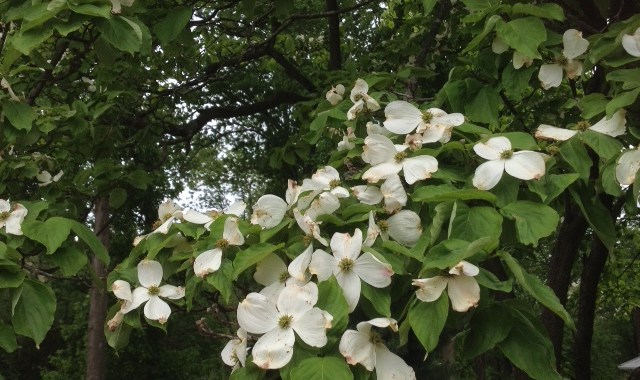
June Tree of the Month – Flowering Dogwood

by  Ann Farnham, LLA

Ewing Township’s Environmental Commission recognizes the beautiful Flowering Dogwood, Cornus Florida, as the Tree of the Month.

This lovely tree, a native to the eastern and central United States, is hardy from USDA zones 5-9 (Ewing is zone 6b), from Massachusetts to Florida and west to Texas.

Among the first trees to bloom in April or May, the Flowering Dogwood becomes covered in greenish-white, bloom-like bracts, four in number, which are usually 3-4” wide.  The bloom period lasts up to two weeks and is followed by clusters of red, berry-like, drupes which turn scarlet in September.  Birds love them.

These trees reach 20-30 feet in height, are beautiful in flower and have outstanding summer and fall foliage.  This species produces brilliant white flowers, but there are varieties ranging from pale pink to warm red.

Flowering Dogwoods do best in acid, well-drained soil, and partial shade, although they will tolerate full sun with appropriate care.  They are, unfortunately, subject to insect and disease problems.  In the Northeast the most widely recognized scourge is a fungus, Anthracnose, which is difficult to control and slowly kills the tree.  Fungicides may be effective.

Dr. Elwin Orton of Rutgers University has developed hybrids of Cornus Florida and Cornus kousa (Japanese dogwood), which are disease resistant and now commercially available.

Some straight species of Flowering Dogwoods which have shown resistance to Anthracnose have been selected and bred and are also now available at nurseries and garden centers.

 The Ewing Environmental Commission (eec@ewingnj.org) welcomes suggestions for the Tree of the Month from all Ewing residents.

Save the Date for EGT Upcoming Energy Seminar

Ewing Businesses – Learn How To Go Greener and Improve Your Bottom Line!

The Ewing Township Green Team will be hosting an energy seminar on June 3rd designed to help the local Ewing business community tap into state funds for energy upgrades while improving their bottom lines and helping the environment.  Ewing small business owners will learn about grants of 70% of the costs for energy saving building upgrades for small and medium size buildings that are available from the State of NJ through its “Direct Install” program.  “Direct Install” is sponsored by the NJ Board of Public Utilities [http://www.state.nj.us/bpu] and Clean Energy Program [http://www.njcleanenergy.com] and helps business owners tap into state funds allocated for improving the environment, while at the same time offering quick investment paybacks.

Tristate Light and Electric Company [http://tsle.com] is the exclusive contractor for “Direct Install” in Mercer County.   Ms. Sandra Torres of Tristate, who has years of experience working with business owners in other townships, will give the presentation. Ms. Torres will provide detailed information on how to save money by taking advantage of this funding.

The seminar is scheduled for Wednesday June 3 at 7pm at the Ewing Senior Center at 999 Lower Ferry Road.  For more information call Pete Boughton at 609-313-5021.

May Tree of the Month

by Ann Farnham, LLA

The beautiful Saucer Magnolia, Magnolia soulangiana, blooms in Ewing in April and May.

This small tree or multistemmed large shrub is a hybrid and usually thrives in USDA Hardiness zones 4 – 9 (Ewing is USDA Hardiness Zone 6b). It is a cross between Magnolia denudata and Magnolia liliflora, reportedly a hybrid made by one of Napoleon’s retired cavalry officers, Étienne Soulange-Bodin, around 1820 in France.

In the garden it makes a beautiful focal point and is one of the first trees to bloom in the spring along with flowering cherries, redbuds, and the shrub, forsythia.

Saucer Magnolia blooms before its leaves appear in the spring but the flower buds are frequently damaged by frost as they open so early. Having a medium growth rate, a tree may reach a height of 20 to 30’ with a variable spread, pyramidal to rounded in form with low branches; it is also grown as a multi-stemmed shrub. There are dozens of varieties, each with a distinctive size and shape, with flowers which measure up to 4 to 8” across, and colors varying from purple-pink to white.

The best site for a Saucer Magnolia will have an acid, moist, porous and deep soil and full sun to partial shade. It tolerates wind and urban pollution fairly well. The roots need ample room to develop and the tree should be mulched to the drip-line (keep the mulch at least 6” from the trunk). If pruning is necessary, it should be done right after flowering.

There are several pests and diseases which attack Saucer Magnolia but fortunately they are infrequent. The Yellow-Bellied Sapsucker woodpeckers seem to favor its bark, and ring the tree with little holes, but the damage is slight.

The Ewing Environmental Commission (eec@ewingnj.org) welcomes suggestions for the Tree of the Month from all Ewing residents.

To calculate the economic and ecological benefits of the trees on your property go to treebenefits.com.