Energy Vampires

When not in use appliances can still use energy.  The US Department of Energy (USDOE) estimates about 5% of your household electric bill is spent on vampire loads that go to keep your electronics and other appliances ready to be used at a moment’s notice.  That is about 425 kWh/year or $70/year or 225 pounds of CO2/year for the average household.

Want to find the vampires lurking in your home? Try a “Kill-A-Watt” meter that allows you to monitor a the energy a device is using even when turned off or shutdown. Learn more at: http://www.p3international.com/products/energy-savers.html or check with the Hopewell Township Branch of the Mercer County Library to see if you can borrow one.

One way to manage vampire loads is to use advanced power strips (APS). The USDOE estimates that a homeowner could save $200 per years using APS.  Visit  https://www.energy.gov/energysaver/articles/choose-right-advanced-power-strip-you for help in choosing the right APS.

Energy Conservation vs. Energy Efficiency

Energy conservation is any behavior that results in the use of less energy.

Energy efficiency is replacing inefficient equipment or appliances with a similar device that uses less energy to perform the same function or task with the same degree of performance or service.

For example: turning a light off is energy conservation while replacing a CFL bulb with a more efficient LED is an energy efficiency measure.

Energy tipThe least expensive energy and the most environmental benefit is the energy not used.  When something is not in use turn it off. Start hitting that off switch today!

Wasting Gas

In New Jersey the largest energy use, costs and impacts are in the transportation sector.  We consume 4.8 billion gallons of motor fuel at a cost of $12 billion emitting 40 million metric tons of carbon dioxide every year. Let’s fix that.  Visit the US Department of Energy website at https://www.fueleconomy.gov/feg/drive.shtml for tips on lowering your personal fuel use.

Start With An Energy Audit

In our daily lives we use energy to light our way, heat and cool our buildings and get us from place to place. To reduce your energy use and its impacts, start with knowing how much energy you use by doing an energy audit. There are lots of resources to help you do your audit.

Do-it-Yourself energy audit
See https://www.energy.gov/energysaver/home-energy-audits/do-it-yourself-home-energy-audits for assistance

Professional energy audit (could cost approximately $300)
See https://njcleanenergy.com/residential/programs/home-performance-energy-star/what-expect-home-energy-assessment for details on Home Performance with Energy Star.

PSE&G customers
See https://nj.pseg.com/saveenergyandmoney/energysavingpage/homeenergyanalyzer for a good start.  This is an online energy audit which takes about 15 minutes to complete by  answering questions about your home. You get a graph of your electric and natural gas usage and tips to reduce your home electric and natural gas energy use. You can save between 5% to 30% of your household energy costs by implementing the tips in the audit.

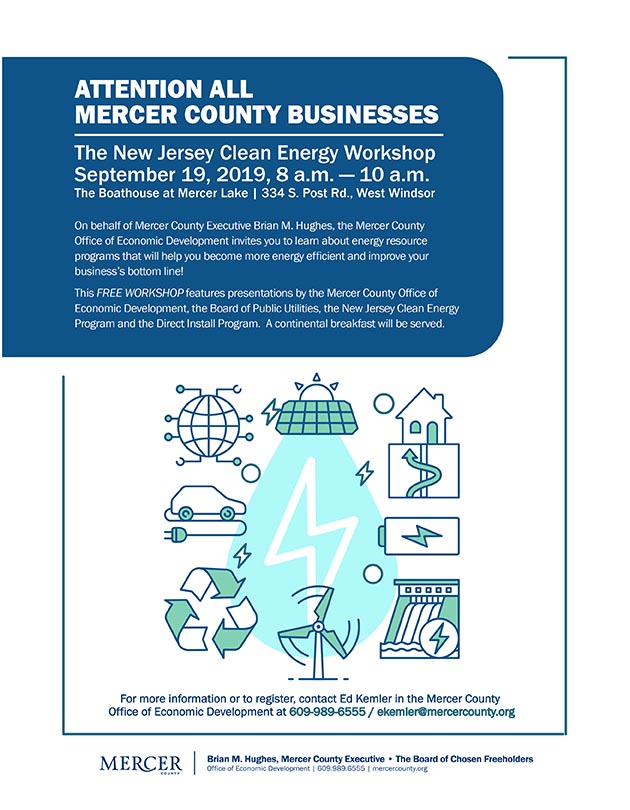
New Jersey Clean Energy Workshop on September 19th from 8 – 10 am

ATTENTION ALL MERCER COUNTY BUSINESSES

On behalf of Mercer County Executive Brian M. Hughes, the Mercer County Office of Economic Development invites you to learn about energy resource programs that will help you become more energy efficient and improve your business’s bottom line!

This FREE WORKSHOP features presentations by the Mercer County Office of Economic Development, the Board of Public Utilities, the New Jersey Clean Energy Program and the Direct Install Program. A continental breakfast will be served.

Event Summary

Date: September 19, 2019,
Time: 8 a.m. — 10 a.m.
Location: The Boathouse at Mercer Lake | 334 S. Post Rd., West Windsor
Register: Ed Kemler 609-989-6555 | ekemler@mercercounty.org