Kick the Habit: A Dirty Dozen of Common Gardening Bad Habits You Need to Kick

From the EGT’s Sustainable Landscaping Series, “The Ecological Benefits of the Not So Perfect Yard”

The Ewing Green Team advocates for using more sustainable methods of landscape care to create what we call “The Not So Perfect Yard.” That may sound somewhat messy, and you wonder if also perhaps irritating to the neighbors. It might suggest an untended look consisting of tall weeds and overgrown lawns, as well as unsightly piles of yard waste. NOT SO. That is not the “Not So Perfect Yard” for which we advocate. However, it is also not the large, open, treeless expanses of lawn and imported, exotic plants that are prevalent across the country.

A “Not So Perfect Yard ” has its own unique beauty that comes from planting native plants and incorporating features that imbue each yard with a sense of place suited to its specific site and region of the country.  It also attracts some of the native local fauna which have otherwise been displaced. Supply food and habitat for the insects at the bottom of the food web and you can enjoy birds and other wildlife returning to your own yard.

Your Not So Perfect Yard will offer much needed benefits to the local environment: helping you decrease your carbon footprint, save energy and money, reduce waste and labor, promote biodiversity, all while beautifying your landscape and affording you a much closer interaction with nature. And you can achieve these benefits by kicking the habit: dropping some of these common gardening habits that we have come to learn are not our best choices.  These include poor tree care, improper autumn cleanup and leaf management, the great American lawn, practices detrimental to soil health, and more.  Look for detailed overviews of these common gardening mistakes in the coming posts.

First Common Gardening Bad Habit

Poor Tree Care

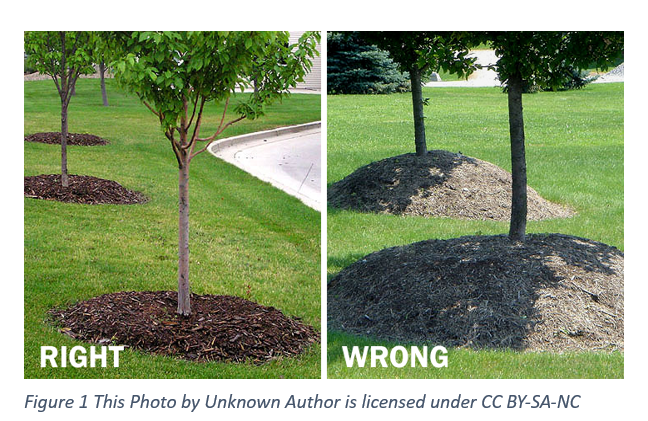
Trees are one of the greatest gifts that we can give to future generations. Our native trees are the most valuable of keystone species for our native wildlife. They cool the earth, provide shade, absorb thousands of gallons of storm water and CO2, and beautify, and add value to the landscape. Unfortunately, improper tree care is rampant in our neighborhoods, e.g., mulch volcanoes, improper staking, tree topping and other poor pruning decisions, and not planting beneath the tree to the drip line…


KICK THE HABIT Plant a tree and learn to care for it properly. Forgo the mulch volcano and mulch carefully out to the drip line, not piling it up around the trunk. Use leaf litter for natural mulch, one that decomposes over time and builds the soil. Plant in layers under your tree from the understory tree layer, to shrubs, herbaceous perennials and finally, ground covers.  This “green mulch” of living plants mimics the way trees live in nature. Hire tree PROFESSIONALS, certified arborists, to prune your tree properly. 
An Emerald Ash Borer Information Session

Come to the Ewing Green Team’s February meeting to learn from the experts about the Emerald Ash Borer (EAB) threat, how it will affect your property, options for managing your ash trees, and potential solutions.

The Emerald Ash borer has been found in Ewing Township.  (See the Rutgers  EAB Rapid Ash Survey Report and Management Options, Prepared for the Township of Ewing, Mercer County , NJ, By The Rapid Ash Survey Team (RAST) October 2015.)  As this invasive pest can easily spread to neighboring trees, all residents should check their ash trees for symptoms of infestation.

“The emerald ash borer will kill 99 percent of all ash trees within the next few years,” said Bill Brash, the NJ State Certified Tree Expert with whom the EGT has been working about the EAB threat to the municipal tree canopy. “Residents should identify ash trees on their property and monitor for signs of damage or decline such as unusual woodpecker activity or missing bark.”

EAB Facts

eabinfosessionSince the discovery of emerald ash borer in Michigan in 2002, the beetle has killed hundreds of millions of ash trees in North America. In May 2014, the New Jersey Department of Agriculture confirmed New Jersey’s first detection of the emerald ash borer in Bridgewater in Somerset County, NJ.

The emerald ash borer is a small, metallic green, non-native invasive pest. Trees can be infested for years before the tree begins to show symptoms of infestation. Symptoms include canopy dieback, woodpecker activity, missing bark, D-shaped exit holes, shoots sprouting from the trunk, and S-shaped larval galleries under the bark.

Ash Tree Management

If a tree is already infested or in poor health, it may be best to remove the tree before it becomes infested and poses a hazard to people and surrounding structures. But for those residents with high-value ash in good health, trees can be treated before they become infested.

A Certified Tree Expert can help residents evaluate, then treat or remove ash trees. Contact the Board of Certified Tree Experts at 732-833-0325 or njtreeexperts@gmail.com for a list of professionals serving your area.

Report any signs. If any signs of the EAB beetle are found, call the New Jersey Department of Agriculture at 609-406-6939. Visit http://www.emeraldashborer.nj.gov for more information and check out our own EAB resource page.


untitled-5This program is being provided by the Ewing EAB Partnership, a coalition composed of Ewing Green Team  and Environmental Commission members and representatives from Mercer County, Rutgers University and PSE&G under the direction of NJ State Certified Tree Expert Bill Brash.  It is funded by a 2016 PSE&G grant Partnering for the Restoration of the Community Forest: The 3P Plan, Partnerships-Plan-Planting which funded development of partnerships  to manage the spread and removals of trees infected with the Emerald Ash Borer on Ewing municipal lands.

Date: Wednesday, February, 22nd, 2017
Time: 6:30 p.m.
Location: Ewing Senior and Community Center, 999 Lower Ferry Road, Ewing
Details:  Free and open to the public. No registration is required.
Additional Information: Contact EGT Co-Chair, Joanne Mullowney at 609-883-0862 or email: ewinggreenteam@gmail.com

Eastern Redbud, the March 2015 Tree of the Month

by Ann Farnham, LLA

The Eastern Redbud, cercis canadensis, is among the first trees to bloom here. Blooming occurs in March-April when the buds turn into pink, white, or pink-purple legume-shaped flowers in clusters, depending on the variety, for up to three weeks. This tree is a breath of fresh air after a long and cold winter. The flowers are followed by bean-like seed pods several inches long, which drop from the tree when fully developed.

Redbud, a native deciduous tree, is found in USDA Hardiness Zones 4-9, from New England and the middle Atlantic states, south to Georgia, and to Illinois and Wisconsin in the Middle West.  Ewing is in zone 6b.

The Redbud leaf, from three to five inches long, is heart-shaped and alternately arranged on a zig-zag branching habit, and is reddish-purple when new.  By summer the leaves turn shiny green, but gradually change to yellow in the fall. One variety, ‘Forest Pansy’, has purple leaves. There are, among more than 20 varieties of Eastern Redbud, some with variegated, green and white leaves.

The Eastern Redbud typically ranges from a mature height of 8’ to 20’, depending on the variety, with a spread of 6’-35’.  Some varieties have a weeping habit and this usually small-sized tree normally has multiple trunks. A specimen in Morris County has been documented as having a trunk 8’-2” in diameter, a true “Champion” Tree. Redbud does well in most soils, but not in very wet, poorly drained soil.  It likes full sun or light shade. This tree, used as an ornamental specimen, is best planted young as it does not transplant well.

Diseases do not seem to be a great problem for this beautiful tree, although Canker and Verticillium Wilt do occur. Some caterpillars enjoy the leaves as do Japanese beetles, borers and web-worms. Regular watering, pruning out dead branches, and fertilization help keep Eastern Redbud healthy.

Another name frequently used for Eastern Redbud is “Spicewood Tree”, because in the southeastern mountains of Appalachia the twigs were once used as seasoning for wild game such as venison.

In the past, the bark of the Redbud was used as an astringent in the treatment of dysentery. The flowers can be eaten in salads, or fried. Cardinals, rose-breasted grosbeaks and pheasants, deer and squirrels enjoy the seeds.

January Tree of the Month – Douglas Fir

Douglas Fir is a “false fir”, as its botanical name, Pseudotsuga menzesii  implies : pseudo = false, and Tsuga is the genus name for hemlock, which resembles firs. Despite its name, this tree is a handsome, large evergreen, named after David Douglas (1799- 1834), a Scotsman reputed to be the greatest of all botanical explorers.

Douglas Fir is native to the western United States and Canada but now grows all over the country, including Ewing, NJ. It is among the tallest conifers in the world, second only to Coast Redwoods, and has been known to reach 330’ in its native habitat; 40’ to 80’ tall and 12’-20’ in spread is more common, however, and its USDA Hardiness Zone is 4-6 (Ewing is USDA Zone 6b).     It is reported to live more than 500 years in good habitats, and one tree is reported to have survived 1000 years.

The leaves ( needles), are flat and spirally arranged on the stems. The bark is thin, smooth and grey in youth, turning reddish-brown and ridged, with resin “blisters” in maturity; the needles are deep green; it has a resinous, fruity odor. The pendant cones are oval, usually reaching 2-3” long and have long bracts projecting from the scales. The cones persist into winter. The shape of the tree is open-pyramidal with straight, stiff branches. The lower branches in older specimens droop but are retained for a long time.

Douglas Fir does poorly in windy or crowded areas. It needs deep, cool, well-drained, neutral to slightly acid soil, and full sun. It seems to be fairly fire and drought-tolerant. It transplants well balled and burlapped. Be warned, however, that Pseudotsuga menzesii hosts many insect pests and needs monitoring in residential and park landscapes.

This is a very ornamental tree which is outstanding in the landscape as a specimen or in a group. The seeds are important food for mice, voles, chipmunks and squirrels, and the tree is a favorite habitat for many species of birds. The needles are a favorite food for porcupines and blue grouse.   The buds are used to flavor eau de vie and colorless fruit brandy, and it is very popular as a Christmas tree, especially since the needles do not fall easily.

This tree, with its very strong but lightweight wood, yields more timber than any other North American tree: it is used for dimensional lumber, timbers, plywood, railroad ties, furniture, posts, fencing and flooring.

Ann Farnham, LLA

Email the Ewing Environmental Commission with your suggestions for the Tree of the Month.

Tree of the Month – Christmas Trees

Among the pleasures we enjoy in December is choosing a Christmas tree. The choices are many: the firs (Douglas Fir, Fraser Fir, Balsam Fir), pines (Scotch, Eastern White), red cedars, and spruce (Colorado Blue, Norway, Concolor). Throughout the United States there are more than 35 different evergreen species grown for the holidays. They are available either cut, in containers, or balled and burlapped.

If you choose to purchase a cut tree, try to prevent the trunk from being exposed to the air for more than three to six hours; it should be put into a container with water as soon as possible. Next, trim off the lowest branches which might interfere with the tree’s staying upright in a stand, and then remove ragged branch tips or unattractive branches. Saw off an inch of the trunk so the tree can absorb water freely, and fasten it to its stand, which should contain plenty of water. The water, especially at first, should be replenished often.

Artificial Christmas trees are often made of PVC, a dangerous chemical, are not biodegradable, and do not have the wonderful fragrance of a real tree. However, they may be used for many years and are maintenance free.

A live tree, while somewhat more labor intensive to care for, may also be planted in your yard after its holiday use, and enjoyed for years to come. You must do some planning before you take the tree home but it is well worth while.

  1. Determine what spot on your property affords the correct exposure (full sun) and room. Check a good source or the internet to determine how much space your particular species of tree will require when mature.
  2. Dig the hole NOW before the ground freezes. Digging a frozen hole is no fun. Make the hole approximately 2 times the width of what you expect the container or root ball will be. This is important; and do not dig the hole any deeper than the height of the container or root ball. Fill the hole with leaves or mulch as insulation, and cover the hole and the pile of soil with a tarp and more leaves or mulch to avoid freezing. Throw away whatever sod was dug up as you do not want it included in the backfill.

Your live tree should be indoors as briefly as possible; place it at first (in a waterproof tub or container) in a garage or porch to allow it to acclimate to warmer temperatures. You can water it lightly and frequently, or place ice cubes over the root ball to keep the moisture levels up. Spraying the tree with an antidessicant such as Wiltproof will help control moisture loss through the needles.

When the tree is ready for planting, roll it into the hole and orient it so that its best side faces your house or the street. If the hole is too deep, add soil into the bottom and compact it until it is the right depth. Remove as much of the burlap around the root ball as possible; if it is in a container, remove the container. If it is in a wire basket, cut off as much of the basket as you can. Then, begin to backfill with the soil you set aside. Water it thoroughly and slowly as you fill the hole; this will push out air pockets and saturate the sides of the hole as well as the back fill.

It is not necessary to stake or guy the tree. Cover the area – to the drip-line- with 2-3” of double-shredded, hardwood bark mulch, keeping the mulch 2” away from the trunk. Water your Christmas tree every day for a week, twice the second week, and then once a week until the ground freezes and your hose becomes useless.

By Ann Farnham, LLA
December 2014

Best Wishes For The Holidays From Your Ewing Environmental Commission!