Rediscover the Night

International Dark Sky Week April 22 – 30

Have you ever vacationed or visited a remote or rural destination and wondered why you felt particularly refreshed or rested afterwards?  Have you marveled at the starry skies and thought to yourself “Why are the stars so much brighter here?”  Have you wondered why it has become the norm to leave outdoor lights on through the night and so endanger not only our own nighttime heritage, but also cause serious environmental consequences for humans, wildlife, and our planet?

Help make a difference. Turn out your lights and encourage your friends and neighbors to do the same. Join the Ewing Green Team in addressing this issue during International Dark Sky Week (April 22nd – 30th) and every night and help to reclaim our nighttime heritage.

Light Pollution Matters

The nighttime environment is a crucial natural resource for all life on Earth, but the glow of uncontrolled outdoor lighting has hidden the stars, radically changing the nighttime environment.

Before the advent of electric light in the 20th century, our ancestors experienced a night sky brimming with stars that inspired science, religion, philosophy, art, and literature.  The common heritage of a natural night sky is rapidly becoming unknown to the newest generations. In fact, millions of children across the globe will never see the Milky Way from their own homes.

We are only just beginning to understand the negative repercussions of losing this natural resource. A growing body of research suggests that the loss of the natural nighttime environment is causing serious harm to human health and the environment.

Light Pollution Threatens Wildlife

For billions of years, life has relied on Earth’s day-night rhythm to govern life-sustaining behaviors. It’s encoded in the DNA of all plants and animals. Humans have radically disrupted this cycle by lighting up the night. Research shows that artificial light at night has negative and deadly effects on many species.

Sea turtles live in the ocean but hatch on the beach at night. Hatchlings find the sea by detecting the bright horizon over the ocean. Artificial lights can draw them away from the sea, stranding them on land. In Florida alone, millions of hatchlings die this way every year. Many insects are drawn to light, but artificial lights can create a fatal attraction. Think of the fireflies that used to dance around by the millions on lawns in our youth.  Or even the bug-splattered windshields of our cars that traversed the nights.  Where are they now? 

Declining insect populations negatively impact all species that rely on insects for food or pollination. Nocturnal mammals sleep in the day and are active at night. Light pollution disrupts their nighttime environment.

Artificial lights also endanger many bird species. They can disrupt the migratory schedules of birds causing them to leave too early or too late in the season, missing ideal conditions for nesting. Birds that navigate by moonlight and starlight can wander off course. Millions die every year by colliding into illuminated buildings.

Light Pollution Threatens Human Health

Humans are not immune to the negative effects of light in their nighttime spaces. Excessive exposure to artificial light at night, particularly blue light, has been linked to increased risks for obesity, depression, sleep disorders, diabetes, and breast cancer.

Light Pollution Wastes Energy and Money

In the U.S. alone, there are about 162 million public and commercial outdoor light fixtures including:

  • 45 million streetlights,
  • 52 million parking-lot lights,
  • 62 million lights on commercial buildings.

Residential outdoor lighting isn’t as bright, but there’s a lot more of it — about 1 billion light fixtures.

Lighting consumes lots of energy. In an average year in the U.S., outdoor lighting uses some 120 terawatt-hours of energy, mostly to illuminate streets and parking lots. That’s enough energy to meet New York City’s total electricity needs for 2 years! Excessive light at night causes light pollution and unnecessary greenhouse gas emissions, contributing to climate change.

So, let’s stop wasting so much energy! With so much lighting, even modest efforts to control outdoor lighting saves money, reduces carbon emissions, and helps the environment. We do need some light at night, but much of it is wasted by lights that are overly bright or left on when not needed. Unshielded fixtures waste the most energy. Their light shines upward, instead of down on the ground where it’s needed. At least 30% of outdoor light is wasted. That adds up to $3.3 billion and the release of 21 million tons of CO2 per year! To offset all that CO2, we’d have to plant 875 million trees annually.

But Don’t We Need Nighttime Lighting for Safety & Security?

There is no clear scientific evidence that increased outdoor lighting deters crime. It may make us feel safer, but it does not make us safer. The truth is bad outdoor lighting can decrease safety by making victims and property easier to see.

Glare from overly bright, unshielded lighting creates shadows in which criminals can hide. It also shines directly into our eyes, constricting our pupils. This diminishes the ability of our eyes to adapt to low-light conditions and leads to poorer nighttime vision, dangerous to motorists and pedestrians alike.

What Can Be Done?

The EGT is regularly asked: “What can I do to make a difference?” Well, here is one way that you can make a contribution.  The good news is that light pollution is reversible, and its solutions are immediate, simple and cost-effective. Here are a few simple things you can do to confront the problem and take back the night:

  • Check around your home. Use only fully shielded, dark sky friendly fixtures for all outdoor lighting, so lights shine down, not up, to minimize “light trespass” beyond your property lines.
  • Use only the right amount of light needed. Too much light is wasteful, harms wildlife and creates glare.
  • Install timers and dimmer switches and turn off lights when not in use. If you must have security lighting, use motion sensors.
  • Use only lighting with a color temperature of 3000K and below. This means that there is less blue (cool) light that is more harmful to many animal species.

Check out this resource page on outdoor lighting basics.

Talk to neighbors. Explain that poorly shielded fixtures waste energy, produce glare and reduce visibility. Work with your local governments to ensure outdoor lighting isn’t harming the wildlife in your area.

Become a Citizen Scientist with Globe at Night and document light pollution in your neighborhood and share the results. Doing so, contributes to a global database of light pollution measurements.

[Resources and background materials for this article come from The International Dark Sky Association, a 501(c)(3) non-profit organization based in Tucson, Arizona. For 25 years, it has advocated for the protection of the nighttime environment and dark night skies by educating policymakers and the public about night sky conservation and promoting environmentally responsible outdoor lighting. More information about IDA and its mission may be found at http://www.darksky.org.]


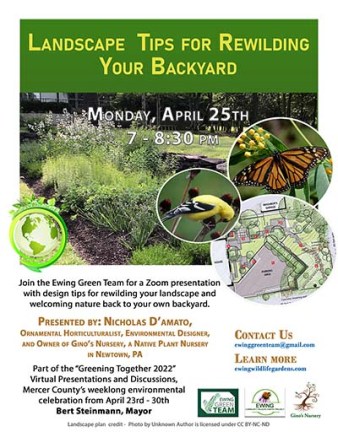
Landscape Tips for Rewilding Your Backyard

Join the Ewing Green Team on Monday night, April 25th at 7 pm for a fascinating look at design aesthetics and principles for planting native trees, shrubs and perennials on your property to make it more welcoming to wildlife.

landscapetipsflyerweb

According to renowned entomologist Doug Tallamy[1], a minimum of 70% native biomass is required to safeguard wildlife habitat, support biodiversity, and mitigate the effects of climate change.  How to meet that minimum threshold in our own small suburban backyards is the challenge, especially in heavily developed areas.   Plant a tree, rip out some lawn, install a rain garden, the options are plentiful.  But where to start?  Don’t let the choices overwhelm you.  In this webinar Nick D’Amato, Environmental Designer, Ornamental Horticulturalist, and owner of Gino’s Nursery in Newtown, PA, will share some approaches for rewilding your landscape and welcoming nature back to your own backyard.

Presenter: Nicholas D’Amato is the founder and owner of Gino’s Nursery, specializing in the growing and sales of plants native to the Mid-Atlantic region. Nick graduated from Delaware Valley College with a degree in Ornamental Horticulture and Environmental Design. While there he developed a strong passion for ecological restoration. Armed with a growing awareness of the need for native plants and the scarcity of availability he founded Gino’s Nursery to address the issue. Starting with only 10 species of Native plants they now grow and sell over 500 species and cultivars catering to both the homeowner and the wholesale trade.   And, it is close to Mercer County!!

This program is a part of the Mercer County Sustainability Coalition’s Greening Together, offering in-person and virtual events in celebration of the environment between Earth Day and Arbor Day.

Get started with rewilding your backyard by planting some natives! Take advantage of our Native Plant Sale – Offered for sale by Gino’s Nursery. Orders accepted through Wednesday, April 27th. Delivered to the Green Get Together on Saturday, April 30th (10 am – 1 pm). Click here for a printable flyer in PDF format.

Date: Monday, April 25th
Time: 7 pm
Location: Live virtual
Cost: Free and open to the public

(Pre-register here/Join on the day…)

[1] Bringing Nature Home, et al., Douglas Tallamy

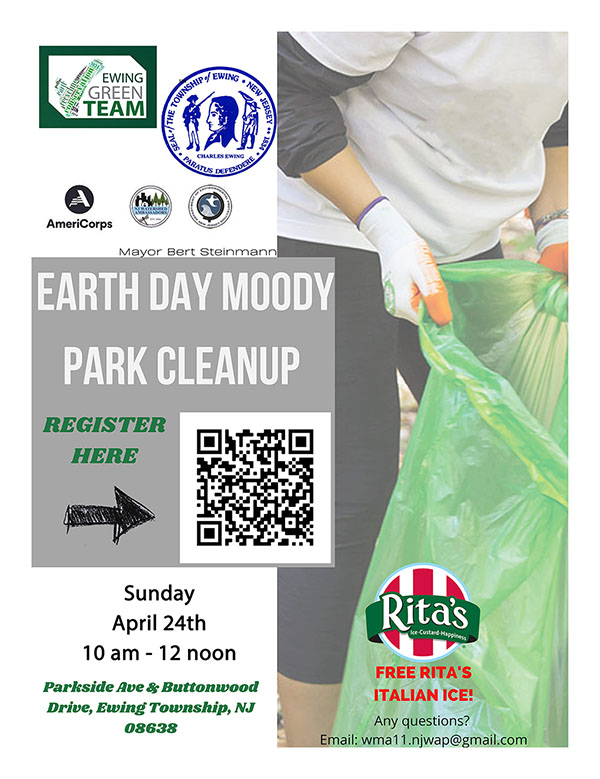
Earth Day Moody Park Clean Up* (date change)

You’re invited to join the Ewing Green Team in showing Moody Park some love.

In coordination with AmeriCorps NJ Watershed Ambassador Program, the Ewing Green Team will be holding an Earth Day Community Park clean-up event at Moody Park on Sunday, April 24th. 

The clean-up will run from 10 am – noon and pre-registration is required.  Participants aged 15 or younger must be accompanied by an adult. The adult should complete the registration and waiver and include the name(s) of the minor(s) in the comments as well as include the total number of people who will be attending under the adult’s name. Waiver

Trash bags, disposable gloves, hand sanitizer, and trash pickers will be available on site. Participants are also encouraged to bring their own supplies.

“Our Community Clean-up, slated for Earth Day+2, coincides with regional, state and county events focused on beautifying our communities,” stated Councilwoman Jennifer Keyes-Maloney, “including the Mercer County Sustainability Coalition’s Greening Together event, a week-long celebration of Earth Day- Arbor Day with both in-person and virtual events.”

Community members will be notified upon sign-up as to their reporting location at the park.  This is a rain or shine event. 

“We are so appreciative of residents who are willing to give up a bit of their Sunday to help beautify an important recreational space in Ewing.”  said Ewing Mayor Bert Steinmann.

As a thank you for all your hard work, cleanup participants will be rewarded with a treat from Rita’s Italian Ice! Each ice flavor will be pre-packaged, and you will receive biodegradable spoon! What a sweet way to end a cleanup!

Community members unable to participate in the event at Moody Park are encouraged to consider cleaning up their portion of the community, whether that be a street corner, storm drain or common area.  We invite you to share photos of your personal cleanups.

Thank YOU for making a difference in Ewing!

Event Summary

Title: Earth Day Community Park Cleanup
Date: Sunday, April 24th
Time: 10 am – noon
Location: Moody Park (parking lot at the corner of Buttonwood and Ewingville Rd
Pre-registration is required

Gardening for Storm Water and Wildlife: How to Build a Rain Garden

Is water from your downspout creating a soggy place in your backyard? Has there been an increase in the number of flooding events in your neighborhood?  Did you know that studies specific to New Jersey show that rainfall intensity is likely to increase with climate change? Rain gardens can help us manage storm water runoff from rooftops, driveways, lawns, roads, and other hard surfaces.

Rain gardens look like regular perennial gardens, but they are much more. During a storm, they fill with water which slowly filters into the ground rather than running into storm sewers. By capturing storm water, rain gardens help to reduce the impact of human activities and pollution in the environment such as road sediment/salt, fertilizers, pesticides, bacteria from pet waste, eroded soil, grass clippings, litter, etc. This helps protect the health of our waterways.  Rain gardens also add beauty to neighborhood and provide wildlife habitat. 

Ewing resident Jean Graham shared her experience: “Removing a large tree to add an addition left us with rainwater washing the topsoil to the bottom of the yard. Then after the grass grew, the rainwater collected in large pools. A modest-sized rain garden takes care of the rainwater from only one of the three backyard downspouts, but that’s enough to solve the problem and to provide lovely flowers that attract butterflies and other pollinators all spring and summer. A buried pipe draws the rainwater from the downspout into the rain garden, with an outlet at the other end of the rain garden to a buried emergency overflow tank. We had the rain garden installed in October 2020.”

In this 1.5-hour evening workshop, you can learn how to plan and plant your own rain garden.  Learn about how to site it, which plants to choose and much more.  Enhance your property and your neighborhood this spring with a rain garden in your yard. 

Presenters: Kendra McKoy and Olvia Spildooren from The Watershed Institute.   Kendra is the Delaware River Advocate / Olivia is the River-Friendly Coordinator.

Date: Wednesday, April 13
Time: 7 pm
Location: Live Virtual
Cost: Free and open to the public

Please click the link below to join the webinar:
https://us02web.zoom.us/j/86595500126?pwd=amtvQkZHYmM2dFRiTTUzL1ltdGlkQT09
Passcode: 218153
Or One tap mobile :
US: +13126266799,,86595500126#,,,,*218153#  or +16465588656,,86595500126#,,,,*218153#
Or Telephone:
Dial(for higher quality, dial a number based on your current location):
US: +1 312 626 6799  or +1 646 558 8656  or +1 301 715 8592  or +1 346 248 7799  or +1 669 900 9128  or +1 253 215 8782
Webinar ID: 865 9550 0126
Passcode: 218153
International numbers available: https://us02web.zoom.us/u/kcgZIAoD1x

DIY No-Sew T-shirt Bag Workshop

You are invited to a DIY No-Sew T-shirt Bag Workshop on Monday March 21, 11:00 at the Hollowbrook Community Center, 320 Hollowbrook Dr., Ewing.

Ewing Township and the Green Team invite you to join us as we prepare for the new plastic bag ban which goes into effect on May 4.

There is no charge for this workshop, and T-shirts will be provided; however, you may bring your own if you like. A pair of sharp scissors would also be helpful.

To register, please call the ESCC office at 609-883-1776 and ask to be transferred to the Senior Center Office.

Event Summary

Title: Bag Up, Ewing Township: DIY No-Sew T-Shirt Bag Workshop
Date: Monday, March 21st
Time: 11 am
Location: Hollowbrook Community Center, 320 Hollowbrook Drive
Cost: Free and open to the public