Volunteers Needed for Sept. 18th NJ Delaware River Cleanup

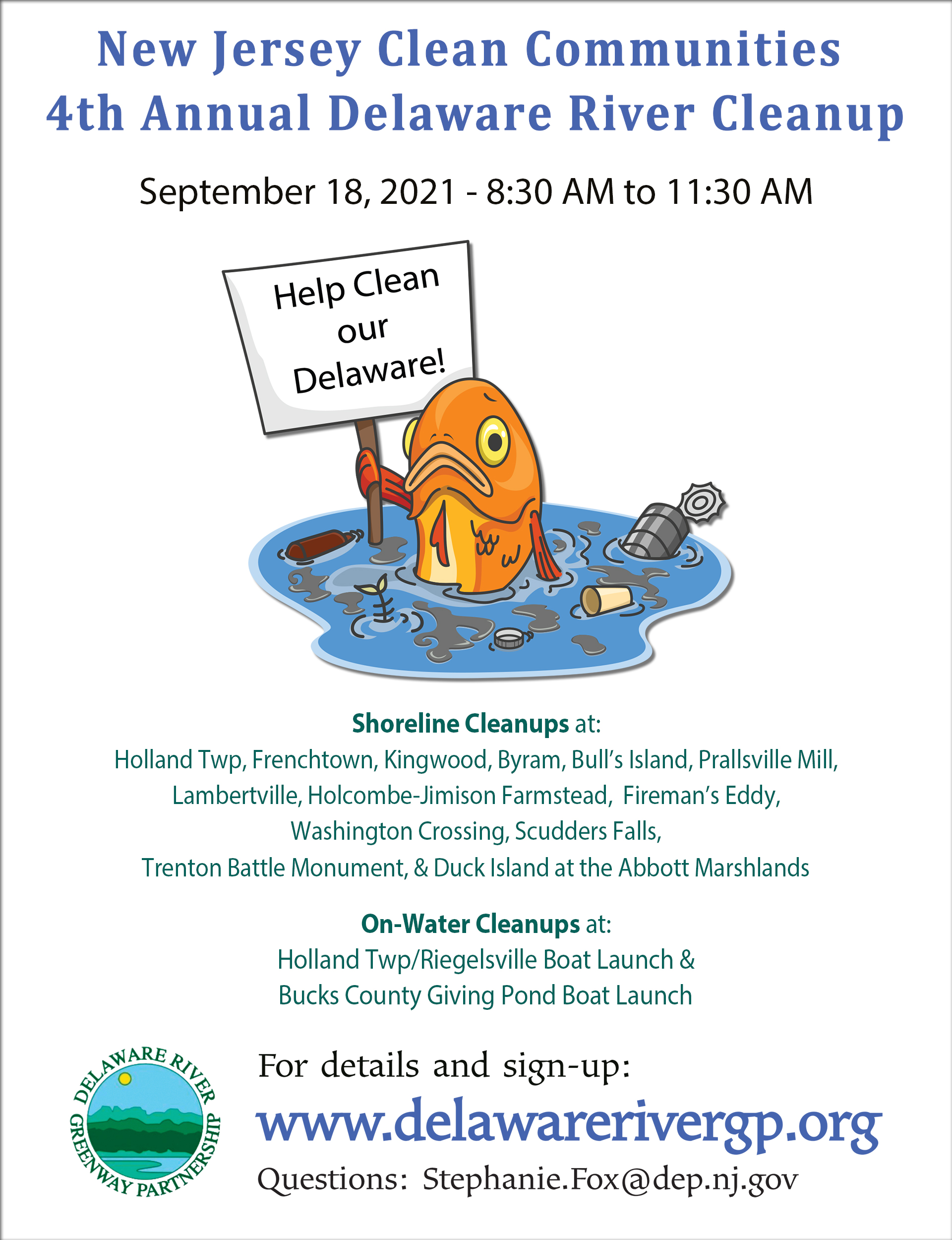
In an effort to help cleanup the Delaware River, a coalition of volunteer organizations and Clean Communities programs in Hunterdon and Mercer Counties, together with New Jersey and Pennsylvania State Parks, announced the 4th Annual Delaware River Cleanup for the morning of Saturday, September 18th from 8:30 AM to 11:30 AM.  

The Delaware River gives so much to our community- drinking water, habitat for hundreds of different flora and fauna, and numerous recreational opportunities. Let’s give back to the Delaware by working together to clean its banks.

Donna Morgan, the Ewing Green Team Representative helping with the event.

The NJ State Park Service, Delaware Canal State Park (PA), Hunterdon County, Delaware River Greenway Partnership, many Clean Communities programs including Delaware Township, West Amwell Township, Lambertville, Kingwood, Stockton, Holland Township, Frenchtown Borough, Hamilton Township, as well as the Trenton Kiwanis, and Friends of the Marsh, are all co-sponsoring the event.

Last year the cleanup attracted over 100 volunteers. Collecting over 100 bags of trash and recycling along with 30 tires and large pieces of debris, this event was recognized as a 2021 National Scenic Byway Foundation Community Award Winner. “Sleepy communities saw thousands of more visitors than in years past, so the cleanup made a huge difference to maintain the Byways’ appearance,” according to the Foundation. The Delaware River Cleanup was one of only eight winners selected from across the country.

This year with expanded locations in Mercer County, there are more opportunities for additional volunteers. There are currently 14 volunteers signed up and it would be wonderful to fill the event.  There are no COVID restrictions, but the organizers reserve the right to impose requirements if health conditions change.

Registered volunteers should bring a signed waiver, insect repellent, and water to the event. Comfortable clothing, long pants, closed-toe shoes, and masks are mandatory. Participants will be provided with trash bags and gloves. Volunteers will receive a t-shirt and light refreshments as a thank you for their time.

Advance registration is required by visiting www.delawarerivergreenwaypartnership.org. The cleanup will focus on river areas from Holland Township in Hunterdon County all the way south to the freshwater tidal area of the Delaware River in Hamilton Township. The Scudder Falls area in Ewing Township will be the focus of the Ewing Green Team’s efforts.  When registering for the cleanup, volunteers can select from 15 locations for the area most convenient for them including two boat-based cleanups, one in Upper Bucks County, PA. To see all the location options, volunteers can adjust the map on the registration site.

If you see someone dumping or involved in illegal activities at any State Park, call the NJDEP at 1-877-927-6337 (1-877-WARN DEP). 

Come Ride With Us at the 6th Annual Community Fall Spin Bike Tour Set For October 2nd

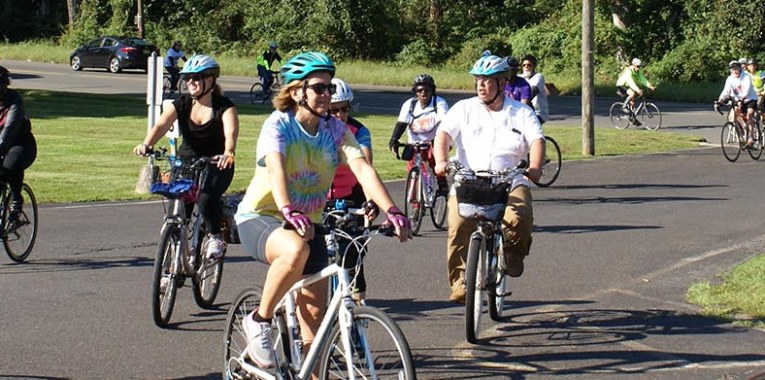
Mayor Bert Steinmann, the Ewing Green Team and the Ewing Recreation Department are pleased to announce the 6th Annual Ewing Fall Spin bike tour, to be held on Saturday, October 2, 2021, from 8:15am to 11:00am. The event will start and end at the Ewing Senior Community Center. All proceeds from this year’s event will be donated to Anchor House, Inc.  

Individuals or teams, ages 18 years and older are encouraged to register early as there is a maximum number of 50 riders allowed. “We would love participants to sign up as individuals or come as a team of friends, family members or co-workers,” says EGT Member and Bike Tour Chairperson, Garry Keel. The Fall Spin registration fee is $20 prior to September 25th and $25 thereafter. All persons registering by September 25th will receive a T-shirt. Day-of-event registration will begin at 7:45am.

Participants will enjoy a leisurely paced, 11-mile ride along the Canal and through Ewing Township neighborhoods. The tour will be escorted by Ewing Police, and rest stops and free bike inspections will be available. 

The Ewing Green Team (www.ewinggreenteam.org) was established in 2009 by municipal resolution under the auspices of the Ewing Environmental Commission, and is part of the statewide Sustainable Jersey effort (www.sustainablejersey.com). The Ewing Green Team envisions a township that incorporates sustainability into the actions and decision-making processes of community members and municipal offices to create and maintain sustainable ways of living; builds strong and diverse economic opportunities; and cultivates a community that welcomes people from all walks of life.

For more information on the Ewing Fall Spin, please visit https://ewinggreenteam.org/ewingfallspin, email ewinggreenteam@gmail.com or call Garry M. Keel at 609-902-8722. 

First 2021 Ewing Township Shred Day

This Saturday, May 15th from 9 am until 1 pm, the Township will be hosting a Shred Day at the Municipal Complex located at 2 Jake Garzio Drive.

This free event is for Township residents only and provides a safe and secure way to clean out those old checks, bills and any confidential documents that need proper disposal.

Restrictions

Materials will not be accepted from businesses and Ewing residents will be required to provide Proof of Residency.

Because this is an extremely popular program please be prepared to spend a few minutes waiting in line.

COVID Precautions

For your safety and the safety of others face masks must be worn, and all citizens will be required to stay in their cars while workers remove your shredding items from your car for you. Items to be shredded should be placed in your trunk or rear cargo area. Please do not get out of your car while waiting in line or while your items are being shredded.

County Executive Hughes Announces New Electric Car Charge Stations

Good news! Mercer County Executive Brian M. Hughes announced that Mercer County has been awarded a grant of $88,000 to install EV charging stations at close to a dozen county-owned locations. Three of the locations for the new charging stations are in Ewing. We share the announcement below:

County awarded $88K DEP Pay$ to Plug grant

Ownership of electric vehicles (EVs) and plug-in hybrid electric vehicles is growing by the year, and with an eye toward that trend, Mercer County is committed to the inclusion of sustainable practices such as the support of EVs. To meet the growing need for vehicle charging stations, Mercer County Executive Brian M. Hughes announces that Mercer County has been awarded a grant of $88,000 to install EV charging stations at close to a dozen county-owned locations.

The funding comes through the N.J. Department of Environmental Protection’s Pay$ to Plug In Program, which was designed to expand the state’s growing network of electric vehicle infrastructure, allowing residents, businesses and government agencies to purchase and drive electric vehicles.

“Studies show that range anxiety, the fear that the car will somehow run out of power, is a fear that keeps consumers from investing in electric vehicles, and our goal is to expand the opportunities to charge a vehicle and further educate consumers on the environmental benefits of gasoline alternatives,” Mr. Hughes said.

The transportation sector accounts for 46 percent of the New Jersey’s net greenhouse gas emissions, making it the largest emissions source in the state, according to drivegreen.nj.gov. By installing EV charging stations on county property, Mercer County can help to slow climate change and reduce air pollution while providing an essential service for the growing number of EV drivers in the region, Mr. Hughes added.  Additionally, the number of EVs will likely increase due to the initiatives from the New Jersey State government to promote the purchasing of electric vehicles.

On recommendation of the Mercer County Planning Department, the new charging stations will be installed at (Ewing sites bolded and in green) :

  • Mercer County Administration Building, 640 South Broad St., Trenton
  • Mercer Office Park, 1440 Parkside Ave, Ewing
  • Hopewell Valley Golf Course, 114 Pennington-Hopewell Road, Hopewell
  • Mercer County Improvement Authority, 80 Hamilton Ave., Trenton
  • Mercer County Boathouse, 334 South Post Road, West Windsor
  • Mercer Oaks Golf Course, 725 Village Road West, West Windsor
  • Mountain View Golf Course, 850 Bear Tavern Road, Ewing
  • Princeton Country Club, Wheeler Way, West Windsor
  • Mercer Meadows (Hunt House), 197 Blackwell Road, Pennington
  • Mercer County Technical Schools Assunpink Center, 1085 Old Trenton Road, Hamilton
  • Mercer County Technical Schools Sypek Center, 129 Bull Run Road, Ewing

It Pay$ to Plug In provides grants to purchase, install and maintain EV charging stations in New Jersey.  Eligible costs include those necessary for and directly related to, the acquisition, installation, operation and maintenance of new EV charging stations.

Discover the Night: International Dark Sky Week 2021 – April 5 -12

Have you ever vacationed or visited a remote or rural destination and wondered why you felt particularly refreshed or rested afterwards?  Have you marveled at the starry skies and thought to yourself “Why are the stars so much brighter here?”  Have you wondered why it has become the norm to leave outdoor lights on through the night and so endanger not only our own nighttime heritage, but also cause serious environmental consequences for humans, wildlife and our planet?

Help make a difference. Turn out your lights and encourage your friends and neighbors to do the same. Join the Ewing Green Team in addressing this issue during International Dark Skies Week (April 5th – 12th) and every night and help to reclaim our nighttime heritage.

Light Pollution Matters

The nighttime environment is a crucial natural resource for all life on Earth, but the glow of uncontrolled outdoor lighting has hidden the stars, radically changing the nighttime environment.

Before the advent of electric light in the 20th century, our ancestors experienced a night sky brimming with stars that inspired science, religion, philosophy, art, and literature. (Think of van Gogh’s Starry Night.)

The common heritage of a natural night sky is rapidly becoming unknown to the newest generations. In fact, millions of children across the globe will never see the Milky Way from their own homes.

We are only just beginning to understand the negative repercussions of losing this natural resource. A growing body of research suggests that the loss of the natural nighttime environment is causing serious harm to human health and the environment.

Light Pollution Threatens Wildlife

For billions of years, life has relied on Earth’s day-night rhythm to govern life-sustaining behaviors. It’s encoded in the DNA of all plants and animals. Humans have radically disrupted this cycle by lighting up the night. Research shows that artificial light at night has negative and deadly effects on many species.

Sea turtles live in the ocean but hatch on the beach at night. Hatchlings find the sea by detecting the bright horizon over the ocean. Artificial lights can draw them away from the sea, stranding them on land. In Florida alone, millions of hatchlings die this way every year. Many insects are drawn to light, but artificial lights can create a fatal attraction. Think of the fireflies that used to dance around by the millions on lawns in our youth.  Or even the bug-splattered windshields of our cars that traversed the nights.  Where are they now? 

Declining insect populations negatively impact all species that rely on insects for food or pollination. Nocturnal mammals sleep in the day and are active at night. Light pollution disrupts their nighttime environment.

Artificial lights also endanger many bird species. They can disrupt the migratory schedules of birds causing them to leave too early or too late in the season, missing ideal conditions for nesting. Birds that navigate by moonlight and starlight can wander off course. Millions die every year by colliding into illuminated buildings.

Light Pollution Threatens Human Health

Humans are not immune to the negative effects of light in their nighttime spaces. Excessive exposure to artificial light at night, particularly blue light, has been linked to increased risks for obesity, depression, sleep disorders, diabetes and breast cancer.

Light Pollution Wastes Energy and Money

In the U.S. alone, there are about 162 million public and commercial outdoor light fixtures including

  • 45 million streetlights,
  • 52 million parking-lot lights,
  • 62 million lights on commercial buildings.

Residential outdoor lighting isn’t as bright, but there’s a lot more of it — about 1 billion light fixtures.

Lighting consumes lots of energy. In an average year in the U.S., outdoor lighting uses some 120 terawatt-hours of energy, mostly to illuminate streets and parking lots. That’s enough energy to meet New York City’s total electricity needs for 2 years! Excessive light at night causes light pollution and unnecessary greenhouse gas emissions, contributing to climate change.

So, let’s stop wasting so much energy! With so much lighting, even modest efforts to control outdoor lighting saves money, reduces carbon emissions, and helps the environment. We do need some light at night, but much of it is wasted by lights that are overly bright or left on when not needed. Unshielded fixtures waste the most energy. Their light shines upward, instead of down on the ground where it’s needed. At least 30% of outdoor light is wasted. That adds up to $3.3 billion and the release of 21 million tons of CO2 per year! To offset all that CO2, we’d have to plant 875 million trees annually.

But Don’t We Need Nighttime Lighting for Safety & Security?

There is no clear scientific evidence that increased outdoor lighting deters crime. It may make us feel safer, but it does not make us safer. The truth is bad outdoor lighting can decrease safety by making victims and property easier to see.

Glare from overly bright, unshielded lighting creates shadows in which criminals can hide. It also shines directly into our eyes, constricting our pupils. This diminishes the ability of our eyes to adapt to low-light conditions and leads to poorer nighttime vision, dangerous to motorists and pedestrians alike.

What Can Be Done?

The EGT is regularly asked: “What can I do to make a difference?” Well, here is one way that you can make a contribution.  The good news is that light pollution is reversible and its solutions are immediate, simple and cost-effective. Here are a few simple things you can do to confront the problem and take back the night:

  • Check around your home. Use only fully shielded, dark sky friendly fixtures for all outdoor lighting, so lights shine down, not up, to minimize “light trespass” beyond your property lines.
  • Use only the right amount of light needed. Too much light is wasteful, harms wildlife and creates glare.
  • Install timers and dimmer switches and turn off lights when not in use. If you must have security lighting, use motion sensors.
  • Use only lighting with a color temperature of 3000K and below. This means that there is less blue (cool) light that is more harmful to many animal species.

Check out this resource page on outdoor lighting basics.

Talk to neighbors. Explain that poorly shielded fixtures waste energy, produce glare and reduce visibility. Work with your local governments to ensure outdoor lighting isn’t harming the wildlife in your area.

Become a Citizen Scientist with Globe at Night and document light pollution in your neighborhood and share the results. Doing so, contributes to a global database of light pollution measurements.

[Resources and background materials for this article come from The International Dark Sky Association, a 501(c)(3) non-profit organization based in Tucson, Arizona. For 25 years, it has advocated for the protection of the nighttime environment and dark night skies by educating policymakers and the public about night sky conservation and promoting environmentally responsible outdoor lighting. More information about IDA and its mission may be found at http://www.darksky.org.]