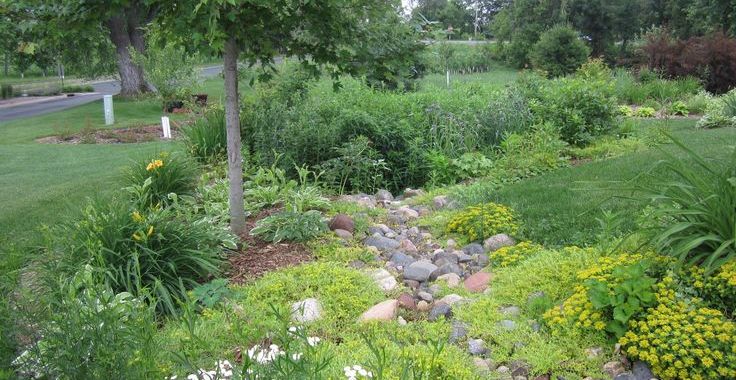
We invite you to join us on Saturday, May 17th for a 2-hour workshop to learn more about the benefits of adding a rain garden to your landscape. You will enhance its beauty, all while improving drainage, and creating a wildlife habitat.
Rain gardens can help us manage storm water runoff from rooftops, driveways, lawns, roads, and other hard surfaces. They look like regular perennial gardens, but they are much more. During a storm, a rain garden fills with water, and the water slowly filters into the ground rather than running into storm sewers. By capturing storm water, rain gardens help to reduce the impact of human activities and pollution in the environment such as road sediment/salt, fertilizers, pesticides, bacteria from pet waste, eroded soil, grass clippings, litter, etc. This helps protect the health of our waterways. Rain gardens also add beauty to neighborhood and provide wildlife habitat.
In this 2-hour workshop, you can learn how to plan and plant your own rain garden, enhancing your property and your neighborhood, about the stormwater benefits of rain gardens, providing watershed-wide benefits with native plants, and go home with a plant list or draft design for your yard. Now is the perfect time to plan a rain garden for planting this spring!
Presenters: Olvia Spildooren from The Watershed Institute. Olivia is the River-Friendly Coordinator
Starry skies are a vanishing treasure because light pollution is washing away our view of the cosmos. It not only threatens astronomy but also disrupts wildlife and affects human health. The glows over cities and towns- seen clearly from space- are testament to the billions of dollars spent in wasted energy lighting up the sky.
What is Light Pollution?
It is adding light to brighten the outdoors. It is a fully human made form of pollution. Light pollution disrupts wildlife, impacts human health, wastes money and energy, and contributes to climate change. In an average year in the US alone, outdoor lighting uses about 120 terawatt-hours of energy, mostly to illuminate streets and parking lots. That’s enough energy to meet New York City’s electricity needs for two years!
Dark Sky International estimates that 30% of outdoor lighting in the US alone is wasted, mostly by lights that aren’t shielded correctly. That adds up to $3.3 billion and the release of 21 million tons of carbon dioxide per year. To offset all that carbon dioxide, we need to plant 875 million trees annually.
How can you help?
• Join us by participating in Dark Sky Week April 21-28,2025. • Watch the video below and clip on the various links included in the publication to learn more. • Turn off all unnecessary lighting inside and outside. • Make sure outdoor lights are properly shielded and direct light down instead of up into the sky. • Close window blinds, shades, and curtains at night to keep light inside. • Go outside and enjoy the stars.
Fill Your Landscape with Native Plants to Sustain Our Native Wildlife
April is officially Native Plant Month, and the Ewing Green Team is committed to increasing awareness of the critical role that native plants play in supporting a healthy environment and thriving wildlife populations. During this month, and every month, we encourage you to learn about the benefits to our local ecosystems gained by planting native trees, shrubs, and perennials that support bees, birds, butterflies, and all wildlife.
What could be better? Native plants are underrated beauties that, once established, weather the vicissitudes of climate change better than non-natives. They generally have deeper root systems, which can search down for water in times of drought such as we are experiencing now. They also anchor in and absorb stormwater runoff during times of excess rain, all while offering support in terms of food, cover, and shelter to our declining wildlife populations. They require fewer artificial inputs: no fertilizers, pesticides, and herbicides, no soil amendments, and limited watering. Finally, they offer a truer enjoyment of the natural world as we experience not only its beauty but also a deeper connection to nature as we observe our landscape used as habitats. We urge you to plant natives because wildlife matters and is worth protecting.
What exactly are native plants? And why are they important?
Plants are considered to be native to an area where they occurred naturally over time and developed symbiotic relationships with insects and other wildlife that have evolved with them. Since evolution is not a quick process, this means over hundreds, or even thousands, of years in a particular area or region. Only plants found in this country before European settlement are generally considered to be native to the United States. And, plants that are native to other areas of the country such as the west or northwest, California… may be native to the United States, but are not considered to native to our area in New Jersey. Some plants may have a very wide native geographic range, and others may be much more limited. When selecting plants for your garden, it is important to pay attention to their native range and to choose plants that are native to our Central Jersey area.
Did you know that New Jersey is home to over 3000 species of native plants (as defined by the New Jersey Native Plant Society), offering tremendous variety as well as diversity of habitat and sustenance to the critters that evolved alongside with them? Mercer County also has its own unique set of plants defined as native to the county.
Since New Jersey’s animals, insects, and microorganisms have evolved in conjunction with our regional gasses, ferns, wildflowers, shrubs, and trees, they have developed symbiotic relationships and depend upon each other for their survival. Our native plants will attract and feed birds, bees, butterflies, small mammals in your yard and you can feel good about sustaining the food web in the habitat they need to survive.
So, how to choose
While our NJ natives always provide sustenance for some wildlife, there are some that provide special ecosystem value for their relative biomass, supporting the greatest number of wildlife species. They are called keystone native plants and are critical to the food web, and necessary for many wildlife to complete their life cycles. Every region of the country has different native plant communities. (Here in Ewing, we are in the Eastern Temperate Forests, Ecoregion 8. )
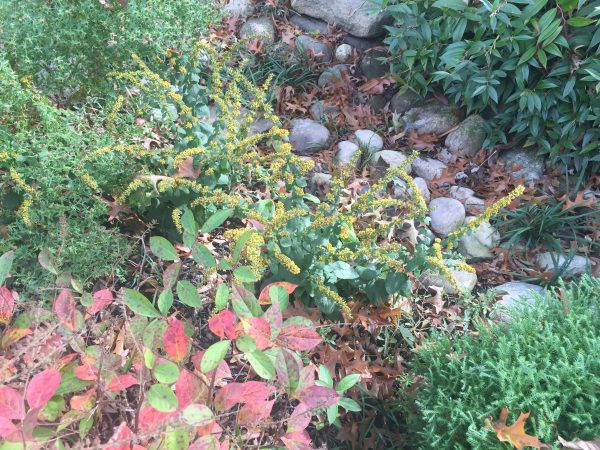
Rudbeckia and EchinaceaSolidagoAsters
If you have the room, you will get the biggest wildlife bang for your buck by planting a tree, particularly oaks. The Red oak (Quercus rubra) is NJ’s state tree and is particularly beautiful, but there are numerous oaks that are native to our state that provide great wildlife value. The Northern red oak grows up to 100 feet tall and is a good choice for a street tree because it is salt resistant. Oaks in general support over 436 species of caterpillars alone. Willows (in the shrub category) support 289 species. And then there are the flowering perennials. Top among them are the goldenrod and asters, Black-eyed Susans, and more. This author particularly loves the perennials that flower later in the season as they support butterflies and other insects as they begin their fall migrations, or prepare for the winter hibernation.
Members of the team will regale you with their favorites during the coming weeks. Through our promotion of Native Plant Month, Ewing and its citizens can engage and make a difference in our home landscapes. As invasive species overrun more and more of both our cultivated and wild spaces, native species that support local biodiversity play an increasingly important role. We ask that during Native Plant Month you start to dedicate some space, whether it be a container, your patio, or yard to make a difference and sustain our wildlife.
Now’s the time to secure your spot in Ewing’s lineup of fantastic culinary establishments participating in our fourth annual Restaurant Week! We’re inviting you to take part in this exciting event, offering an opportunity to showcase your restaurant and draw in new customers while celebrating the vibrant culinary scene in our town.
The event will run from Saturday, April 26th – Sunday, May 4th. Nine whole days of exclusive menus and special offers from the best our town has to offer.
This year, we’re encouraging restaurants to offer special discounts on dining to help attract even more Ewing residents. Whether it’s a discount on a signature dish, a percentage off the bill, or a fixed-price menu, we’d love for you to offer something special that gives diners an extra incentive to visit.
The choice is yours. Participate in a way that best suits your restaurant and your menu. Our role is to help promote your offerings and get the word out, driving more traffic to your restaurant throughout the week.
By joining in, you’ll be part of a community-wide celebration of our local eateries, and we’ll work hard to make sure the residents of Ewing know where to go for a great meal at a great price! At week’s end, we’ll finish it off tallying a vote by participants for the Best of Ewing Restaurant Week! So, be sure to add your restaurant to the mix! The favorite will be announced at the end of the event.
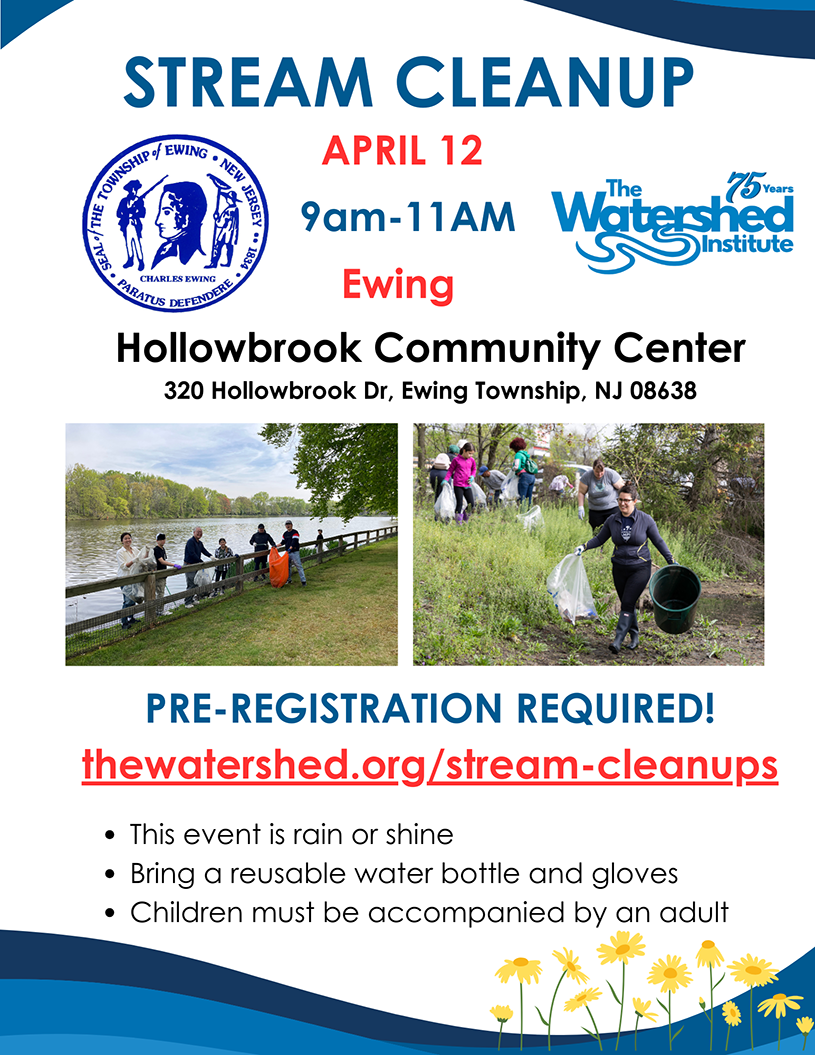
Calling all our Ewing Friends and Neighbors: Let’s work together to show the Shabakunk Creek some much needed TLC on Saturday, April 12th 9-11 am. Pre-registration required.
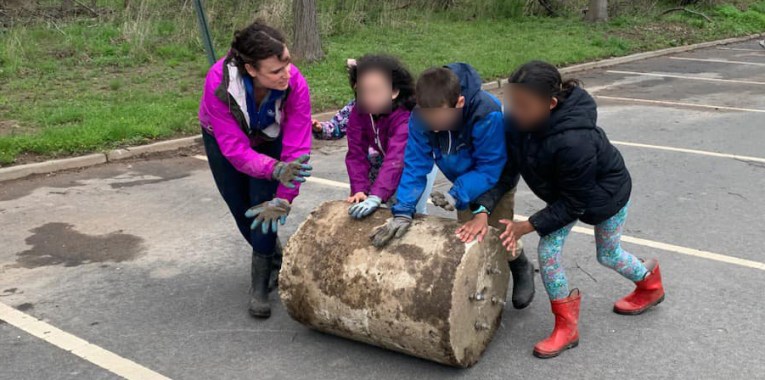
Cleanup days are a good time for Ewing residents to get out into the environment and experience nature while working to protect our important natural resources. Volunteers walk along specific stream segments and pick up trash and litter. This event, run by Mayor Bert Steinman and the Ewing Green Team in partnership with The Watershed Institute has been run in a number of Ewing locations over the years resulting in the removal of over 9200 pounds of trash during this event alone.
Additionally, over the past decade, The Watershed Institute’s annual cleanups have coordinated the hard work of over 9,300 enthusiastic volunteers who have removed more than 160,000 pounds of trash from our local area communities.
The Ewing event this year will concentrate cleanup efforts at the Shabakunk Creek at the Hollowbrook Community Center and its environs, at 320 Hollowbrook Drive, Ewing.
Pre-registration is required!
This is a rain or shine event. Long pants, gloves, and closed-toed shoesare highly recommended. Please don’t forget to bring the gloves and your reusable water bottle!This is an in-person program. Masks are optional. A parent or legal guardian is required to attend with all children. To attend this event, you must agree to the terms of the waiver included during registration.
Thank You Giveaways!
Trees NOT Tees! The Watershed will continue to offer cleanup volunteers a complimentary tree sapling to say thank you for helping keep our waterways clean! They will not be offering stream cleanup t-shirts as we typically do to reduce our environmental impact and conserve limited natural resources. One cotton t-shirt takes 650 gallons of water to produce while a single oak tree can host 532 species of caterpillars, 147 species of birds, 120 species of mammals, and 60 species of reptiles and amphibians. In addition, one mature white oak can absorb over 2000 gallons stormwater per year which can reduce stormwater runoff pollution, flooding, and recharge groundwater.
Sponsors
The following generous sponsors make these cleanups possible. PSE&G, Colgate-Palmolive, American Rivers, and New Jersey Clean Communities have provided funding, volunteers, and supplies.
Event Summary
Event: Stream Cleanupat the West Branch of the Shabakunk Creek. Date: Saturday, April 12th Time: 9 – 11 am Location: Hollowbrook Community Center, 320 Hollowbrook Drive, Ewing. Cost: a couple of hours of your time Pre-registration required: Click Here






 Sustainable Ewing Green Team