Spring is just around the corner and it’s time to get involved in community gardening in Ewing. Mayor Bert Steinmann and Ewing Township invite interested residents to grow local and register for a garden plot at the Ewing Community Gardens on Whitehead Road Extension.
Returning gardeners can register beginning on Monday, March 3rd. New applicants may register beginning March 17th. Plots are limited, so come early.
There is an active gardening organization, the Ewing Community Gardens. Their mission is to promote public gardening in Ewing. “It is not just about growing produce in the ground; it’s about growing community.” They encourage all registrants to meet their neighbors and get involved. Regular site clean ups will be held.
Registration Details for the 2025 Gardening Season
The 2025 registration for garden plots at the Ewing Community Gardens on Whitehead Road Extension will begin in March in the
Office of the Clerk 2 Jake Garzio Drive Ewing, NJ 08628
Plots are $5.00 each and you can purchase up to two plots. (Park in the upper-level parking lot.)
Registration Dates
Monday, March 3, 2025, Registration will Open for Previous Year Plot Holders
Monday, March 17, 2025, Registration will Open for New Applicants
Owners of Plots in 2024 will have an opportunity to reserve their same plots from the prior year.
If there are still plots available on April 15th, 2025, you may purchase additional plot(s). Please call the clerk’s office at 609-883-2900 ext. 7618 to find out if more plots are available.
Requirements (No Exceptions Granted to Any of the Following Requirements!!)
You must be present to buy your plot(s).
Ewing Township residents only (proof of residency is required)
You must provide an Email Address.
The official opening of the gardens is weather determined and announced later in the season.
About the Gardens
The Ewing Community Gardens are located on Whitehead Road Extension in Ewing. They are enclosed in an 8’ deer fence and water sources are available. Half of the plots are organic and no-till.
For information about the Ewing Community Gardens Association email ewingcommunitygardens@gmail.com. Look for the upcoming ad in the March Ewing Observer.
As the old year ends and the new one begins, we frequently resolve to begin anew, to do something better and be better. To kick off 2025, the Ewing Green Team and some of our supporters share some of the personal resolutions to which we have committed for the coming year. We believe these answer a question that we commonly receive: “What can one person do to make a difference?” We share them with you as examples of simple and realistic sustainable resolutions you can implement in your daily life. What would you add to the list?
These green resolutions are part of our collective commitment to embodying the principles and actions necessary to help us face issues such as climate change, environmental pollution, the biodiversity crisis, and much more. They range from the very personal to resolutions that can easily be adopted on a wider scale. We thank you for all that you do and invite you to join us to help build a better world for future generations to come.
Best wishes for a Happy & GREEN 2025!
The Ewing Green Team
Ruth Chin
“Eradicate this spring’s garlic mustard in a 20’x30′ patch along the canal by March 31.“
Kathy Barringer
“I resolve to skip the stuff when I order takeout. I will decline plastic utensils, napkins and condiment packs. My family has also resolved to discontinue use of plastic water bottles in 2025.”
Heidi Furman
“I’ve been asked by our West Trenton Garden Club to “green” our Hospitality Committee’s practices for our monthly meetings. I resolve to do this by helping to educate our members in matters of sustainability. We’ve already primed members to remember to bring their personal reusable flask to meetings.”
Devin Spence
“I will become a more conscious consumer, knowing where products are coming from, the impact they have and questioning if I really need it.”
Daniel Bowen
“My New Year’s resolution is to choose to take my bike instead of the car to the grocery store more often this year.”
Joanne Mullowney
“As a gardener who gardens for wildlife, I resolve to step up my efforts to garden sustainably. This includes removing more non-native plants from my property and replacing them with natives, particularly keystone species that provide the greatest support for wildlife relative to their biomass. I also plan on adding a couple of new native trees to my landscape and removing more lawn to provide additional soft landings under my trees for wildlife… Whatever I can do to provide habitat and support for disappearing wildlife is on my to-do list.
Evan Crumiller
“I am going to try going the first week of January without using a single piece of reusable plastic! Depending on the results I hope to continue from there, at the very least cutting way down.”
Jennifer Keyes-Maloney
Jenn has shared that she plans to become more sustainable in 2025 with the following resolutions:
“Limit clothing purchases generally, and only purchase items that do not require dry cleaning
Bundle online purchases to avoid shipping impact
Share plants with others, and recycle plant containers
Commit to reusable containers for water and coffee.”
Aaron Watson
“We should strongly encourage everyone to enjoy nature, become stewards of the outdoors and to strive for deeper engagement in the environmental sector.”
Lisa Feldman
“I resolve to become a more mindful consumer, particularly of the food that I buy. I have gotten in a bad habit of unrealistic food purchases and end up throwing a lot of food away, salad bags that go bad, fruit that I don’t eat. Prepared meals that I think will be appealing but never seems to eat? I hate that it’s ending up in the waste, it’s costly and wasteful. I hope that I can be a better planner.”
Caroline Steward
“I hope to work on a butterfly garden. I plan to reduce my lawn size by converting it into a more bird and butterfly friendly space.”
Karen Sare
“I resolve to attend more environmental webinars and also research ways Ewing can make more of an impact regarding clean communities.”
Alexis Freiling
Has a number of goals to she wants to work on. “I plan to focus on buying fruit and vegetables that are in season. This helps reduce the reliance on greenhouses to keep fruit/vegetables stocked year-round. I also pledge to remember to bring Tupperware from home when eating out at restaurants, so I can pack up my leftovers without relying on the restaurant to-go containers. And finally, I want to create a wildlife pond in my garden, plant more native plants and replace some of my non-native plants with native alternatives in my garden.”
Mark Wetherbee
“I resolve to compost food waste and provide nature support to my landscape.”
Garry M. Keel
“Please take the time to recycle the proper items. If you are not sure what is recyclable and what is regular garbage, check with Mercer County Recycling. We all have a duty to do what we can to make our world as clean and as green as possible”
Thank you to all our members for their wonderful suggestions!
We add one final suggestion. We don’t know what the future holds for us in the coming year, but the roles of the states, local governments and environmental organizations will be more critical than ever in continuing efforts to protect and clean up our environment. So, resolve to join with us in our work, you are more than welcome. Come to a meeting and help us influence others to make needed positive changes for a better tomorrow for our town, our state, our country and our world.
Recycling Update!
#5s now accepted in 2025!
The Mercer County Improvement Authority (MCIA) which manages most of the curbside recycling in Mercer County, will now be accepting #5 plastics in your curbside recycling containers in 2025.
This includes items like yogurt containers, condiment containers (think ketchup bottles), amber colored medicine bottles, plastic beverage caps, and to-go containers. See Recycle Your #5s in 2025! If you are uncertain, be sure to check for the #5 in the little triangle on the bottom of the container. As a reminder, all items must be empty, clean, and dry and should not have contained any toxic or hazardous substances.
Report Road Salt Spillage
During winter ice and snow events applying road salt helps to lower the melting point of ice, allowing sidewalks, parking lots, driveways, and roadways to stay free of ice buildup. But there is a downside. Salts are also soluble. As we put it down, it dissolves into snow melt and stormwater runoff. This works its way into our storm drains that empty into our streams and rivers. As a result, the US Geological Society reports that waterway chloride levels have doubled over the past 50 years.
A Few Road Salt Facts
Salt doesn’t “go away” and is not removed by traditional water treatment plants.
Fish and plants don’t like salty water, it is toxic to freshwater animals. It is also toxic to plant life, and the soil as it builds up.
Humans don’t like it either. Our drinking water gets salty when chloride concentrations are over 250 mg/L.
Salt harms our infrastructure, corroding metal and concrete resulting in damage to our roads, bridges, and personal vehicles as well.
How You Can Help
Reduce salt use: shovel right after it snows and then salt sparingly if needed.
Remove excess salt after the salt has done it’s work.
Consider environmentally friendly alternatives such as cheese brine, beet juice and sand.
Help the Ewing Green Team in monitoring the impacts of road salt by participating in the annual New Jersey Salt Watch.
Report road salt spills on Ewing Township roads using our reporting form here. This will help the Public Works Department to remove the excess as required by NJ statute and keep our community safe.
Township Sustainability Reminder for EV Owners
If you have an electric vehicle or are considering purchasing one, Ewing Township has made recharging your vehicle more convenient with four charging stations now online at Ewing municipal locations! One ChargePoint dual port level two charger is located at the Hollowbrook Community Center (in front of the pool), and two ChargePoint dual port level two chargers are located at the Municipal Building – one in the front lot on the lower level, and the other is in the rear lot on the upper level. There is a Livingston Energy Charger by BTC dual port level two charging station at the Station 30 Fire Company at 1666 Pennington Rd. in the parking lot in the rear of the building.
Electric vehicle owners are encouraged to use these charging stations while they conduct business at the municipal building, enjoy the pool or a program at the Community Center, or visit the Construction Office to apply for a permit, or whether they’ve simply found Ewing in an EV map while on the go.
Happy New Year!
May your 2025 be filled with joy and success and may we all come together to work for a healthier, greener Ewing!
Ahhh, yes, it’s happening. Fall is finally here, and we can all breathe a deep sigh of relief. We are finally leaving the hot, sticky days of summer behind us for the cooler, more breathable days of fall. (Now, if only we could get some rain….) As we begin the dive into the month of October, we all remember why we so love autumn. Our neighborhood trees will soon blanket the ground with their last gift of the growing season, a recharge for our landscape that creates habitat for wildlife. The Ewing Green Team entreats all Ewing homeowners to treat their leaf litter, not as trash to be carted away, but rather as the gift that it truly is to the millions of tiny creatures that are a part of the life of our gardens.
Ewing Township New Leaf Collection Guidelines
By now we hope that you have heard about the updated leaf collection guidelines that will begin this fall for leaf pickup at the curb. Ordinance 24-19 allows a scheduled period of loose leaf collection during the months of November and December (and as needed in October and January) to simplify and expedite the process of leaf collection for residents. (Yard waste must be containerized for collection at the curb any time outside this scheduled collection window.) We will leave it to the Township to explain the basics of the new collection system, but suffice it to say, that the new system is a compromise. Allowing loose leaves in the street for very limited windows of time for pick up by DPW staff will be a major convenience for residents and will be balanced with the need help Ewing to keep our storm drains clear and improve water quality while maintaining compliance with New Jersey stormwater regulations.
The Green Team, of course, strongly encourages you to mulch your leaves, but does recognize that for some that may be impractical. However, we do want to take this opportunity to put in our annual plug about the benefits of keeping your leaf litter on site and dispensing with the piles of leaves in the street leaving your property.
Leave the Leaves
Leaves are a valuable resource that many property owners let go to waste every fall. They are blown into piles on the street and left for DPW pickup. They cause unsafe driving and biking conditions, clog storm drains, and can become a source of unwanted nutrient runoff into our streams and rivers causing unhealthy algae blooms.
As a homeowner, landscaper, or property manager, are there better options? Yes! “Leaving the Leaves” is a growing environmental movement that provides the best and simplest solution. It is easy to learn, easy to implement, gets great points for being “green,” and better yet, actually saves time and money!
The Benefits of Leaf Litter
In nature, trees don’t drop their bounty at the curb for pick up, but rather they bestow a host of ecological benefits including providing an insulating winter cover in the garden for plants and the tiny creatures that sustain life in the garden and help to conserve soil moisture. We encourage you to mulch with fallen leaves. As much as possible, leave them to decompose where they fall in your garden beds. Or settle the leaves under the branches of your trees and shrubs. Give it a year or so and your leaf litter will have broken down while providing mulch, improving your soil, and increasing its water retention abilities.
You can also rake out some of the leaves from the beds that might smother tender plants and cause them to rot over the winter. One option here is to add them to the compost pile. A second option is to add them to the leaf pile on the lawn. Then take your mulching mower and chop them up into small pieces. Rake up most of the chopped leaves and place them back in the garden around shrubs and plants. Now that they are greatly reduced in volume, they contribute to a neater appearance. The remainder can stay on your lawn and decompose there. Do this as needed until the end of the season and the leaves will break down over the winter.
While the option of mowing your leaves into mulch is not optimal and destroys some of the small critters that overwinter there, it is a far superior option to carting ones leaves to the curb where they provide no benefit at all to your landscape.
You might think that this leaves the yard looking a little less than perfect, however you are nourishing the landscape.
The Benefit of Providing Habitat
This somewhat messy yard contributes yet another important benefit – habitat. While habitat is not a traditional concern of the average gardener, we believe it should be, and more and more gardeners are coming to realize it. Did you know that despite its not so perfect look, leaf litter provides an important foraging space and shelter for a wide variety of birds, small mammals, and insects? Also providing benefit is the untrimmed winter garden where ladybugs and lacewings reside in native grasses and pollinating bees settle in hollow plant stems. Butterflies and moths winter in chrysalides on the ground and baby spiders hide out amid the decaying plant stems. Birds feed from dried seed heads in winter.
Some wildlife uses the leaf litter and other dead vegetation to insulate them from winter’s chill, while others, such as earthworms feed on the litter, breaking it into smaller pieces. Bacteria and fungi in turn convert theses smaller pieces into nutrients which then sustain neighboring plants. They in turn help support biodiversity by becoming food themselves. Toads, beetles, ladybugs and much more also live in your backyard’s leaf litter. Each is an integral part of the food web.
Support Wildlife Thru Your Not So Perfect Yard
We recommend the following practices to help you in your quest to provide habitat and reduce your ecological impact. Adopting good practices in the fall also leaves you well set for spring in the garden.
Leave your leaves on the property. Leave them in the garden beds when you can, mow them, or compost them.
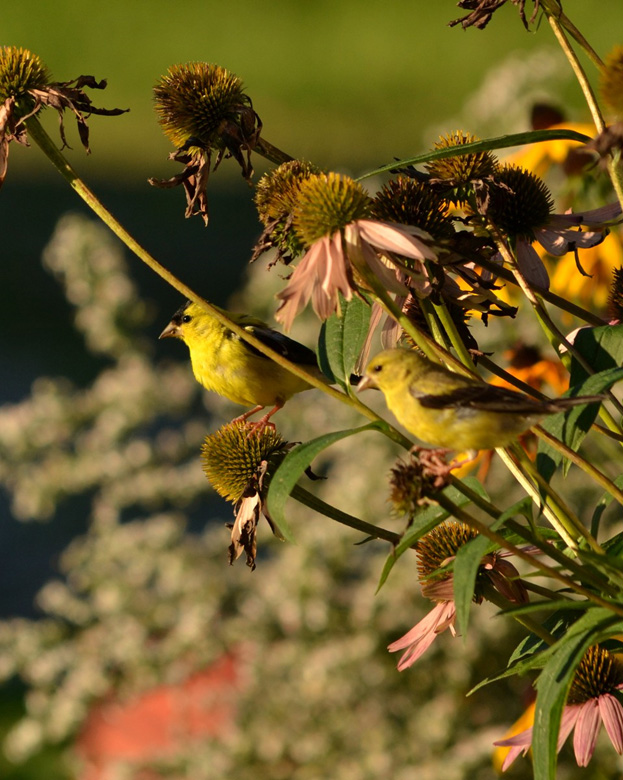
Allow dried flower heads of some of your garden favorites to stay standing in your garden as a food resource. The dark stems and flower heads of some of our native flowers look gorgeous against the snow and nothing is more exciting than seeing our small, winged friends feasting upon the seed heads.
Don’t cut down your native ornamental grasses. Let them grow tall and seed. They provide shelter for the insects that pollinate our gardens and feed fledgling birds and other wildlife. Not to mention that they also look fabulous swaying in the wind. They make a fabulous addition to the fall and winter landscape.
Build a brush pile with fallen branches instead of removing them. If you build it, they will come. This author no sooner established a small brush pile in a back corner in the yard and it was inhabited.
Forget the chemicals. (This one is not hard. Just do it!) They flow from our properties during rain events and end up in our water supply.
Finally, don’t be in a rush to begin your garden cleanup in the spring. Wait until after several 50℉ days to begin, when spring has really arrived, allowing overwintering pollinators to move on first. You gave them a home all winter; don’t take it away from them too soon.
Vanishing Habitat
As habitat for wildlife decreases, the wildlife it supports does also. More than half the world’s wildlife has vanished since 1970. This includes mammals, birds, reptiles, amphibians, and fish.
Wildlife needs habitat to survive, and we need to do a better job balancing the need to provide habitat for animals’ survival against commercial forces. Habitat requires food, water, and shelter and even a small yard can support birds, butterflies, beneficial insects, and small animals thru proper landscaping and landscaping habits.
We ask you to adopt a somewhat messy yard and eschew the leaf disposal. Keep your leaves so that they can decompose naturally in your own yard and support the butterflies and other small insects that live in the leaf litter. To learn more about how the Ewing Green Team is promoting gardening for wildlife, take a look at our initiative – the Ewing Community Wildlife Habitat Project. During this season of renewal so essential to preserving the next generation of wildlife, we invite you to join with us and pledge to garden messy. Then put your feet up and enjoy the season.
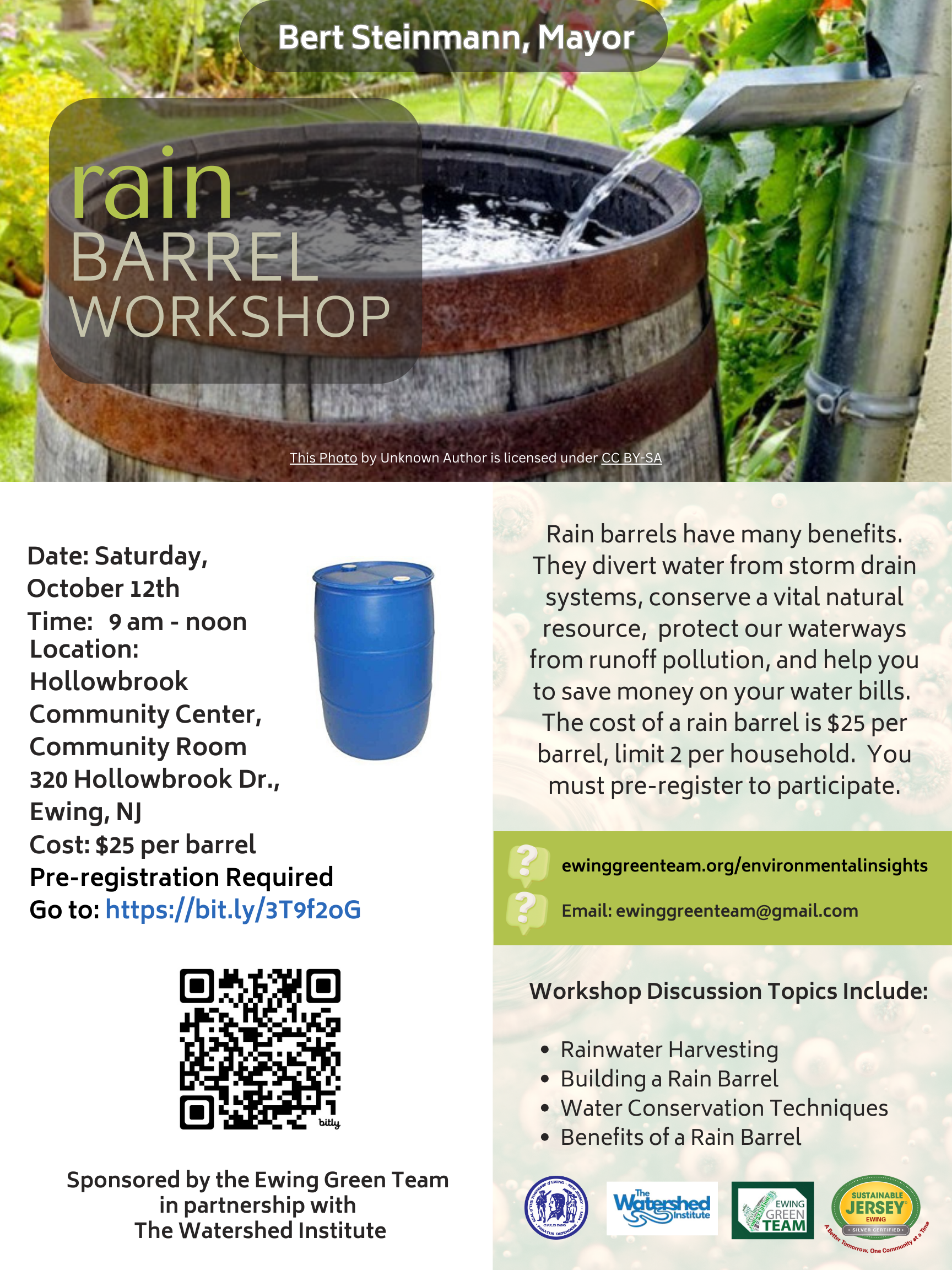
We invite you to learn more about water conservation and how to harvest rainwater from your roof and divert it for on-site usage in the landscape at out October 12th Rain Barrel Workshop. The Ewing Green Team, in partnership with The Watershed Institute in Pennington, will teach you how to build a rain barrel at the workshop. The program will be presented by Olivia Spildooren, River-Friendly Coordinator at The Watershed. The fee for the program is $25. We have obtained 20 free food grade barrels while has enabled us to offer this program at a bargain price. Registration is limited so be sure to register early. The workshop will run approximately 2 hours. Sign up here.
Event: Rain Barrel Workshop Dates: Saturday, October 12th Time: 9 a.m. – Noon Location: Hollowbrook Community Center, Community Room, 320 Hollowbrook Drive, Ewing, NJ 08638 Cost: $25 per rain barrel Pre-register: https://bit.ly/3T9f2oG
Installation of rain barrels in your yard will enable you to take an active role in reducing flooding and pollution in local waterways. Install rain barrels under your gutter’s downspout to harvest rainwater from your roof. Each rain barrel holds approximately 50 gallons. You can install them singly on hook them up in tandem to reserve even more water. Use the water to save money and save water when you irrigate your gardens with it during times of low rain. In case you miss the workshop or are unable to attend, rain barrels are also for sale at local garden centers for approximately $100, give or take.
Mayor Bert Steinmann, the Ewing Green Team and the Ewing Community Affairs Department are pleased to announce the 10th Annual Ewing Fall Spin bike tour, to be held on Saturday, September 21, 2024, starting at 8:15am. The event will start and end at Campus Town at The College of New Jersey. All proceeds from this year’s event will be donated to the Trenton Area Soup Kitchen (T.A.S.K.).
Individuals or teams, ages 16 years and older are encouraged to register early. “We would love participants to sign up as individuals or come as a team of friends, family members or co-workers,” says EGT Member and Bike Tour Chairperson, Garry Keel. The Fall Spin registration fee is $15 for students ages 16 and older, $20 for adults (individuals 18 years or older) and $40 for a Family Plan (3 or more individuals living in the same household 16 years and older). All persons registering by September 14th will receive a T-shirt. Register through communitypass.net or call the recreation office at 609-883-1776 x 6202 for assistance. Day-of-event registration will begin at 7:45am.
Participants will enjoy a leisurely paced, 12-mile ride throughout Ewing Township neighborhoods. The tour will be escorted by Ewing Police, and rest stops and free bike inspections will be available.
The Ewing Green Team (www.ewinggreenteam.org) was established in 2009 by municipal resolution under the auspices of the Ewing Environmental Commission, and is part of the statewide Sustainable Jersey effort (www.sustainablejersey.com). The Ewing Green Team envisions a township that incorporates sustainability into the actions and decision-making processes of community members and municipal offices to create and maintain sustainable ways of living; builds strong and diverse economic opportunities; and cultivates a community that welcomes people from all walks of life.



 During winter ice and snow events applying road salt helps to lower the melting point of ice, allowing sidewalks, parking lots, driveways, and roadways to stay free of ice buildup. But there is a downside. Salts are also soluble. As we put it down, it dissolves into snow melt and stormwater runoff. This works its way into our storm drains that empty into our streams and rivers. As a result, the US Geological Society reports that waterway chloride levels have doubled over the past 50 years.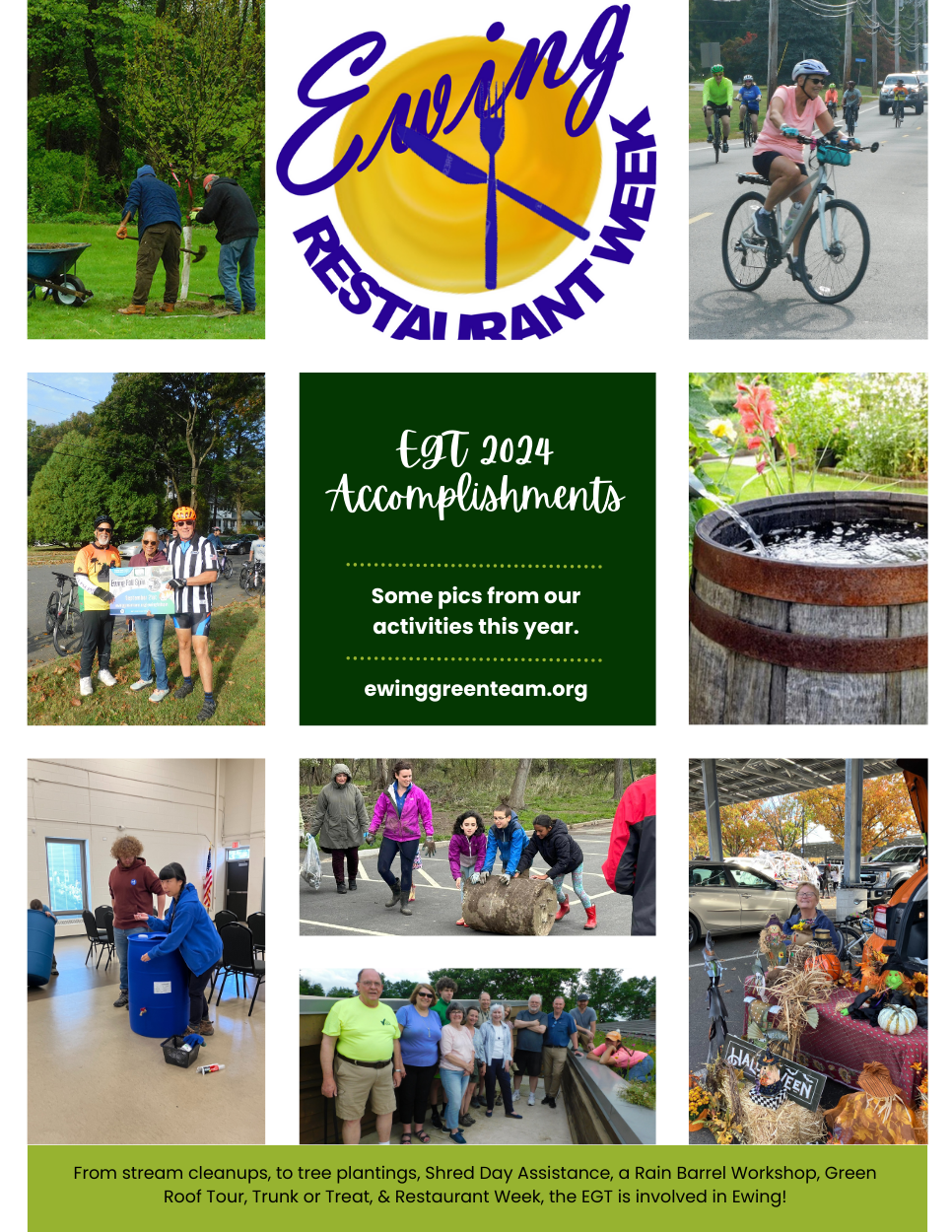




 Sustainable Ewing Green Team