Winter De-Icing Choices

With the recent advent of real winter we thought that it was time to recycle our recommendations for winter de-icing choices.

Sodium Chloride, or rock salt, is the typical de-icing chemical used on our roads and highways. It lowers the freezing point of water, letting it remain as a liquid at colder temperatures and its large granules help provide traction for vehicles and pedestrians alike, often with the addition of sand.  However, while salt does an excellent job of de-icing and keeping us safer on our roads, the long term damage to the environment from excess road salts causes a perennial tension.  Like the practice of using too much plastic in our daily lives, this is another practice the results of which don’t just “go away.”  Salt on the roadways and sidewalks washes off into lakes and streams and seeps into groundwater supplies making a salty home for aquatic plants and wild animals and adversely affecting the quality and taste our drinking water.  Our pets too, are adversely affected by the big, jagged granules of rock salt between their paw pads.  They can irritate the area around the paw pads and cause the animals to lick the area.  The ingested salts and other contaminants can irritate their digestion or worse still, poison them.

Home Landscape Considerations

Excess salt in the landscape is toxic to plants.

  • “When the salt dissolves in water, the elements separate and the sodium the sodium ions in the salt replace the other nutrients in the soil that plants need (potassium, calcium, and magnesium), so these nutrients are unavailable to the plant.
  • Rock salt also absorbs the water that would normally be available to roots, which dehydrates the roots, changes their physiology, and causes additional plant stress. Meanwhile, roots absorb the chloride ions and transport them to the leaves, where they accumulate and interfere with chlorophyll production and photosynthesis.” [3]
  • Salt spray also damages a plant’s leaves, buds and small twigs, reducing cold hardiness and making its tissue more susceptible to freeze damage.

Protect your landscape from salt damage. The Ewing Green Team recommends you use coarse sand and/or clean clay kitty litter to provide traction on your sidewalks and driveways. If you must use salt, try to limit its use as much as possible.  You might erect fencing to protect sensitive plants and minimize their contact with the salt product.   After icy winters where a number of salt applications were necessary, irrigation of the soil prior to spring green up to leach out the sodium and chloride has also been shown to be effective.

Alternatives

There are a number of alternatives to sodium chloride for both residential and government usage that have cropped up due to environmental concerns. These include increased use of sand, calcium magnesium acetate, calcium chloride, magnesium chloride, cheese and pickle brine (Bergen County in NJ has experimented with pickle brine), beet or corn solution,  potassium acetate, and an idea for the future – solar roads.[1] Calcium Chloride is the alternative that is most readily available to homeowners at your local hardware store or home improvement store and our comparison follows.

Sodium Chloride (Rock Salt) vs. Calcium Chloride

Rock Salt is the number 1 enemy of concrete. While effective at melting snow and ice at temperatures as low as 20 °F, during colder weather it allows melt-off to refreeze. This leads to a long series of alternating freezing and thawing, which will erode your concrete driveway and sidewalk surface.  Additionally, rock salt has the highest quantity of chloride ions in it of any deicer, and these ions can dissolve in water and pollute local lakes and rivers and cause potential harm to vegetation and animals.  It is also very corrosive and harms certain metals such as rebar in your concrete structures and the underbody of vehicles.  A vehicle that has spent time on salted roadways should have the underbody washed frequently to reduce the corrosion of the steel structure.

Calcium Chloride is effective to as low as -20 deg. F. It is noncorrosive and will not harm concrete or other surfaces.  It is more expensive than rock salt as a product, but in the long run of its use does not cause the need for the repairs that the damage that Rock Salt causes and, if used as directed, will not harm vegetation.[2]It also works much faster and pound for pound it melts twice as much ice.[3]

Summary

Anyone who has been through an ice-storm will justifiably applaud the de-icing benefits that rock salt provides for our road crews and around our homes. However, its long term environmental impacts call for inclusion of more environmentally friendly and unfortunately, more expensive options.  We hope that a combination of these options will make us safer in both the short and the long term.

[1] http://www.mnn.com/earth-matters/translating-uncle-sam/stories/de-icing-dilemma-do-streets-need-salt

[2] http://www.peterschemical.com/calcium-chloride-vs-rock-salt-which-do-you-use/ Peters Chemical Company.

[3] https://www.extension.purdue.edu/extmedia/id/id-412-w.pdf, “Salt Damage in Landscape Plants,” Janna Beckerman and B. Rosier Lerner, Purdue University Extension publication HO-142-W Table 1. De-icing Alternatives


Tips for Recycling Your Christmas Tree

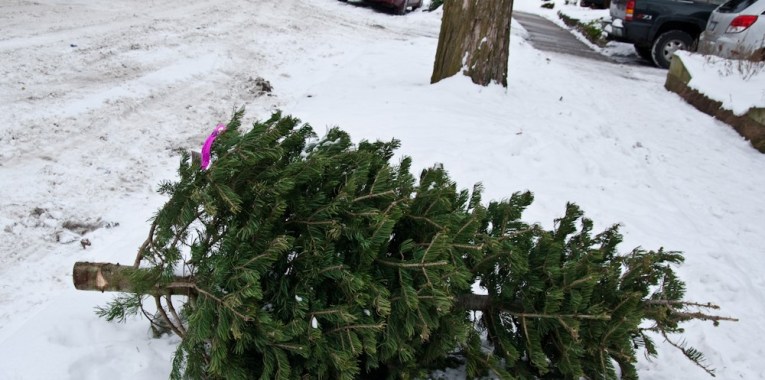
Next week we will be seeing that holiday staple, the Christmas tree, that gave its all for Christmas cheer, forlorn and discarded by the hundreds at the curbside.   Ewing Township, of course, collects your tree at the curb for recycling into mulch to be used around local parks, however, there are also many environmentally- and taxpayer-friendly ways you can use your tree on your own property.

Reuse your Christmas tree around your home and in your yard this winter and not only will you nourish the landscape, providing valuable resources and habitat for the environment, but you can also help reduce staff time with tree pickup, saving taxpayer dollars.

  • Winter mulch
    Evergreens provide winter insulation for tender plants in your yard and reduce frost heaving. Cut the boughs from the tree and place them over any delicate plants for the winter.   They also help alleviate the weight of snow on branches that might otherwise break from the added load.
  • Mulch with the needles
    Needles from your tree dry out quickly and decompose slowly.  They make an excellent mulch for the garden.  Pine needles are full of nutrients that can reduce the PH of your soil if its more alkaline.  Many on a branch fall off the boughs placed in the beds during the winter.
  • Brush Pile for Wildlife Habitat
    Wildlife need snug hiding places and protection from winter weather. Make a small brush pile from the boughs in a back corner of your yard and create a safe place to support our threatened vanishing wildlife.  Or leave your tree intact and place it in its stand outdoors.  Fill it with bird feeders hung from the boughs.  Again, this makes a wonderful addition to wintertime habitat for a variety of small animals such as birds, rabbits, and squirrels…
  • Firewood
    You can use your tree as firewood, but not right away. The wood is wet and can pose a fire hazard. Cut your tree up and let it dry out and then use in an outdoor fire pit.  It’s not good with an inside fireplace, but works well outside.
  • Fresheners
    Make a sachet from the tree’s pine needles to keep that Christmas scent in your home throughout the New Year.
  • Fish feeders
    Sunk into private fish ponds, trees make an excellent refuge and feeding area for fish.
  • Coasters
    The creative and crafty among us can make round coasters from the trunk.

These are just a few suggestions garnered from our own usage and around the web.  Perhaps you can think of more.

The Ewing Green Team hopes you all had a great holiday season and sends best wishes for  a wonderful New Year.

1. http://www.realchristmastrees.org/dnn/All-About-Trees/How-to-Recycle

Tips for a More Sustainable Thanksgiving

Tomorrow is one of our favorite holidays when we all look forward to the annual American ritual of the traditional Thanksgiving dinner complete with turkey and all of the trimmings, surrounded by family and friends.  It is a day free from the commercialism of other holidays and a day to give thanks for all of our blessings.

Thanksgiving is also a great time to thank Mother Nature for all her bounty and blessings by practicing more sustainable Thanksgiving rituals.  Here are a number of tips to help achieve that aim.

  • Minimize waste
    Use reusable dinnerware, glasses and napkins to reduce the amount of materials that end up in landfills.
  • Buy local and organic
    Local food is fresher, cuts down on food miles and support local farmers. Choosing organic foods not only is more humane for the animal but free range and naturally fed animals taste better and are healthier.
  • BYO Bags
    Don’t forget your reusable bags when shopping.  Let’s work to keep plastic out of the waste stream.
  • Create a Natural Centerpiece
    Mother Nature can supply leaves, acorns, pine cones … that will make a beautiful centerpiece. Use your creativity and if you are not feeling especially creative, look online for ideas that you can copy.
  • Eat less
    Thanksgiving is a day that we tend to associate with eating to excess. Be healthy.  Slow down to enjoy your food.  While you’re at it, eat less meat.   We’re not suggesting that you eschew the turkey, but the meat industry is the number one source of methane gas which is a major contributor to climate change.  Try filling your plate with a little less meat and more of the green healthy sides.
  • Drink Local Water
    Eschew the bottled water and drink local water. If you are concerned about its quality, get a filter. Americans spend billions on bottled water each year which, not only is wasteful, but leaches toxic chemicals from the plastic into the water.   It also creates mountains of plastic waste that needs to be disposed of.
  • Leftovers
    Try to get more out of your leftovers. Use the leftover turkey carcass for a soup base and leftover meat and vegetables in stews or salads.  Try to use up all of the food that you purchased to reduce waste.
  • Compost
    Don’t forget to add the vegetative foods that cannot be reused to your compost pile.
  • Enjoy the Outdoors
    Tomorrow’s weather in our area if forecast to be cool, but sunny. It is perfect for squeezing in a walk and connecting with nature.   It not only makes you feel better, it is good for your health!
  • Give Thanks.
    Remember to give back to others as you are thankful for all of your own blessings. Make a donation to a good cause.  Meals on Wheels, Mercer Street Friends, the Trenton Area Soup Kitchen and other organizations all work to end hunger in America and are a good place to give back.

We at the Ewing Green Team wish all of you a very happy (and sustainable) Thanksgiving.

2017 Autumn Festival a Treat for Ewing Families

A good time was had by all last Saturday, October 28th at Ewing’s annual Halloween celebration featuring the popular ‘Trunk-or-Treat’, the Ewing Green Team’s award-winning 4th Annual Scarecrow Contest, pumpkin painting, and build-your-own scarecrow crafting with refreshments and music.

The sun was shining and it was unusually warm for a late October day.  It was a glorious day for trick or treating.  Hundreds of Township kids arrived at the Ewing Senior and Community Center costumed in their scariest, spookiest, most entertaining and colorful Halloween duds for the Recreation Department’s annual Trunk or Treat event.  About 30 individuals and groups opened their trunks to display their creative talents to the treaters.  From Jurassic Park, to pirates, to graveyards, the themed trunks brought smiles to the faces of the adults and treaters alike.  Once through the candy-collecting parade, it was on to Halloween crafts of pumpkin-painting and scarecrow building led by the Ewing Green Team with assistance from Ewing High School student volunteers.

With music playing and goodies in hand, it was also time to check-out the Scarecrows being judged for cash prizes of $100, $50 and $25.00. These had to be made of 80% recycled materials in order to qualify.  Event goers ambled down the Alley of Scarecrows in front of the ESCC to admire the skills and creativity of the 25 participants who submitted entries in this year’s contest.  There were football players, soccer goalies, brownies, witches and more composed of used plastic jugs, soda cans, paper towel rolls, old clothes and curbside castoffs to fasten innovative masterpieces.

Judging for the Scarecrow Contest was graciously done by local officials and artists. They were: Councilwomen Jennifer Keyes-Maloney and Sarah Steward, member of the Ewing Arts Commission – Jennifer Winn, and local artists Joy Kreves and Robin Keyes.

Emceeing the event were Ewing’s Town Councilwomen Sarah Steward and Jennifer Keyes-Maloney.  And the winners were:

1st prize: Samantha and Cora Dupee for their creation ‘Mary, Mary Quite Contrary.’ This unique entry was constructed from a curbside castoff garden umbrella, garden tools and plant materials.

2nd Prize: Ella Lloyd for ‘Amanda-Pan-da,’ which was created using metal pans and other recyclables.

3rd Prize: Charlotte Kaplan-Piepszak and Caleb Kaplan-Phillips for ‘Rubbish Rosie.’  Rosie was a singular entry dressed in a pleated skirt fashioned from the paper wrapping from toilet paper rolls.

Contestant Billyann Stark received an honorable mention prize for her entry of ‘Granny and Elly May’ on a bicycle with a live chicken.

This slideshow requires JavaScript.

As the event drew to a close, lots of people were still hanging out painting the last couple of pumpkins, finishing scarecrows to take home and admiring the scarecrows on display – sure signs of a successful event!  For more photos from the day go to the Ewing Green Team Facebook page.


Dispose of Your Unused Medications Safely on National Take Back Day This Saturday, October 28th

If your medicine cabinet is filled with expired drugs or medications that you no longer use, and you are concerned about detrimental environmental effects from improper disposal or eliminating the potential for abuse of medications, here is the information that you need to properly dispose of them.

The Ewing Police Department will be participating in the DEA’s twice yearly National Prescription Drug Take-Back Day which will take place on Saturday, October 28, 2017, from 10:00 a.m. to 2:00 p.m. This is a great opportunity for those who missed the previous events, or who have subsequently accumulated unwanted, unused prescription drugs, to safely dispose of those medications.  Just go to Ewing Municipal Building, 2 Jake Garzio Drive and use the upper level entrance to go downstairs to the Police Department during the Zabitosky Memorial Dedication.  Ewing Police will have an officer between 10 and 2 to take the items.

All medications are accepted, prescription and over-the-counter, as well as liquids.  Liquids are accepted in their original prescription bottle only and with the cap tightly secured. Syringes and other sharp instruments should not be turned in at this event.  Hypodermic needles are not accepted.  The disposal is handled completely securely; all accepted medications with any labels that you leave on the containers are placed in a large cardboard box, lined with plastic.  At the end of the day the contents are taken to the prosecutor’s office.  The DEA will pick up and incinerate.

Guidelines for Drug Disposal

Follow any specific disposal instructions on the drug label or patient information that accompanies the medication. Do not flush prescription drugs down the toilet unless this information specifically instructs you to do so.

If no instructions are given on the drug label and no take-back program is available in your area, take them out of their original containers and mix them with an undesirable substance, such as used coffee grounds or kitty litter — to make the medication less appealing and unrecognizable — then put them in a sealable bag, empty can, or other container to prevent the medication from leaking or breaking out of a garbage bag.

You should also remove any identifying information on the label to protect your identity and privacy.

Despite the safety reasons for flushing drugs, some people are questioning the practice because of concerns about trace levels of drug residues found in surface water, such as rivers and lakes, and in some community drinking water supplies. However, the main way drug residues enter water systems is by people taking medications and then naturally passing them through their bodies.  That said, the FDA does not want to add drug residues into water systems unnecessarily. The agency reviewed its drug labels to identify products with disposal directions recommending flushing or disposal down the sink. This continuously revised listing can be found at FDA’s Web page on Disposal of Unused Medicines.

National Take Back Day Information

Date: October 28, 2017
Time: 10 a.m. – 2 p.m.
Location: Ewing Municipal Building, 2 Jake Garzio Drive Don’t forget to use the upper level entrance during the Zabitosky Memorial Dedication.

If you are unable to participate in the National Take Back Day event there is a Project Medicine Drop Box outside of Police headquarters where you may drop off medications 24/7.  For more information see the Project Medicine Drop Box page on the Township’s website.