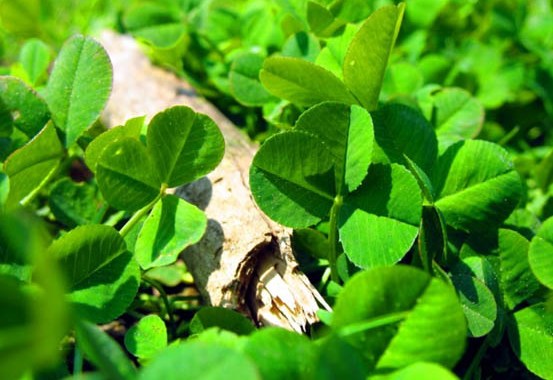
Ten Green Tips to Save Some “Green” as You As You Wear the Green

With St. Patty’s Day fast approaching it won’t be too long until you until are able to get outside to your own little patch of green.  Here are a few tips to make your green even greener.

  1. Tear out some lawn

    Help reduce some of our vast suburban monoculture by removing some of your lawn and planting a garden. Manicured, tended lawns, though beautiful, provide very little habitat for wildlife. And, BTW, your lawns don’t have to be perfect! (see #4 below) An array of green plants in your lawn is perfectly fine.

  2. Create a rain garden

    Plant a rain garden near a downspout to intercept roof runoff.   It will help to slow the flood of storm water, reduce erosion, and absorb pollutants.  Check out the Rutgers Rain Garden Manual or call the Master Gardeners of Mercer County for more info.

  3. Plant a native plant garden

    The birds, bees and butterflies will also repay your hard work by appearing regularly and pollinating your landscape.  And then enjoy the fun of watching wildlife up close. Doug Tallamy’s books are great resources: see The Living Landscape and Bringing Nature Home at Mercer County Library.

  4. Eliminate chemical usage in your yard

    Please, please, please eschew the chemical insecticides and pesticides and herbicides on your property. Not only are these practices lethal to wildlife but it also ends up in your drinking water and our oceans.

  5. Compost!!!

    Start a compost bin in your yard. This is a great way to recycle vegetable and fruit scraps, along with the yard debris. Compost is nature’s gold and you can use it to feed your property the natural way and eliminate those nasty chemicals in the environment.

  6. Apply mulch, more mulch and yet more mulch…

    Your gardens will benefit from the application of mulch in your beds. Lay mulch 2 – 3” deep and allow breathing room around the base of the plants. Mulch will help keep your plantings moist, so you won’t have to water as frequently in dry spells. It will also decompose and add nutrients to your soil.

  7. Tip for Mulching trees

    Although it might seem from Tip 6 that there is no such thing as too much mulch, in actuality, improper mulching can be harmful and you see it all the time around area trees.  Do NOT pile up mulch around the base of your trees. Mulch softens the bark. Mice, insects, and fungus then feed on the living parts of the tree, killing tissue, cutting off water and nutrient supply as well as causing other serious problems that can greatly damage and kill a tree.

  8. Plant a vegetable garden this year!

    Nothing is greener than growing your own healthy, chemical free vegetables. Start some seeds now if you haven’t already and you will soon be ready to move them outside when the snow finally melts and the weather warms.

  9. Use water wisely

    There are a number of things that you can do to reduce your property’s water usage. These include mulching, planting natives, only irrigating when necessary, and harvesting rainwater with rain barrels. If you must irrigate, water your lawns and gardens in the morning to minimize evaporation.

  10. Join the Ewing Community Gardens

    Ewing residents, if you don’t have a large enough property or enough sun, don’t fret. Join the Ewing Community Gardens on Whitehead Rd. Extension. Each plot is approximately 20’ x 16’ and costs $5 for the season. Newcomers to the Gardens can purchase two beginning on March 16th at the Township Clerk’s office. The site boasts a number of amenities including deer fencing, a water supply, a port-a-john, and the companionship of like-minded gardening enthusiasts. For more information contact the Ewing Community Gardens Association at ewingcommunitygardens@gmail.com.

Feel free to add to our suggestions!

Save the Dates – March 5th and 11th for TCNJ’s Environmental Justice Film Series

Semper Fi: Always Faithful

(Co-Producers Rachel Libert, Tony Hardmon, Editor Purcell Carson, 2011)

An award-winning documentary about one man’s fight to reveals a grave injustice at North Carolina’s Camp Lejeune and a looming environmental crisis at military sites across the country.

Introduced and followed by Q & A with the film’s editor Purcell Carson

Date: Thursday March 5th
Time: 7 p.m.
Location: TCNJ Kendall Hall Screening Room


Chasing Ice

 chasingice(Dir. /Producer Jeff Orlowski, 2012)

Acclaimed environmental photographer James Balog travels to the Arctic to capture images telling the dramatic story of the Earth’s changing climate in this celebrated film on the impact of global warming.

Followed by panel discussion with Professors Diane Bates (Sociology) and Michael Nordquist (Political Science and the Bonner Center). Moderated by Professor Janet Morrison (Biology)

Date: Wednesday, March 11th
Time: 5:30 p.m.
Location: TCNJ Kendall Hall Screening Room

Sponsored by the Alan Dawley Center for the Study of Social Justice and the Department of Communication Studies at TCNJ

Eastern Redbud, the March 2015 Tree of the Month

by Ann Farnham, LLA

The Eastern Redbud, cercis canadensis, is among the first trees to bloom here. Blooming occurs in March-April when the buds turn into pink, white, or pink-purple legume-shaped flowers in clusters, depending on the variety, for up to three weeks. This tree is a breath of fresh air after a long and cold winter. The flowers are followed by bean-like seed pods several inches long, which drop from the tree when fully developed.

Redbud, a native deciduous tree, is found in USDA Hardiness Zones 4-9, from New England and the middle Atlantic states, south to Georgia, and to Illinois and Wisconsin in the Middle West.  Ewing is in zone 6b.

The Redbud leaf, from three to five inches long, is heart-shaped and alternately arranged on a zig-zag branching habit, and is reddish-purple when new.  By summer the leaves turn shiny green, but gradually change to yellow in the fall. One variety, ‘Forest Pansy’, has purple leaves. There are, among more than 20 varieties of Eastern Redbud, some with variegated, green and white leaves.

The Eastern Redbud typically ranges from a mature height of 8’ to 20’, depending on the variety, with a spread of 6’-35’.  Some varieties have a weeping habit and this usually small-sized tree normally has multiple trunks. A specimen in Morris County has been documented as having a trunk 8’-2” in diameter, a true “Champion” Tree. Redbud does well in most soils, but not in very wet, poorly drained soil.  It likes full sun or light shade. This tree, used as an ornamental specimen, is best planted young as it does not transplant well.

Diseases do not seem to be a great problem for this beautiful tree, although Canker and Verticillium Wilt do occur. Some caterpillars enjoy the leaves as do Japanese beetles, borers and web-worms. Regular watering, pruning out dead branches, and fertilization help keep Eastern Redbud healthy.

Another name frequently used for Eastern Redbud is “Spicewood Tree”, because in the southeastern mountains of Appalachia the twigs were once used as seasoning for wild game such as venison.

In the past, the bark of the Redbud was used as an astringent in the treatment of dysentery. The flowers can be eaten in salads, or fried. Cardinals, rose-breasted grosbeaks and pheasants, deer and squirrels enjoy the seeds.

2015’s First Electronics Recycling and Document Shredding Event

mciarecycleshredeventThe Mercer County Improvement Authority (MCIA) will hold its first Electronics Recycling and Document Shredding event of 2015 this Saturday, February 7th from 9:00 am – 2:00 pm at the Sun National Bank Center in the City of Trenton[ get directions] .

Electronics Recycling

This is the perfect time to dispose of unwanted computers, monitors, televisions, printers and other electronics.  Computers contain a number of materials that should be reused as well as a number of components that are hazardous in a landfill. Laptops can contain small fluorescent lamps in the screen that contains mercury, and may also use lithium-ion rechargeable batteries. Additionally, CRT computer monitors contain lead, circuit boards may include mercury, lead and cadmium, as well as batteries made of mercury and mercury switches.
Reusable materials include:  plastic, aluminum, copper and gold. Hazardous materials include: mercury, lead and other heavy metals.

Document Shredding

This is also an opportunity to safely and securely dispose of sensitive documents.  This is one of 2 such events held each year by the MCIA.

Date: this Saturday, February 7th
Time: 9 am – 2 pm
Location: Sun National Bank Center in the City of Trenton [ get directions]
Restrictions: Mercer County residents only (proper identification required)