Save the Date! – Living Local Expo on March 28th

The 8th Annual Living Local Expo is in the planning stages!

Sourcing food locally is an essential part of sustainability efforts. Visitors to the 8th annual Living Local Expo in Lawrence on March 28  will have the opportunity to discover the many food resources we have right here in our community. The free Expo will showcase more than a dozen local farm businesses and chefs. The farmers market, the first of the spring season, will feature local fruits and vegetables, meat, cheeses, food and food products.

Visit the farmers market to talk with local farmers about the coming season. Have a locally prepared lunch, soup, chili, bread, cider, fruit and more from local farms and food businesses. Find out about local cheeses, jams and jellies, pickled peppers, desserts, and wonderful flowers. Cooking demonstrations and samplings by local chefs will be offered all afternoon.

After your visit to the market you can check out a presentation on fuel efficient cars and electric bikes.  Area residents with fuel efficient cars will also have their vehicles on display. Walking and biking is the ultimate sustainable transportation, and as a bonus you get your exercise too. At the Expo you can find out about bike trails and walking paths throughout the area.

Newly organized by the Mercer County Sustainability Coalition, a  partnership of sustainability organizations from Ewing, Hopewell, Lawrence, Princeton, Trenton and the Mercer County Office of Economic Development and Sustainability, this year’s Expo will feature hands-on workshops, displays from 90-plus local businesses and non-profits, and the “Ask your Neighbor” table where visitors can hear how homeowners and businesses completed successful energy-efficient projects. Speakers will be on hand to discuss a variety of sustainability issues ranging from local farms, school gardening & projects, to the future of transportation and recycling in Mercer County, and more.

Ask your neighbors about their experiences in green remodeling and energy efficiency projects. Get to know the inside scoop and the incentives that you can still get from New Jersey Clean Energy.

Donate your old bike to The Trenton Bike Exchange, or donate gently used medical equipment to Goodwill Home Medical Equipment, a non-profit that sells affordable medical equipment like wheelchairs, walkers and canes.

This year we are trying to “green” our Green Fair, so don’t forget to bring your travel mug for your drinks.

Stay tuned for more info soon.

New Year Begins with Swearing in of New EGT Members and Officer Elections

The Ewing Green Team began the New Year with the swearing in of two new appointees, Mary Corrigan and Caroline Steward at the January monthly meeting.    In addition, an election of officers was held and the following individuals will serve for the 2015 term.

Co-Chair   – Michael Nordquist
Co-Chair – Joanne Mullowney
Secretary – Mary Corrigan
Membership – Dave Byers
Communications – Mark Wetherbee
IT – Joanne Mullowney

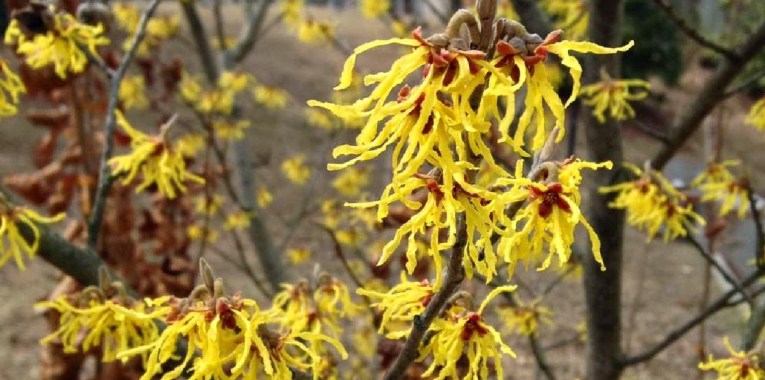
February Tree of the Month — Witchhazel

Hamamelis x intermedia  USDA Zones 5-9

The Ewing Environmental Commission has chosen the Witchhazel hybrid, Hamamelis x intermedia to be the February Tree of the Month. Although this small tree – or large shrub – is not a native (the crossing of Japanese Witchhazel, H. japonica, and Chinese Witchhazel, H. mollis), these two species combined produce a beautiful, fragrantly blooming plant that is outstanding in our winter landscape from late January through mid-March, depending on the weather and location.

Hamamelis x Intermedia can easily be mis-identified as a Forsythia from a distance. The flowers can be clear yellow but depending on the variety, are sometimes orange or reddish, and appear before the leaves. The flowers, 1.5” in diameter, have four ribbon-like, contorted and showy petals which are frost-proof. The fruit, which is a small, dried ½” hairy capsule, matures in the fall and opens to explosively discharge its two seeds a considerable distance. Turkeys, pheasants, cardinals and grouse enjoy Witchhazel seeds.

The bright green leaves are broadly oval and waxy, alternately arranged on zig-zag stems; they usually measure 3-4” long and the edges are toothed. The fall color is outstanding, with orange to red to copper hues. The bark is smooth grey to grayish brown

Hamamelis x intermedia will grow to 15’ to 20’ in height and will be equally broad; it is upright- spreading and will develop an irregular, rounded crown. It can thrive in either full sun or partial shade and is tolerant of poor soils although a well-drained, moist and fertile soil will allow it to thrive. Witchhazel is considered to be a maintenance-free plant, although occasional pruning may help to tidy it up. It is relatively slow-growing.

This small tree is useful in naturalized situations, near large buildings and in shrub borders. It is well suited for Ewing, USDA Hardiness Zone 6 B.

There are many cultivated varieties (CVs) of this plant available, not all of them yellow-flowering, as its characteristics have made it very popular. Most frequently seen varieties are “Arnold Promise’, ‘Jelena’ and ‘Pallida’.

Witchhazel oil extract is used medicinally as an astringent and for soothing sprains and bruises. The flexible wood was once popular for making divining rods, which were employed to detect water sources; the term “witch” is derived from the old English “wice” which meant bendable.

There are very few significant pests or diseases which affect this plant but Japanese beetles are known to enjoy the foliage. Deer do not favor Witchhazel.

Ann Farnham, LLA

Email the Ewing Environmental Commission with your suggestions for the Tree of the Month.

Visioning 2 Event Set for Monday Night – Jan 12th

Dear Ewing Neighbor,

The year 2013 marked the Ewing’s first Sustainable Jersey Bronze certification, a recognized milestone for NJ towns that are forward moving. In 2014, the Ewing Green Team (EGT), working in partnership with Township Administration, wanted to capitalize on that as well as other Township successes by gathering Ewing citizens to look ahead and prepare for coming challenges and to anticipate the many opportunities that await our town  by creating a multi-year vision and action plan for sustainability in Ewing!

On June 7th at the EGT’s first Community Conversation: Preserving Our Past, Transforming Our Future, we began a journey together to thoughtfully chart a course for our future.   That morning was lively and exhilarating and reminded us all why we chose to live in Ewing – wonderful neighbors all working hand in hand to envision the best future for our town.  Led by a pair of sustainability champions from Cherry Hill, we worked to Preserve Our Past, evaluating our township as it currently exists and identifying the aspects of our community that we most valued.  We then envisioned how to Transform Our Future, imagining where we would like our community to be in ten or twenty years.  All of this was to create a shared vision that would form the basis for developing goals and completing actions that move the community toward a more ideal, sustainable community.   As one participant stated:  “I truthfully wanted to skip it when I saw what a beautiful day it was, but I’m so glad that I went!  I think this will be a very beneficial process for Ewing, if it is communicated to and shared with the community.”

During the months following we refined and amplified the suggested actions believed most realistic for Ewing that best reflected citizen ideas.  Now on January 12, 2015 we are pulling the effort together.  Many of you contributed ideas and experiences during 2014.  Now on Monday we invite you back to continue the journey with us and help make the community vision a reality.  Monday night’s program will feature an overview of the highlights of our Sustainability Plan, a fusion of the collective values and aspirations that have been expressed by you all during the Visioning process.  This community wrap-up session will include also break-out sessions where you will be encouraged to further hone specific doable actions, suggest partnerships, additional sub-actions, individuals or businesses to contact, specific educational topics, etc.

Our Sustainability Plan can become a great resource for our town by allowing us to peer into the future and lend shape to the unknown. Together, through the Vision, we have been able to plan for the future of our town with imagination and thoughtful wisdom. We laid the foundation for what Ewing will look like 10 or 20 years in the future including perhaps a Ewing that will make it into NJ Monthly Magazine’s bi-annual Best Cities/Towns to Live, a front porch community where people no longer retreat to their backyards but commune more with their neighbors, where block parties for neighborhoods to come together are common, and a town that is more walkable and bikeable, and one that has more community plantings and more community gardens.  These visions and many more are addressed throughout the Vision Plan.

We invite you to journey with us to the Ewing of the future, as envisioned by you, our neighbors.

The Ewing Green Team

All Conversation documents are located at https://ewinggreenteam.org/conversation-documents.

You may reference the current draft plan at the bottom of the page at: https://ewinggreenteam.files.wordpress.com/2015/01/egt_strategic_plan.pdf.

IMPORTANT: We request that you please REPLY NOW if you are coming, to help us ensure sufficient seating and refreshments.

Date: this coming Monday January 12, 2015
Time: 6:30 – 8:30 pm.
Place: Community Room of the Ewing Senior & Community Center at 999 Lower Ferry Rd.

January Tree of the Month – Douglas Fir

Douglas Fir is a “false fir”, as its botanical name, Pseudotsuga menzesii  implies : pseudo = false, and Tsuga is the genus name for hemlock, which resembles firs. Despite its name, this tree is a handsome, large evergreen, named after David Douglas (1799- 1834), a Scotsman reputed to be the greatest of all botanical explorers.

Douglas Fir is native to the western United States and Canada but now grows all over the country, including Ewing, NJ. It is among the tallest conifers in the world, second only to Coast Redwoods, and has been known to reach 330’ in its native habitat; 40’ to 80’ tall and 12’-20’ in spread is more common, however, and its USDA Hardiness Zone is 4-6 (Ewing is USDA Zone 6b).     It is reported to live more than 500 years in good habitats, and one tree is reported to have survived 1000 years.

The leaves ( needles), are flat and spirally arranged on the stems. The bark is thin, smooth and grey in youth, turning reddish-brown and ridged, with resin “blisters” in maturity; the needles are deep green; it has a resinous, fruity odor. The pendant cones are oval, usually reaching 2-3” long and have long bracts projecting from the scales. The cones persist into winter. The shape of the tree is open-pyramidal with straight, stiff branches. The lower branches in older specimens droop but are retained for a long time.

Douglas Fir does poorly in windy or crowded areas. It needs deep, cool, well-drained, neutral to slightly acid soil, and full sun. It seems to be fairly fire and drought-tolerant. It transplants well balled and burlapped. Be warned, however, that Pseudotsuga menzesii hosts many insect pests and needs monitoring in residential and park landscapes.

This is a very ornamental tree which is outstanding in the landscape as a specimen or in a group. The seeds are important food for mice, voles, chipmunks and squirrels, and the tree is a favorite habitat for many species of birds. The needles are a favorite food for porcupines and blue grouse.   The buds are used to flavor eau de vie and colorless fruit brandy, and it is very popular as a Christmas tree, especially since the needles do not fall easily.

This tree, with its very strong but lightweight wood, yields more timber than any other North American tree: it is used for dimensional lumber, timbers, plywood, railroad ties, furniture, posts, fencing and flooring.

Ann Farnham, LLA

Email the Ewing Environmental Commission with your suggestions for the Tree of the Month.