GREEN BUSINESS RECOGNITION PROGRAM INDUCTS TWO NEW MEMBERS

Ewing Township and the Ewing Green Team inducted two local businesses into the Ewing Green Business Recognition Program on June 14th, bringing the total number of Program members to ten.

Abiding Presence Lutheran Church and Rock Paper Garden, LLC received proclamations from Mayor Bert Steinmann and the Ewing Council, and were lauded for their consistent efforts to improve sustainability and operate with an environmental focus. 

Abiding Presence and Rock Paper Garden have gone above and beyond when it comes to implementing sustainable practices,” Councilwoman Jennifer Keyes-Maloney remarked.  “We are proud to honor their efforts and welcome them to the Ewing Green Business Recognition Program.”

Abiding Presence Lutheran Church Green Business RecognitionAbiding Presence Lutheran Church is well-known around Ewing for the large solar panels that reside on its grounds, which serve as a symbol of the commitment to sustainability shared by its congregation and leadership. With an internal Green Team leading the way, members of Abiding Presence have greatly reduced waste by eliminating one-time-use products with their “Sustainable Hospitality” program, involvement in recycling hard-to-recycle materials, and planting of native flora in their National Wildlife Federation-certified pollinator garden, among many other endeavors.

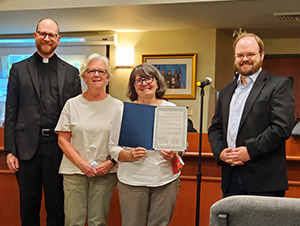
Pictured here receiving the award with Green Team (EGT) Vice-Chair Evan Crumiller (right) are (from left to right) Pastor Miles Hopgood, and APLC Green Team members Sharon Huber and Heidi Furman (EGT member also). APLC Office Manager Karen Lemorvan (not shown) was the driving force in working with Evan on the certification.

Rock Paper Garden Green Business RecognitionRock Paper Garden, LLC is a locally owned and operated landscape design and build firm that has incorporated sustainable practices into many different aspects of its work, including the utilization of energy-efficient double-pane windows, the addition of electric vehicles to its fleet, the installation of rain barrels to capture rainwater for reuse as supplemental irrigation, and finding creative ways to recycle used materials.

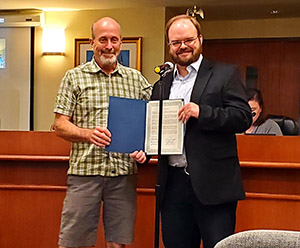
Receiving the award from Evan is Landscape Architect Dan Burke from Rock Paper Garden.  In addition to his work in modeling sustainable business practices, Dan has also devoted many years to serving on Ewing Township Boards and Commissions such as the Planning Board and the Environmental Commission.

Rock Paper Garden and Abiding Presence are terrific examples of the outstanding work so many of our local organizations have done to make Ewing Township a better place to live, both in the present and far into the future,” Green Team member and Program founder Evan Crumiller said.  “They deserve to be recognized for their work, and so we are honored to include them as the newest members of the Ewing Green Business Recognition Program.”

For more information on the Green Business Recognition program, including contact details and applications, please visit ewinggreenteam.org/greenbusiness/.

Proclamations

Abiding Presence Lutheran Church

Rock Paper Garden

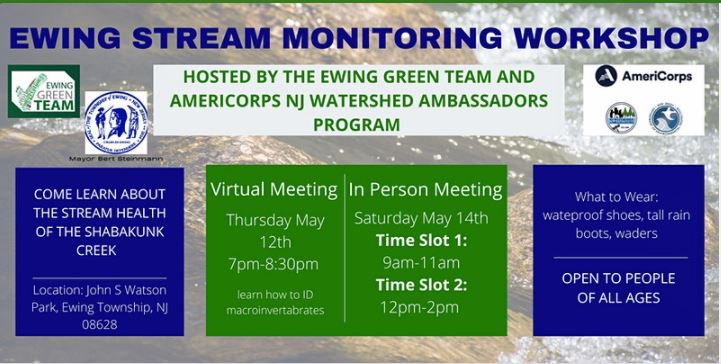
Ewing Stream Monitoring Workshop

Please join the Ewing Green Team and the AmeriCorps New Jersey Watershed Ambassadors Program to determine the stream health of the Shabakunk

About this event

Stream monitoring is critical to understand what is happening in our waterways. Currently, there are gaps in water monitoring data in NJ and environmental non-profits can help to provide a more comprehensive statewide water quality assessment.

Are you interested in being a stream monitor?

The Ewing Green Team is partnering with the NJ Watershed Ambassadors Program and Watershed Ambassadors Amanda Weigand, to host two days of stream monitoring workshops!

Each free workshop will have two parts — one virtual to learn about the process and why assessments are important, and one held outdoors where volunteers will have the opportunity to gain hands-on experience in stream monitoring. In each session, volunteers will learn about the importance of water quality, how water health is impacting the watershed and how to monitor stream health.

Workshop options:

– Part 1 Virtual: Thursday May 12th at 7-8:30 PM

– Part 2 In Person: Saturday May 14th-

Time Slot 1: 9am-11pm

Time Slot 2: 12pm-2pm

The Virtual Workshop is to be attended by all volunteers. A Zoom link will be sent out after registration. Spaces are limited per time slot for the In-Person Workshop. Please sign up for the most convenient time.

For the in-person workshops: Equipment will be provided, but please wear waterproof shoes (or a pair you don’t mind getting wet) or waders/ tall rain boots. You should also bring water, snacks/ lunch, bug spray/ sunscreen, and clothing to suit the weather and being outside. More information on what to bring will be provided upon registration.

Register here.

Mercer County Sustainability Coalition to host Greening Together April 23-30, 2022

Please be sure to check our event website for most up to date details. 

Green Teams from throughout Mercer County are organizing an Earth Week+ celebration in a way that has never been done before. Planned to run from April 23 – April 30, Greening Together is providing a line-up of virtual activities, Zoom presentations highlighting sustainable resources and topics, art education, and safe outdoor activities are the featured activities for all interested in celebrating Earth Week 2022. 

Greening Together provides an opportunity for residents to learn from other local stewards, Green Teams, and experts about best practices for protecting our natural resources and living sustainably. 

There will be many opportunities to learn with events ranging from stream clean-ups and park cleanups, to tree plantings, presentations on climate change, rewilding your backyards, energy tools for homeowners, as well as an energy forum for businesses. Events kick off outside on April 23rd and 24th, with stream cleanups throughout the County conducted in partnership with The Watershed Institute, as well as local park cleanups.  These clean-ups give the ultimate gift to our parks — our time, love, and care. If you can’t participate in a cleanup, residents are still encouraged to get out and enjoy Mercer County’s beautiful open spaces and pick up a piece or trash or two should you see it.

On Sunday afternoon, we start of the virtual part of our week-long program with a look a climate change by C-Change Conversations who collaborated with scientists and energy and policy experts to develop their C-Change Health Primer. It is widely hailed as an intelligent, dispassionate introduction to and illumination of climate change. It is followed up on Monday night with the Ewing Green Team’s featured speaker presentation on approaches for rewilding your landscape and welcoming nature back to your own backyard.

On Tuesday morning, the Mercer County Office of Economic Development and the Office of Planning will host a Business Clean Energy Forum at the Boathouse at Mercer Lake in West Windsor. Wednesday night we invite you to Join staff from The Watershed Institute as they use local Lawrenceville examples to discuss issues associated with stormwater runoff and flooding in Plant Power: Preventing and Fixing Stormwater Problems with Plants. Then learn how, when used correctly, plants can not only manage but also prevent water problems 

Thursday night the Hopewell Valley Green Team & Lawrence Green Team join together to give you a virtual presentation on an overview of selected energy tools to enhance your home’s efficiency. On Friday we’re back to in-person gatherings as we celebrate Arbor Day around the County. Enjoy an Early morning Bird Walk at Fiddler’s Creek, learn what you can do to protect our trees from the Spotted Lantern Fly at the Lawrence Nature Center, and/or attend a Tree Planting and Meadow Walk also at the Lawrence Nature Center.

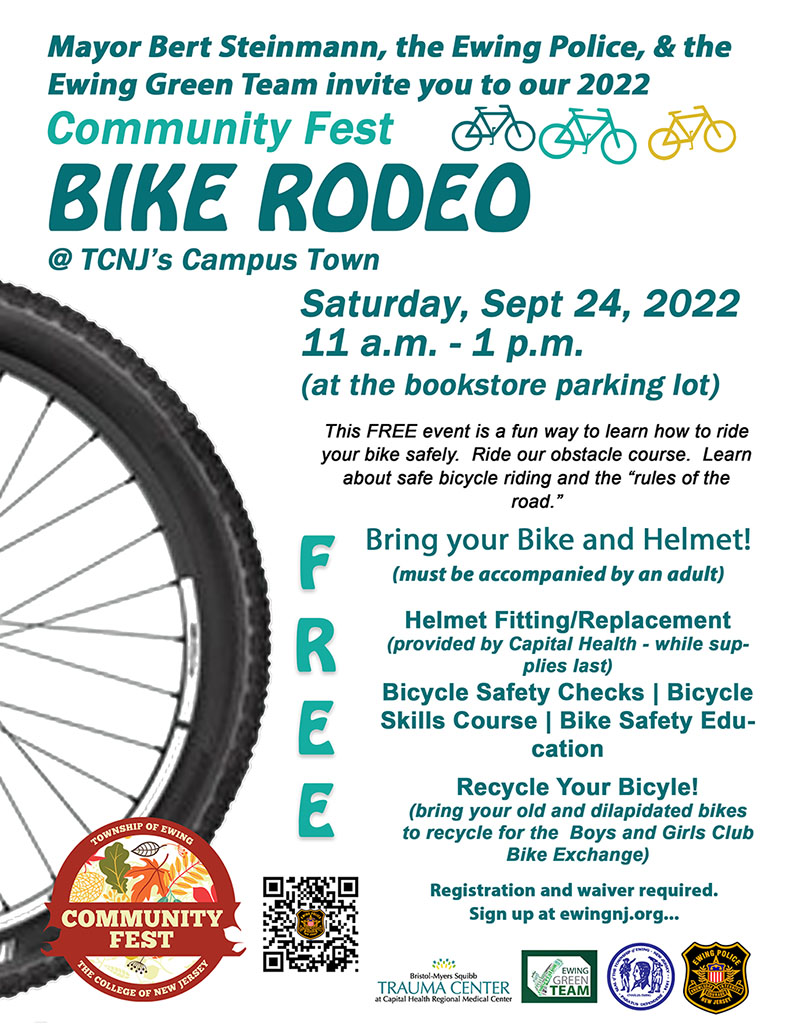
For our grand finale, on Saturday, we offer a combination of in-person events in communities around the county, as well as our Green Get Together at Lawrence High featuring a Bike Rodeo, an Electric Vehicle Meet-up, composting demo, a demonstration on how to make reusable bags from old t-shirts, and much more. All events are free.

Learn more at Greening Together 2022 | Mercer County Sustainability Coalition (mercersustainabilitycoalition.org).  We think that there’s something for everyone, so come on out, enjoy the spring weather, while you learn how to live a greener, healthier life.

Rediscover the Night

International Dark Sky Week April 22 – 30

Have you ever vacationed or visited a remote or rural destination and wondered why you felt particularly refreshed or rested afterwards?  Have you marveled at the starry skies and thought to yourself “Why are the stars so much brighter here?”  Have you wondered why it has become the norm to leave outdoor lights on through the night and so endanger not only our own nighttime heritage, but also cause serious environmental consequences for humans, wildlife, and our planet?

Help make a difference. Turn out your lights and encourage your friends and neighbors to do the same. Join the Ewing Green Team in addressing this issue during International Dark Sky Week (April 22nd – 30th) and every night and help to reclaim our nighttime heritage.

Light Pollution Matters

The nighttime environment is a crucial natural resource for all life on Earth, but the glow of uncontrolled outdoor lighting has hidden the stars, radically changing the nighttime environment.

Before the advent of electric light in the 20th century, our ancestors experienced a night sky brimming with stars that inspired science, religion, philosophy, art, and literature.  The common heritage of a natural night sky is rapidly becoming unknown to the newest generations. In fact, millions of children across the globe will never see the Milky Way from their own homes.

We are only just beginning to understand the negative repercussions of losing this natural resource. A growing body of research suggests that the loss of the natural nighttime environment is causing serious harm to human health and the environment.

Light Pollution Threatens Wildlife

For billions of years, life has relied on Earth’s day-night rhythm to govern life-sustaining behaviors. It’s encoded in the DNA of all plants and animals. Humans have radically disrupted this cycle by lighting up the night. Research shows that artificial light at night has negative and deadly effects on many species.

Sea turtles live in the ocean but hatch on the beach at night. Hatchlings find the sea by detecting the bright horizon over the ocean. Artificial lights can draw them away from the sea, stranding them on land. In Florida alone, millions of hatchlings die this way every year. Many insects are drawn to light, but artificial lights can create a fatal attraction. Think of the fireflies that used to dance around by the millions on lawns in our youth.  Or even the bug-splattered windshields of our cars that traversed the nights.  Where are they now? 

Declining insect populations negatively impact all species that rely on insects for food or pollination. Nocturnal mammals sleep in the day and are active at night. Light pollution disrupts their nighttime environment.

Artificial lights also endanger many bird species. They can disrupt the migratory schedules of birds causing them to leave too early or too late in the season, missing ideal conditions for nesting. Birds that navigate by moonlight and starlight can wander off course. Millions die every year by colliding into illuminated buildings.

Light Pollution Threatens Human Health

Humans are not immune to the negative effects of light in their nighttime spaces. Excessive exposure to artificial light at night, particularly blue light, has been linked to increased risks for obesity, depression, sleep disorders, diabetes, and breast cancer.

Light Pollution Wastes Energy and Money

In the U.S. alone, there are about 162 million public and commercial outdoor light fixtures including:

  • 45 million streetlights,
  • 52 million parking-lot lights,
  • 62 million lights on commercial buildings.

Residential outdoor lighting isn’t as bright, but there’s a lot more of it — about 1 billion light fixtures.

Lighting consumes lots of energy. In an average year in the U.S., outdoor lighting uses some 120 terawatt-hours of energy, mostly to illuminate streets and parking lots. That’s enough energy to meet New York City’s total electricity needs for 2 years! Excessive light at night causes light pollution and unnecessary greenhouse gas emissions, contributing to climate change.

So, let’s stop wasting so much energy! With so much lighting, even modest efforts to control outdoor lighting saves money, reduces carbon emissions, and helps the environment. We do need some light at night, but much of it is wasted by lights that are overly bright or left on when not needed. Unshielded fixtures waste the most energy. Their light shines upward, instead of down on the ground where it’s needed. At least 30% of outdoor light is wasted. That adds up to $3.3 billion and the release of 21 million tons of CO2 per year! To offset all that CO2, we’d have to plant 875 million trees annually.

But Don’t We Need Nighttime Lighting for Safety & Security?

There is no clear scientific evidence that increased outdoor lighting deters crime. It may make us feel safer, but it does not make us safer. The truth is bad outdoor lighting can decrease safety by making victims and property easier to see.

Glare from overly bright, unshielded lighting creates shadows in which criminals can hide. It also shines directly into our eyes, constricting our pupils. This diminishes the ability of our eyes to adapt to low-light conditions and leads to poorer nighttime vision, dangerous to motorists and pedestrians alike.

What Can Be Done?

The EGT is regularly asked: “What can I do to make a difference?” Well, here is one way that you can make a contribution.  The good news is that light pollution is reversible, and its solutions are immediate, simple and cost-effective. Here are a few simple things you can do to confront the problem and take back the night:

  • Check around your home. Use only fully shielded, dark sky friendly fixtures for all outdoor lighting, so lights shine down, not up, to minimize “light trespass” beyond your property lines.
  • Use only the right amount of light needed. Too much light is wasteful, harms wildlife and creates glare.
  • Install timers and dimmer switches and turn off lights when not in use. If you must have security lighting, use motion sensors.
  • Use only lighting with a color temperature of 3000K and below. This means that there is less blue (cool) light that is more harmful to many animal species.

Check out this resource page on outdoor lighting basics.

Talk to neighbors. Explain that poorly shielded fixtures waste energy, produce glare and reduce visibility. Work with your local governments to ensure outdoor lighting isn’t harming the wildlife in your area.

Become a Citizen Scientist with Globe at Night and document light pollution in your neighborhood and share the results. Doing so, contributes to a global database of light pollution measurements.

[Resources and background materials for this article come from The International Dark Sky Association, a 501(c)(3) non-profit organization based in Tucson, Arizona. For 25 years, it has advocated for the protection of the nighttime environment and dark night skies by educating policymakers and the public about night sky conservation and promoting environmentally responsible outdoor lighting. More information about IDA and its mission may be found at http://www.darksky.org.]

Landscape Tips for Rewilding Your Backyard

Join the Ewing Green Team on Monday night, April 25th at 7 pm for a fascinating look at design aesthetics and principles for planting native trees, shrubs and perennials on your property to make it more welcoming to wildlife.

landscapetipsflyerweb

According to renowned entomologist Doug Tallamy[1], a minimum of 70% native biomass is required to safeguard wildlife habitat, support biodiversity, and mitigate the effects of climate change.  How to meet that minimum threshold in our own small suburban backyards is the challenge, especially in heavily developed areas.   Plant a tree, rip out some lawn, install a rain garden, the options are plentiful.  But where to start?  Don’t let the choices overwhelm you.  In this webinar Nick D’Amato, Environmental Designer, Ornamental Horticulturalist, and owner of Gino’s Nursery in Newtown, PA, will share some approaches for rewilding your landscape and welcoming nature back to your own backyard.

Presenter: Nicholas D’Amato is the founder and owner of Gino’s Nursery, specializing in the growing and sales of plants native to the Mid-Atlantic region. Nick graduated from Delaware Valley College with a degree in Ornamental Horticulture and Environmental Design. While there he developed a strong passion for ecological restoration. Armed with a growing awareness of the need for native plants and the scarcity of availability he founded Gino’s Nursery to address the issue. Starting with only 10 species of Native plants they now grow and sell over 500 species and cultivars catering to both the homeowner and the wholesale trade.   And, it is close to Mercer County!!

This program is a part of the Mercer County Sustainability Coalition’s Greening Together, offering in-person and virtual events in celebration of the environment between Earth Day and Arbor Day.

Get started with rewilding your backyard by planting some natives! Take advantage of our Native Plant Sale – Offered for sale by Gino’s Nursery. Orders accepted through Wednesday, April 27th. Delivered to the Green Get Together on Saturday, April 30th (10 am – 1 pm). Click here for a printable flyer in PDF format.

Date: Monday, April 25th
Time: 7 pm
Location: Live virtual
Cost: Free and open to the public

(Pre-register here/Join on the day…)

[1] Bringing Nature Home, et al., Douglas Tallamy