Build Your Own Rain Barrel at Our October Workshop and Save Water and Money

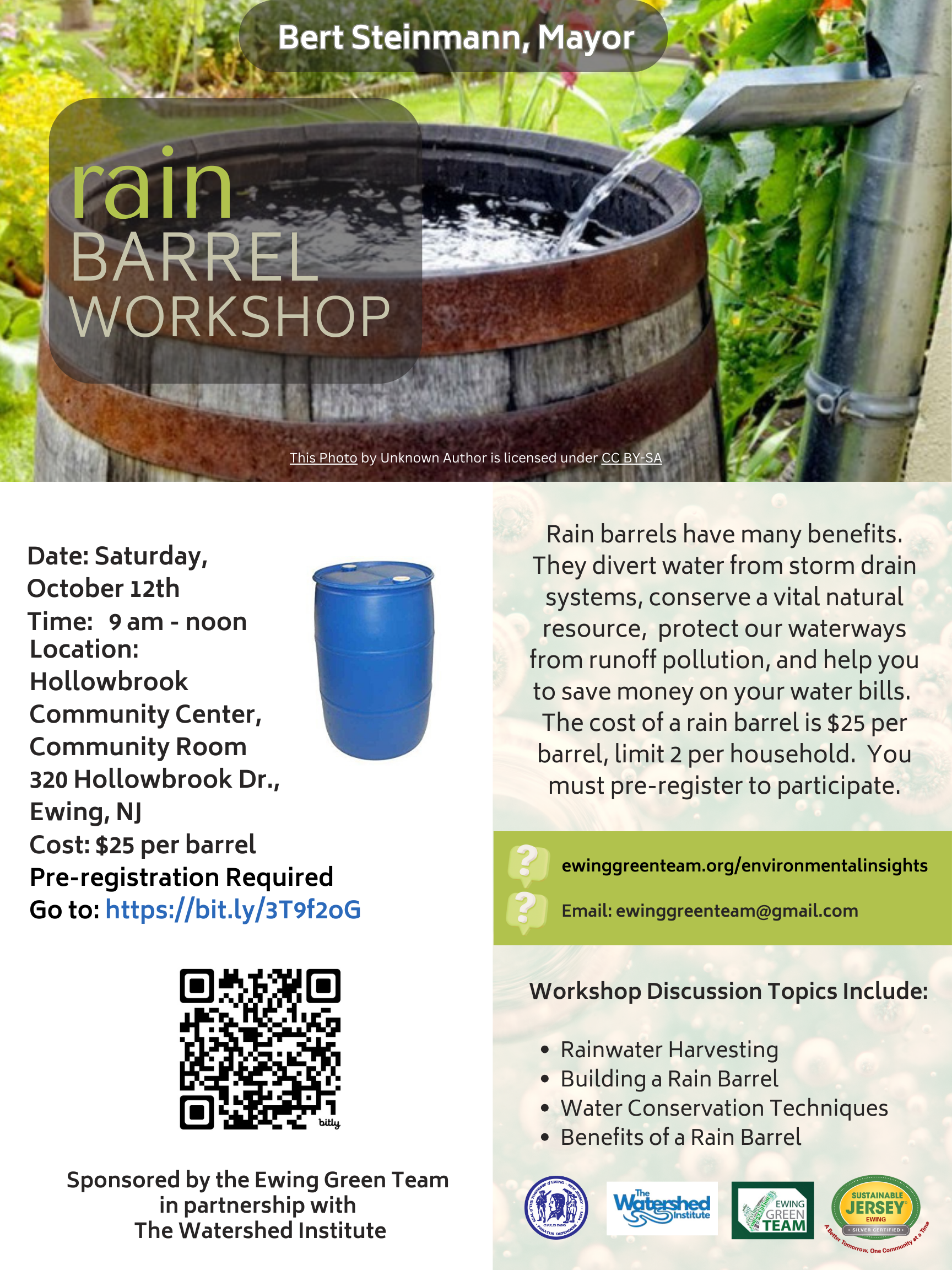
We invite you to learn more about water conservation and how to harvest rainwater from your roof and divert it for on-site usage in the landscape at out October 12th Rain Barrel Workshop.  The Ewing Green Team, in partnership with The Watershed Institute in Pennington, will teach you how to build a rain barrel at the workshop.  The program will be presented by Olivia Spildooren, River-Friendly Coordinator at The Watershed. The fee for the program is $25.  We have obtained 20 free food grade barrels while has enabled us to offer this program at a bargain price.  Registration is limited so be sure to register early.   The workshop will run approximately 2 hours.  Sign up here.

Event: Rain Barrel Workshop
Dates:  Saturday, October 12th
Time: 9 a.m. – Noon
Location: Hollowbrook Community Center, Community Room, 320 Hollowbrook Drive, Ewing, NJ 08638
Cost: $25 per rain barrel
Pre-register: https://bit.ly/3T9f2oG

Installation of rain barrels in your yard will enable you to take an active role in reducing flooding and pollution in local waterways.  Install rain barrels under your gutter’s downspout to harvest rainwater from your roof. Each rain barrel holds approximately 50 gallons. You can install them singly on hook them up in tandem to reserve even more water. Use the water to save money and save water when you irrigate your gardens with it during times of low rain.  In case you miss the workshop or are unable to attend, rain barrels are also for sale at local garden centers for approximately $100, give or take.
Plant for Pollinators: National Pollinator Week (June 17 – 23, 2024)

Every garden matters and can make a difference in our world of threatened ecosystems and loss of biodiversity.  The Ewing Green Team created “Wild About Ewing” in 2018, an initiative in pursuit of certifying Ewing gardens with the National Wildlife Federation to support wildlife.  Through this program, the Green Team encourages all Ewingites to create gardens that are more than just personal sanctuaries, but also refuges for birds, bees, toads, frogs, and many other small creatures with whom we share this world.  Refuges where they can find a home that offers food, water, cover, a place to rear their young.  Places that are free of unhealthy chemicals. If you are doing this, you are gardening for wildlife.

During National Pollinator Week we are reminded of the need to provide food and habitat for our threatened pollinators.  These include bees, butterflies, beetles, moths, wasps, flies, and even the birds, mammals, amphibians and reptiles that also assist with pollination chores.  This need is critical because of the essential role these pollinators play in producing many crops.  The sharp decline in their numbers is due to habitat loss, pesticide use, and climate change.

Things You Can Do for Pollinators

  1. Plant native plants (trees, shrubs, perennials, ground coves…) for pollinators. Use plants that provide nectar and pollen sources. 
  2. Eliminate or reduce the use of pesticides.
  3. Provide a water source.  Wildlife needs clean water to survive.  It need not be large.  Backyard ponds, bird baths, and puddles have immense value to creatures always looking for a clean, reliable source of water.  
  4. Plan out your garden to establish continuous bloom throughout the growing season so that there is food throughout the growing season.
  5. Help pollinators to find your garden by creating large swaths of color of native or non-invasive plants.
  6. Plant true native species.  Avoid cultivars as they are bred for our pleasure, not that of our pollinators and other insect friends.  Changing a native plant’s bloom period, color, fragrance, or flower shape could have serious detrimental effects on the hummingbirds, bees, butterflies, and other wildlife that may use that plant.  Cultivars also lack the genetic diversity that will enable them to best adapt to changing environmental conditions.
  7. Harsh weather and predators are constant threats to wildlife. Cover, such as rock or brush piles, evergreens, snags, and even man-made birdhouses and butterfly houses, all provide needed protection and places to nest.  Pollinators and wildlife need wild areas. 

If you too are alarmed about the extent of this crisis, we invite you to join us in being “Wild About Ewing” and gardening for pollinators this week and every week.  To learn more, you can contact the Green Team at ewinggreenteam@gmail.com