
Fill Your Landscape with Native Plants to Sustain Our Native Wildlife
April is officially Native Plant Month, and the Ewing Green Team is committed to increasing awareness of the critical role that native plants play in supporting a healthy environment and thriving wildlife populations. During this month, and every month, we encourage you to learn about the benefits to our local ecosystems gained by planting native trees, shrubs, and perennials that support bees, birds, butterflies, and all wildlife.
What could be better? Native plants are underrated beauties that, once established, weather the vicissitudes of climate change better than non-natives. They generally have deeper root systems, which can search down for water in times of drought such as we are experiencing now. They also anchor in and absorb stormwater runoff during times of excess rain, all while offering support in terms of food, cover, and shelter to our declining wildlife populations. They require fewer artificial inputs: no fertilizers, pesticides, and herbicides, no soil amendments, and limited watering. Finally, they offer a truer enjoyment of the natural world as we experience not only its beauty but also a deeper connection to nature as we observe our landscape used as habitats. We urge you to plant natives because wildlife matters and is worth protecting.

What exactly are native plants? And why are they important?
Plants are considered to be native to an area where they occurred naturally over time and developed symbiotic relationships with insects and other wildlife that have evolved with them. Since evolution is not a quick process, this means over hundreds, or even thousands, of years in a particular area or region. Only plants found in this country before European settlement are generally considered to be native to the United States. And, plants that are native to other areas of the country such as the west or northwest, California… may be native to the United States, but are not considered to native to our area in New Jersey. Some plants may have a very wide native geographic range, and others may be much more limited. When selecting plants for your garden, it is important to pay attention to their native range and to choose plants that are native to our Central Jersey area.
Did you know that New Jersey is home to over 3000 species of native plants (as defined by the New Jersey Native Plant Society), offering tremendous variety as well as diversity of habitat and sustenance to the critters that evolved alongside with them? Mercer County also has its own unique set of plants defined as native to the county.
Since New Jersey’s animals, insects, and microorganisms have evolved in conjunction with our regional gasses, ferns, wildflowers, shrubs, and trees, they have developed symbiotic relationships and depend upon each other for their survival. Our native plants will attract and feed birds, bees, butterflies, small mammals in your yard and you can feel good about sustaining the food web in the habitat they need to survive.
So, how to choose
While our NJ natives always provide sustenance for some wildlife, there are some that provide special ecosystem value for their relative biomass, supporting the greatest number of wildlife species. They are called keystone native plants and are critical to the food web, and necessary for many wildlife to complete their life cycles. Every region of the country has different native plant communities. (Here in Ewing, we are in the Eastern Temperate Forests, Ecoregion 8. )

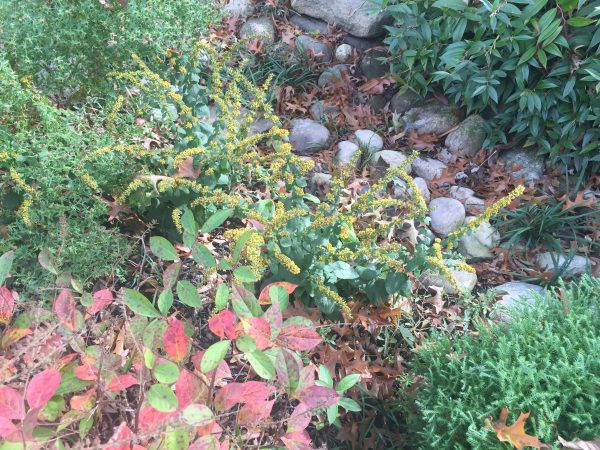

If you have the room, you will get the biggest wildlife bang for your buck by planting a tree, particularly oaks. The Red oak (Quercus rubra) is NJ’s state tree and is particularly beautiful, but there are numerous oaks that are native to our state that provide great wildlife value. The Northern red oak grows up to 100 feet tall and is a good choice for a street tree because it is salt resistant. Oaks in general support over 436 species of caterpillars alone. Willows (in the shrub category) support 289 species. And then there are the flowering perennials. Top among them are the goldenrod and asters, Black-eyed Susans, and more. This author particularly loves the perennials that flower later in the season as they support butterflies and other insects as they begin their fall migrations, or prepare for the winter hibernation.
Members of the team will regale you with their favorites during the coming weeks. Through our promotion of Native Plant Month, Ewing and its citizens can engage and make a difference in our home landscapes. As invasive species overrun more and more of both our cultivated and wild spaces, native species that support local biodiversity play an increasingly important role. We ask that during Native Plant Month you start to dedicate some space, whether it be a container, your patio, or yard to make a difference and sustain our wildlife.


 Sustainable Ewing Green Team