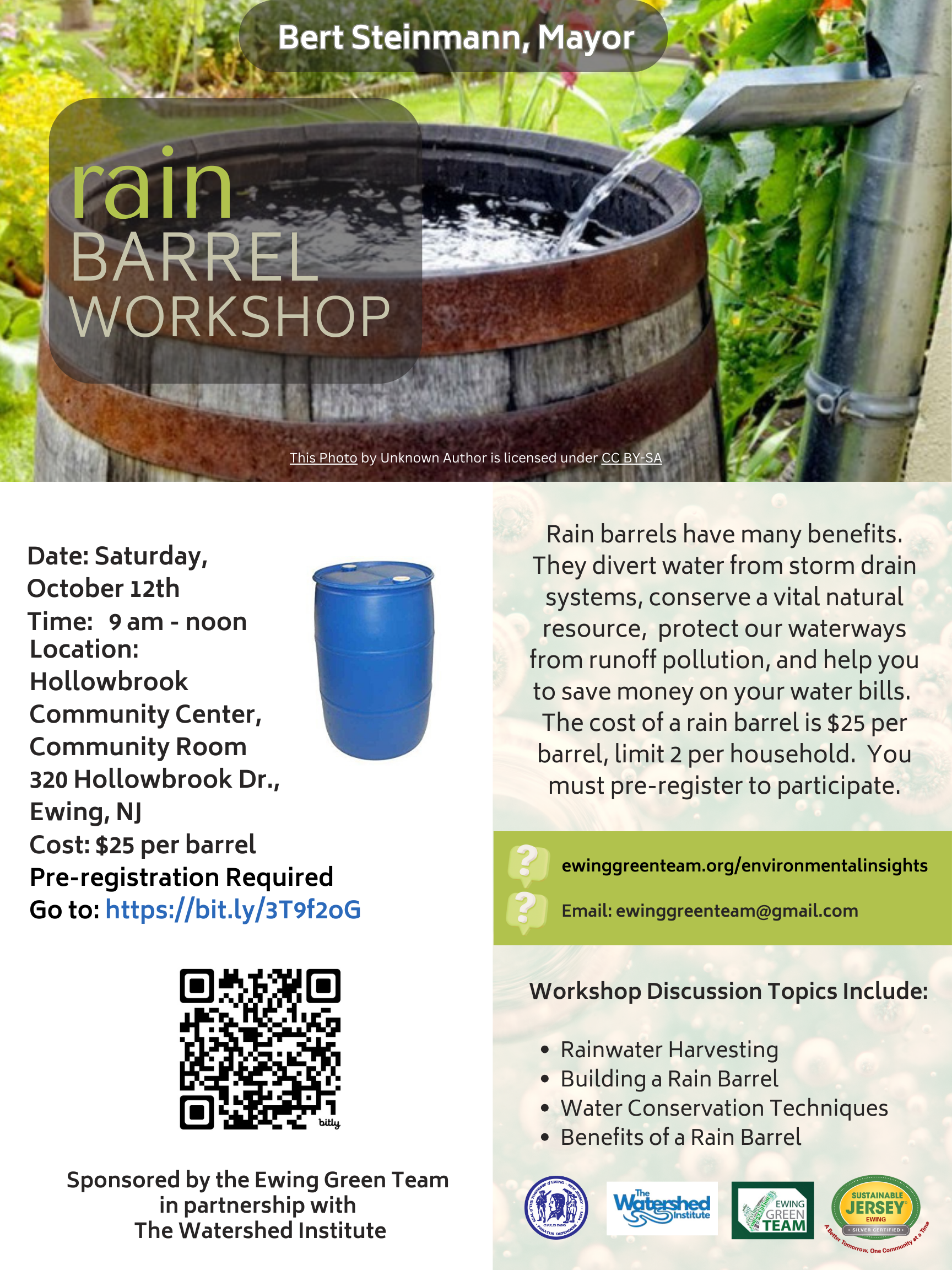
We invite you to learn more about water conservation and how to harvest rainwater from your roof and divert it for on-site usage in the landscape at out October 12th Rain Barrel Workshop. The Ewing Green Team, in partnership with The Watershed Institute in Pennington, will teach you how to build a rain barrel at the workshop. The program will be presented by Olivia Spildooren, River-Friendly Coordinator at The Watershed. The fee for the program is $25. We have obtained 20 free food grade barrels while has enabled us to offer this program at a bargain price. Registration is limited so be sure to register early. The workshop will run approximately 2 hours. Sign up here.
Event: Rain Barrel Workshop Dates: Saturday, October 12th Time: 9 a.m. – Noon Location: Hollowbrook Community Center, Community Room, 320 Hollowbrook Drive, Ewing, NJ 08638 Cost: $25 per rain barrel Pre-register: https://bit.ly/3T9f2oG
Installation of rain barrels in your yard will enable you to take an active role in reducing flooding and pollution in local waterways. Install rain barrels under your gutter’s downspout to harvest rainwater from your roof. Each rain barrel holds approximately 50 gallons. You can install them singly on hook them up in tandem to reserve even more water. Use the water to save money and save water when you irrigate your gardens with it during times of low rain. In case you miss the workshop or are unable to attend, rain barrels are also for sale at local garden centers for approximately $100, give or take.
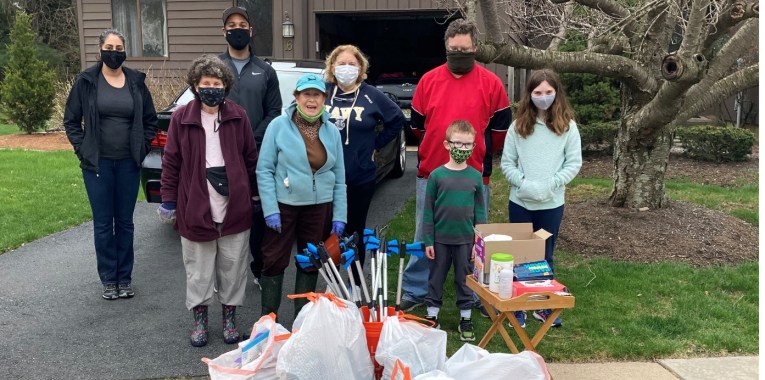
Just over a week ago on a cold and damp Saturday morning on April 13th, the Green Team, Environmental Commission, and The Watershed Institute partnered to perform a cleanup of the Shabakunk Creek at Ewing’s Hollowbrook Community Center and its environs. This event was a part of a Stream Cleanup held every spring where volunteers from local municipalities come together to remove trash and debris from our local waterways to protect and preserve essential wildlife habitat, safeguard our water quality, help control flooding, and engage the citizenry in the beautification and care of our local environment.
This marks The Watershed’s 18th annual cleanup in local watersheds and the 5th in which Ewing participated. Over the past decade, 8,700 enthusiastic volunteers have removed more than 152,000 pounds of trash from our communities.
Our haul this year totaled 1855 pounds of trash, removed by the 56 volunteers who braved the cold and drizzle. The most commonly found items included cardboard, glass bottles, and plastics. Special finds this year were air conditioner parts, a rusty bike, deer stand, lots of concrete (construction) waste, a mailbox, trash cans, a car bumper, bike crossing road sign, seed spreader, seat cushion, half of a ninja blender, a traffic cone, and chicken wire fence.
Ewing had the most pounds of trash collected for that first weekend of cleanups and we ranked 2nd in the number of volunteers who braved the cold and rain. We thank everyone who so generously gave of their time at this event: local students, scout groups, corporate groups, families and, of course, our friends at The Watershed for organizing this once again and including us in this critical effort in watershed protection.
About The Watershed Institute
The Watershed Institute is a non-profit organization committed to keeping water clean, safe, and healthy. They wok to protect and restore Central New Jersey water and natural environment through conservation, advocacy, science, and education.
As the need to be more environmentally conscious becomes more and more apparent, Ewing’s Riverside Townhomes, a small development of townhomes off River Road, has taken conscious steps to lessen the impact that they have on the environment in their little corner of Ewing. Their decision to “go green” has not only improved connections between neighbors in their community while making positive impacts on the local environment, but also helped them “save green” over the long term. So how have they accomplished this? Here is an overview of their process and some green HOA practices that you can adopt in your HOA to become more eco-friendly.
It Starts with A Proposal
In March of 2021, Riverside Townhomes resident and HOA Board Member Priya Vimalassery (and Ewing Green Team member) created the attached Riverside Sustainability Proposal and presented it to the HOA Board at a meeting. The Board was supportive and asked for volunteers to form a Green Committee. Three community members at the meeting volunteered and, along with Priya (as the Board liaison), created the basis of the new committee. The Riverside Green Committee has been meeting monthly ever since. After they got started, the Board voted to formally establish the committee and its members. Every Board meeting (every other month) the committee reports on their activities.
Their objective was thinking about and engaging in more sustainable practices in their townhouse community. They are focused on meeting a number of the sustainability goals outlined in the Sustainability Proposal. These included items that not only benefit the environment, but also would help the HOA save monies.
Tree Plantings
One of the best ways to go green is to plant green – trees, that is. Not only are they aesthetically pleasing, increase property values, and provide desired shade, the environmental benefits from trees are enormous. They provide oxygen, remove carbon dioxide from the air, reduce storm water runoff, and support wildlife by providing food and shelter. The Green Team also planned on replacing any lost trees with native trees and determining if there are any other areas where tree planting would be beneficial to the community aesthetic.
Native Plantings
They also have committed to incorporating native plants into common area garden beds. This is another area where there are dual benefits. Native plants are particularly well adapted to local environmental conditions and require far less water, saving time and money, and are more likely to thrive. They also provide vital food and habitat for various species of wildlife, including our precious pollinators that are essential for growing many crops in New Jersey. As stated in the proposal, “if planned properly using perennial native plants, … garden beds could look beautiful with minimal maintenance while also decreasing costs.”
Sustainable Landscaping Vendor
The proposal also identified another potential money-health-environment saving strategy, committing to hire a landscaping vendor who employs sustainable practices when their current landscape contract ends, and they put the service out for bid. These include using battery-powered equipment rather than gas-powered equipment to reduce air and noise pollution. Someone who will forgo the application of harmful chemicals – the pesticides, herbicides, fertilizers, which are harmful to both humans and the environment. Who also ensures the use of nontoxic mulch, as the source of wood chips used in colored bark mulch can be contaminated with toxic substances.
The proposal further addresses the removal of fall leaves as disposing of fall leaves harms the environment and destroys wildlife habitat. Their current plan is to take the next year to encourage residents to leave the leaves in their own yards and then attempt a community-wide adoption of leaving the leaves.
Sustainability in Decision Making
The group aims to make sustainability a priority in HOA decision making. When engaging in any community-wide project, they plan on prioritizing sustainability when considering the viability of the project and determining vendors and materials. To that end, they also pledged to go paperless. By using electronic methods to issue notices, communications, voting, etc. they felt they could reduce the costs and resources associated with conducting HOA business. The proposal identified another area ripe for sustainability improvements – that of sharing information. They agreed to create an online forum to share ideas and explore community and individual homeowner sustainability initiatives such as solar panel acquisition, composting, and gardening practices.
Results that Matter
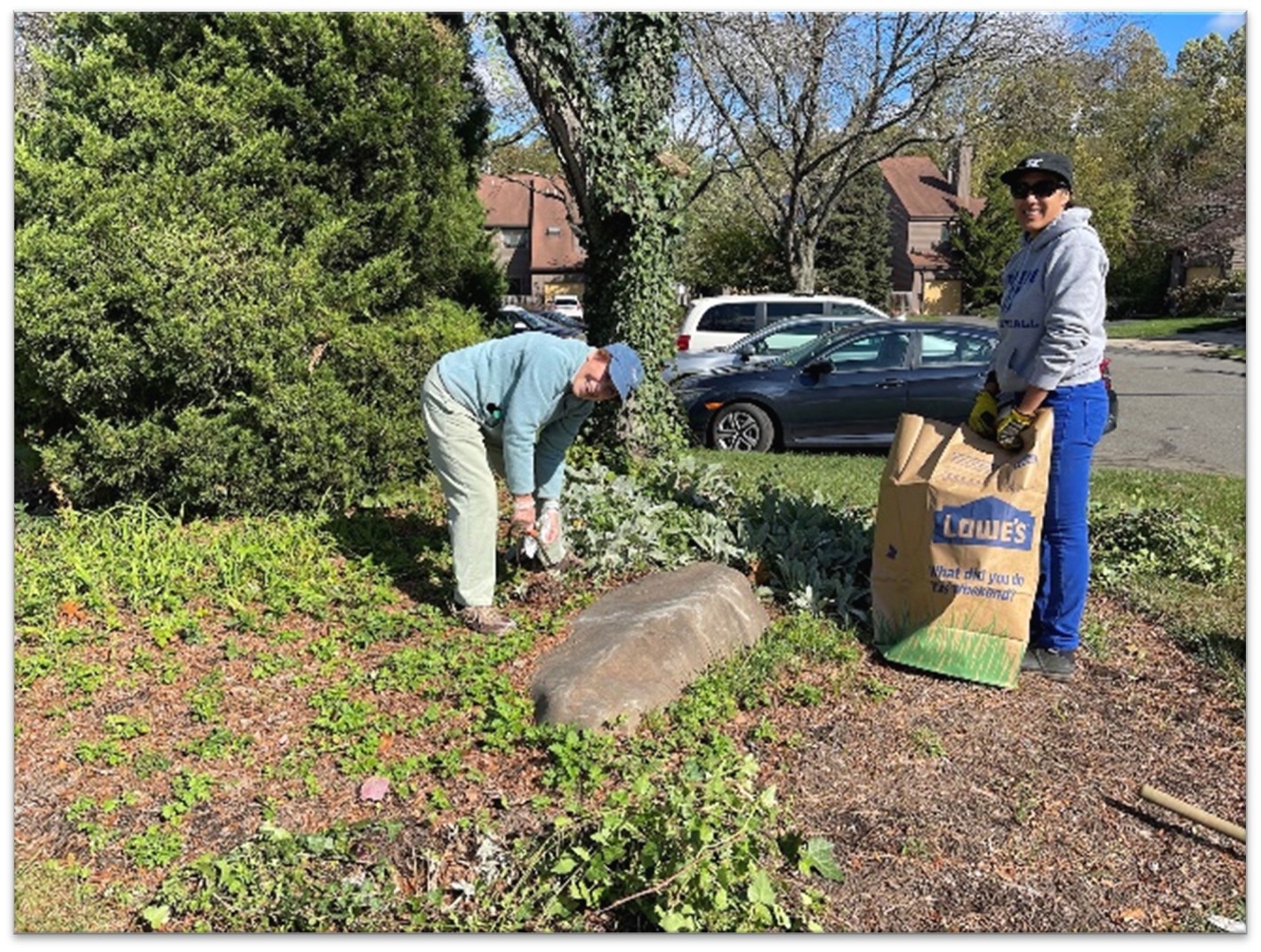
Since the Green Team inception, they have held three community litter clean ups (April 10, August 7, and October 9). They also held two Green Committee litter clean ups, the last one being on November 21 and covering River Road from Lower to Upper Ferry Road. In addition, Green Committee and community members pick up litter on their daily walks.
In another step critical to environmental sustainability, they have begun incorporating native trees and plants throughout the neighborhood and refreshed their first community bed with native plants on October 17.
The Riverside Green Committee credits the HOA Board and wider community with giving them the support they needed without which they could not have made the strides made so far. They are looking forward to continuing their efforts in 2022.
We suggest that that the process followed by the members of this community would serve as a good model for other HOAs in town to follow. All it requires are committed residents interested in playing a role in creating a cleaner and greener HOA community and contributing to a better Ewing. Riverside Townhomes has identified areas in which they decided to prioritize a commitment to sustainability. So, too, could yours. Other suggestions to add to theirs, limiting paper usage, reducing water usage, utilizing eco-friendly landscaping, could include starting a community garden, investing in solar-powered lights, using green construction, and prioritizing recycling to name just a few.
Becoming a green HOA is not necessarily easy or quick. However, the environmental challenges that we face today call for action from everyone. Contact the Ewing Green Team at ewinggreenteam@gmail.com if you would like some help getting started. We encourage you to decrease your community’s ecological footprint and improve the life and health of the residents (including wildlife) of Ewing.


 Sustainable Ewing Green Team