Ride for a Cause: Ewing Fall Spin Bike Tour Benefits Younity

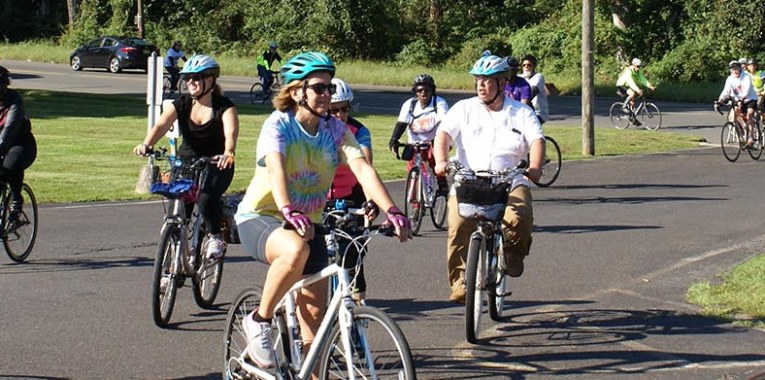
Registration is now open for the 11th annual Ewing Fall Spin bike tour!  Won’t you come ride with us?

The tour, hosted by Mayor Bert Steinmann, the Ewing Green Team and the Ewing Recreation Department  will be on Saturday, October 18, 2025, starting at 8:15 a.m. The event will start and end at Campus Town at The College of New Jersey. All proceeds from this year’s event will be donated to Younity, formerly Womanspace.  “The annual bike tour is a great opportunity to come together as a community, enjoy a morning of exercise and support a great cause,” said Mayor Steinmann. “All the proceeds benefit Younity and will make a real difference for those they serve.”

Individuals or teams, ages 16 years and older, are encouraged to register early. Sign up as individuals or come as a team of friends, family members or co-workers. The Fall Spin registration fee is $15 for students: TCNJ, Rider, & 16-17 year olds, $20 for adults (individuals 18 years or older) and $40 for a Family Plan (3 or more individuals living in the same household 16 years and older). All people registering by October 11th will receive a T-shirt. Register online through CivicRec, fill out and return the registration form or call the Recreation office at 609-883-1776 x 6202 for assistance. Day-of-event registration will begin at 7:45 a.m.  The tour will be escorted by Ewing Police and free bike inspections will be available.

First Time Bike Tour Chairperson, George Steward, shared the following updates:  This year’s 12.5 mile route has been finalized. It will be a leisurely paced ride throughout Ewing Township neighborhoods.  The exact route will be available shortly, but just a quick heads up that we will revisit parts of our very first ride.  Our 2 rest stops this year will be Ewing Town Center (ETC) with a visit to “Hero’s Way” and Ewing’s Benjamin Temple House at Temple Park off Federal City Road. 

“I’ve learned one very important thing so far in my new role. It takes a lot of wonderful people to put this ride together. I want to thank the Township of Ewing, everyone on the EGT Bike Committee, the Ewing Green Team at-large, Ewing Campus Town and our rest stop hosts for their timely help and cooperation with this year’s early planning process.” 

The Ewing Green Team (www.ewinggreenteam.org) was established in 2009 by municipal resolution under the auspices of the Ewing Environmental Commission, and is part of the statewide Sustainable Jersey effort (www.sustainablejersey.com). The Ewing Green Team envisions a township that incorporates sustainability into the actions and decision-making processes of community members and municipal offices to create and maintain sustainable ways of living; builds strong and diverse economic opportunities; and cultivates a community that welcomes people from all walks of life.

For more information on the Ewing Fall Spin, please visit https://ewinggreenteam.org/ewingfallspin, email ewinggreenteam@gmail.com or call George Steward at 609-439-7060. 

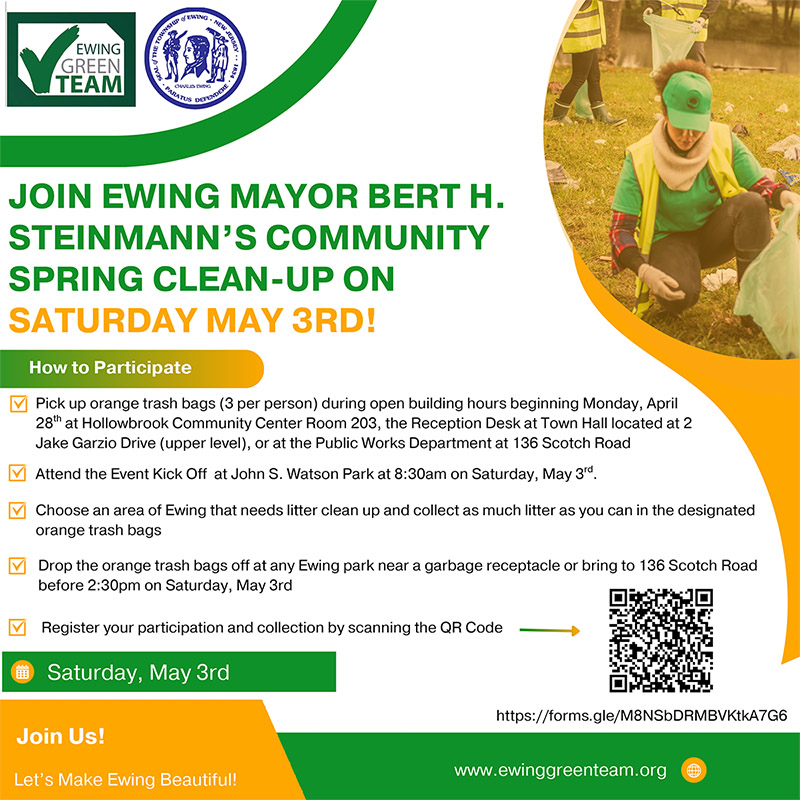
Ewing Joins the Great American Cleanup with a Community Spring Clean-Up Day

Ewing Township is proud to take part in Keep America Beautiful’s Great American Cleanup, the nation’s largest community improvement program. This annual effort brings together millions of volunteers across the country to clean up parks, streets, and neighborhoods—and now, Ewing residents have a chance to get involved locally!

Mayor Bert H. Steinmann invites all residents to join the Ewing Community Spring Clean-Up on Saturday, May 3rd. The event kicks off at 8:30 AM at John S. Watson Park and is part of a larger movement to keep our community clean, green, and beautiful.

Participants can pick up orange trash bags starting Monday, April 28th at three locations:

  • Hollowbrook Community Center (Room 203)
  • Reception Desk at Town Hall (2 Jake Garzio Drive, upper level)
  • Public Works Department (136 Scotch Road)

Each volunteer may take up to three bags. On cleanup day, choose any area of Ewing that could use a little TLC, fill the bags with litter, and drop them off at any Ewing park next to a trash receptacle or at the Public Works Department by 2:30 PM.

Be sure to register your participation and track your cleanup impact by scanning the QR code on the flyer or visiting https://forms.gle/M8NSbDRMBVKtkA7G6.

Let’s come together to show our Ewing pride and help make our town shine!

Rain Garden Design Workshop

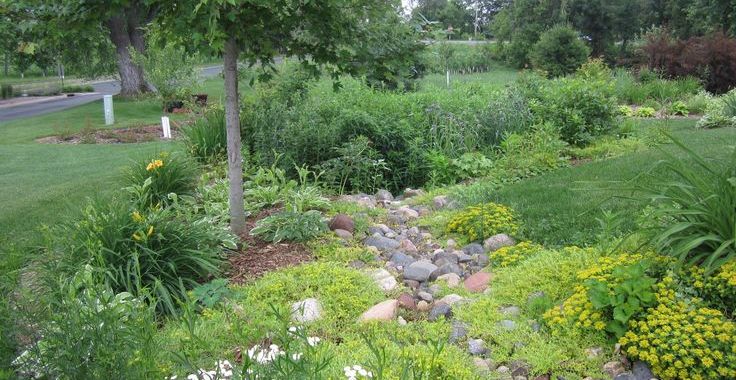
We invite you to join us on Saturday, May 17th for a 2-hour workshop to learn more about the benefits of adding a rain garden to your landscape. You will enhance its beauty, all while improving drainage, and creating a wildlife habitat.

Rain gardens can help us manage storm water runoff from rooftops, driveways, lawns, roads, and other hard surfaces. They look like regular perennial gardens, but they are much more. During a storm, a rain garden fills with water, and the water slowly filters into the ground rather than running into storm sewers. By capturing storm water, rain gardens help to reduce the impact of human activities and pollution in the environment such as road sediment/salt, fertilizers, pesticides, bacteria from pet waste, eroded soil, grass clippings, litter, etc. This helps protect the health of our waterways.  Rain gardens also add beauty to neighborhood and provide wildlife habitat.

In this 2-hour workshop, you can learn how to plan and plant your own rain garden, enhancing your property and your neighborhood, about the stormwater benefits of rain gardens, providing watershed-wide benefits with native plants, and go home with a plant list or draft design for your yard.  Now is the perfect time to plan a rain garden for planting this spring!

Presenters: Olvia Spildooren from The Watershed Institute.   Olivia is the River-Friendly Coordinator

Event Summary

Event: Rain Garden Design Workshop
Date: Saturday, May 17, 2025
Time: 10 am – Noon
Location: Hollowbrook Community Center, Community Room, 320 Holllowbrook Drive, Ewing, NJ 08638
Pre-registration: https://thewatershed.doubleknot.com/event/ewing-rain-garden-design-workshop/3099881

Countdown to Dark Sky Week | April 21 – 28, 2025

Starry skies are a vanishing treasure because light pollution is washing away our view of the cosmos. It not only threatens astronomy but also disrupts wildlife and affects human health. The glows over cities and towns- seen clearly from space- are testament to the billions of dollars spent in wasted energy lighting up the sky.

What is Light Pollution?

It is adding light to brighten the outdoors. It is a fully human made form of pollution. Light pollution disrupts wildlife, impacts human health, wastes money and energy, and contributes to climate change.
In an average year in the US alone, outdoor lighting uses about 120 terawatt-hours of energy, mostly to illuminate streets and parking lots. That’s enough energy to meet New York City’s electricity needs for two years!

Dark Sky International estimates that 30% of outdoor lighting in the US alone is wasted, mostly by lights that aren’t shielded correctly. That adds up to $3.3 billion and the release of 21 million tons of carbon dioxide per year. To offset all that carbon dioxide, we need to plant 875 million trees annually.

How can you help?

• Join us by participating in Dark Sky Week April 21-28,2025.
• Watch the video below and clip on the various links included in the publication to learn more.
• Turn off all unnecessary lighting inside and outside.
• Make sure outdoor lights are properly shielded and direct light down instead of up into the sky.
• Close window blinds, shades, and curtains at night to keep light inside.
• Go outside and enjoy the stars.

It’s April! Celebrate Native Plant Month

Fill Your Landscape with Native Plants to Sustain Our Native Wildlife

April is officially Native Plant Month, and the Ewing Green Team is committed to increasing awareness of the critical role that native plants play in supporting a healthy environment and thriving wildlife populations. During this month, and every month, we encourage you to learn about the benefits to our local ecosystems gained by planting native trees, shrubs, and perennials that support bees, birds, butterflies, and all wildlife.

What could be better?  Native plants are underrated beauties that, once established, weather the vicissitudes of climate change better than non-natives.  They generally have deeper root systems, which can search down for water in times of drought such as we are experiencing now.  They also anchor in and absorb stormwater runoff during times of excess rain, all while offering support in terms of food, cover, and shelter to our declining wildlife populations.  They require fewer artificial inputs:  no fertilizers, pesticides, and herbicides, no soil amendments, and limited watering.  Finally, they offer a truer enjoyment of the natural world as we experience not only its beauty but also a deeper connection to nature as we observe our landscape used as habitats.  We urge you to plant natives because wildlife matters and is worth protecting.

What exactly are native plants? And why are they important?

Plants are considered to be native to an area where they occurred naturally over time and developed symbiotic relationships with insects and other wildlife that have evolved with them.  Since evolution is not a quick process, this means over hundreds, or even thousands, of years in a particular area or region.  Only plants found in this country before European settlement are generally considered to be native to the United States.  And, plants that are native to other areas of the country such as the west or northwest, California… may be native to the United States, but are not considered to native to our area in New Jersey.  Some plants may have a very wide native geographic range, and others may be much more limited.  When selecting plants for your garden, it is important to pay attention to their native range and to choose plants that are native to our Central Jersey area.

Did you know that New Jersey is home to over 3000 species of native plants (as defined by the New Jersey Native Plant Society), offering tremendous variety as well as diversity of habitat and sustenance to the critters that evolved alongside with them?  Mercer County also has its own unique set of plants defined as native to the county.

Since New Jersey’s animals, insects, and microorganisms have evolved in conjunction with our regional gasses, ferns, wildflowers, shrubs, and trees, they have developed symbiotic relationships and depend upon each other for their survival.  Our native plants will attract and feed birds, bees, butterflies, small mammals in your yard and you can feel good about sustaining the food web in the habitat they need to survive. 

So, how to choose

While our NJ natives always provide sustenance for some wildlife, there are some that provide special ecosystem value for their relative biomass, supporting the greatest number of wildlife species.  They are called keystone native plants and are critical to the food web, and necessary for many wildlife to complete their life cycles.    Every region of the country has different native plant communities.  (Here in Ewing, we are in the Eastern Temperate Forests, Ecoregion 8. )  

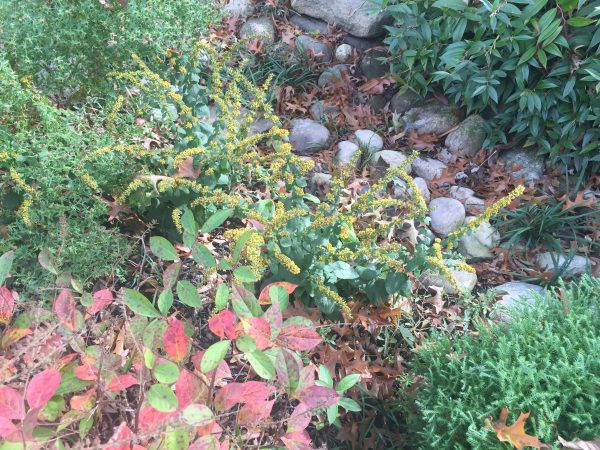
If you have the room, you will get the biggest wildlife bang for your buck by planting a tree, particularly oaks.  The Red oak (Quercus rubra) is NJ’s state tree and is particularly beautiful, but there are numerous oaks that are native to our state that provide great wildlife value.  The Northern red oak grows up to 100 feet tall and is a good choice for a street tree because it is salt resistant.   Oaks in general support over 436 species of caterpillars alone.  Willows (in the shrub category) support 289 species.  And then there are the flowering perennials.  Top among them are the goldenrod and asters, Black-eyed Susans, and more.  This author particularly loves the perennials that flower later in the season as they support butterflies and other insects as they begin their fall migrations, or prepare for the winter hibernation. 

Members of the team will regale you with their favorites during the coming weeks.  Through our promotion of Native Plant Month, Ewing and its citizens can engage and make a difference in our home landscapes.  As invasive species overrun more and more of both our cultivated and wild spaces, native species that support local biodiversity play an increasingly important role.  We ask that during Native Plant Month you start to dedicate some space, whether it be a container, your patio, or yard to make a difference and sustain our wildlife.