Busy Saturday for Recycling – RX Disposal in Ewing and MCIA Hazardous Waste Disposal Day

Two unrelated recycling events will be occurring today, the MCIA’s Hazardous Waste Disposal Day and a drug disposal day.  Please be sure to take advantage of this opportunity to dispose of your recyclables or unwanted prescriptions safely.  Read on for more information.

Hazardous Waste Disposal Day

The MCIA will be running its final Household Waste and Electronics Disposal Day of the year today, September 26th from 8 a.m. – 2 p.m.  It will be held at John T. Dempster Fire School, Lawrence Station Rd in Lawrence Twp.

Accepted for recycling are the following:

Aerosol Cans | Used Motor Oil |Propane Gas Tanks | Pesticides & Herbicides | Car Batteries | Paint Thinner | Oil Based Paint | Stains & Varnishes | Gasoline | Anti-Freeze | Driveway Sealer | Insect Repellents | Mercury | Fluorescent & CFL Bulbs | Computers | Printers | Copiers | Fax Machines | Stereos | Televisions | Microwaves

Materials Not Accepted:

NO LATEX PAINT | NO Heating Oil | NO Infectious Waste| NO Radioactive Materials NO Explosives or Munitions | NO Railroad Ties | NO Asbestos | NO Tires | NO Wood  | NO Fencing | NO Air Conditioners | NO Helium or Oxygen Tanks | NO Unknowns

For Mercer County Residents Only. Only Residential Waste will be accepted, i.e. no Commercial Business waste. Proof of Residency will be required (Driver’s License). For more information call 609-278-8086 or visit WWW.MCIANJ.ORG.


National Take Back Day

drugsThe Ewing Police Department will be participating in the DEA’s biannual National Prescription Drug Take-Back Day  from 10:00 a.m. to 2:00 p.m.    This is a great opportunity for those who missed the previous events, or who have subsequently accumulated unwanted, unused prescription drugs, to safely dispose of them.  Just go to the Ewing Police Department at 2 Jake Garzio Drive.  Enter the main door and make a left to go down the hallway to the Police Department.  The Ewing Police will have an officer available between 10 and 2 to take the items. All medications are accepted, prescription and over-the-counter, as well as liquids.

All medications are accepted, prescription and over-the-counter, as well as liquids.  Hypodermic needles are not accepted.  The disposal is handled completely securely; all accepted medications with any labels that you leave on the containers are placed in a large cardboard box, lined with plastic.  At the end of the day the contents are taken to the prosecutor’s office.  The DEA will pick up and incinerate.

Guidelines for Drug Disposal

If you are unable to participate on the day the FDA’s guidelines for proper drug disposal follow:

Follow any specific disposal instructions on the drug label or patient information that accompanies the medication. Do not flush prescription drugs down the toilet unless this information specifically instructs you to do so.

If no instructions are given on the drug label and no take-back program is available in your area, take them out of their original containers and mix them with an undesirable substance, such as used coffee grounds or kitty litter — to make the medication less appealing and unrecognizable — then put them in a sealable bag, empty can, or other container to prevent the medication from leaking or breaking out of a garbage bag.

You should also remove any identifying information on the label to protect your identity and privacy.

Despite the safety reasons for flushing drugs, some people are questioning the practice because of concerns about trace levels of drug residues found in surface water, such as rivers and lakes, and in some community drinking water supplies. However, the main way drug residues enter water systems is by people taking medications and then naturally passing them through their bodies.  That said, the FDA does not want to add drug residues into water systems unnecessarily. The agency reviewed its drug labels to identify products with disposal directions recommending flushing or disposal down the sink. This continuously revised listing can be found at FDA’s Web page on Disposal of Unused Medicines.

National Take Back Day Information

Date: Saturday, September 26, 2015
Time: 10 a.m. – 2 p.m.
Location: Ewing Police Department, 2 Jake Garzio Drive

Becoming a Leaf Litter Bug: the Ecological Benefits of the Not So Perfect Yard

by Joanne Mullowney

Every autumn we post our Annual Autumn Cleanup article asking readers to rethink the prevailing custom of treating leaves as waste by raking them to the curb for Township pickup. We suggest instead that you channel your inner Environmental Steward by leaf cycling. The benefits of leaf cycling, the practice of hoarding your autumn leaf drop for use in your landscape, are many. They include the retention of raw materials for the compost pile, provision of an insulating winter cover in the garden, soil building, moisture retention, and reduction in the amount of resources our Township puts out for fall cleanup, saving taxpayer dollars. And while you might think that this leaves the yard looking a little less than perfect, less labor may be required as we strive to become Leaf Litter Bugs.

The Benefit of Providing Habitat

The somewhat messy yard contributes yet another important benefit – habitat, not a traditional concern of the average gardener. Did you know that despite its not so perfect look, leaf litter provides an important foraging space for a wide variety of birds, small mammals and insects? Also providing benefit is the untrimmed garden where ladybugs and lacewings reside in native grasses and pollinating bees settle in hollow plant stems. Butterflies and moths winter in chrysalides on the ground and baby spiders hide out amid the decaying plant stems.[1] Birds feed from dried seed heads in winter.

Some wildlife use the leaf litter and other dead vegetation to insulate them from winter’s chill, while others, such as earthworms feed on the litter, breaking it into smaller pieces. Bacteria and fungi in turn convert theses smaller pieces into nutrients which then sustain neighboring plants. They in turn help support biodiversity by becoming food themselves. Toads, beetles, ladybugs and much more also live in your backyard’s leaf litter. Each is an integral part of the food web.

The Challenge

We have a tendency to want to put things in order at the end of the gardening season. Raking up and disposing of our leaves, chopping down dead flower stalks and grasses all contribute to a manicured appearance. So how do you balance a desire to have a not-so-messy yard (and not irritate the neighbors) with the needs of the interconnected web of creatures that provide biodiversity and heretofore underappreciated benefits to your garden?   First you have to realize that you don’t have to let your whole garden go wild; you can start out small. Just leave a section or two untrimmed or start in the backyard. One trick also is to settle the leaves under the branches of your shrubs. Give it a year and your leaf litter will have broken down while providing mulch and increasing the soil’s water retention abilities.

The Winter Garden

In addition, learn to appreciate your winter garden. I highly recommend The Garden in Winter by Suzy Bales to assist you in this task.[2] Light brown native grasses swaying in the wind look beautiful against the snow, as do the seed heads of Echinacea, Rudbeckia and Yarrows which all provide winter forage and are inviting to the birds.

So what to do with those leaves?

You might try a combination of methods. Rake out some of the leaves from the beds that are simply too much and might smother tender plants and cause them to rot over the winter. Add them to the compost pile or the leaf pile on the lawn while the rest remain in the beds. Then take your mulching mower and chop them up into small pieces. (Yes, using gas mowers is considered an unsustainable gardening practice, but consider the greater good.) Rake up most of the chopped leaves and place them back in the garden around shrubs and plants.   Not surprisingly, they are greatly reduced in volume and contribute to a more manicured look. The remainder can stay on your lawn and decompose there. Do this as needed until the end of the season and the leaves will break down over the winter providing your soil with valuable nutrients all the while enhancing habitat.

Then, don’t rush your spring cleanup. Many insects living in your backyard habitat do not emerge all that early. This past year I left the leaves in a large part of the garden undisturbed and they were quickly hidden by emerging vegetation. Some I pulled out and chopped for mulch and put back in the beds. This yielded a combination of leaf litter and mulch. It was fascinating to watch the birds forage in the leaf litter around the shrubs and perennials.

Set yourself a goal of gardening more sustainably by trying to reach a balance between aesthetics and respecting the natural processes occurring in the landscape. After all, Mother Nature doesn’t have anyone carting out leaves to the curb. Our world desperately needs more environmental stewards, eco-gardeners working in harmony with nature and conserving natural resources. We ask you to become a litter bug; a Leaf Litter Bug, that is.

[1] McManus, Melanie Radzicki, Before You Clean Up Plant Debris, Consider the Benefits of a Messy Yard. https://www.nwf.org/News-and-Magazines/National-Wildlife/Gardening/Archives/2000/Consider-Benefits-of-Plant-Debris.aspx , 10-01-2000.

[2] Bales, Suzy, The Garden in Winter: Plant for Beauty and Interest in the Quiet Season. New York: Rodale, 2007

EGT Produces New Ewing Recycling Map

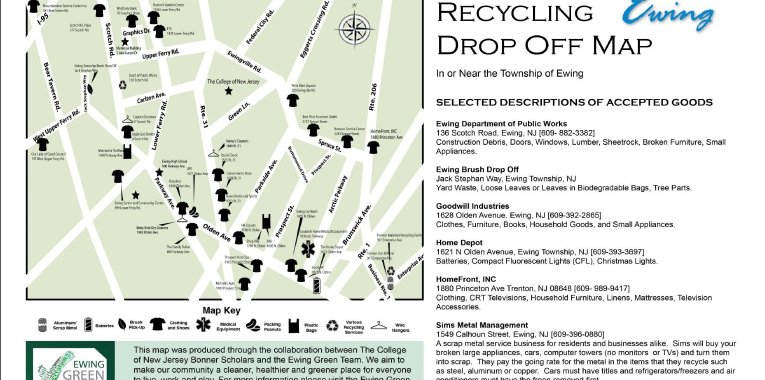
Want to do your bit to help out the environment?  Recycling is something that everyone can do.  However, sometimes you just don’t know what can be recycled and where.  The EGT has tried to answer those questions with a new recycling map that focuses on Ewing Township.   Find out where the all the clothing donation bins are in town, where you can recycle plastic bags, drop off wire hangers and much more.  The Ewing Public Works Department is also a great resource for recycling and the map also highlights items that are accepted there.  Check out it out!

More detailed information in support of the map can be found at ewingrecycles.org, a new Ewing-centric website filled with detailed information about what you can recycle in Ewing and where.  Ewing Recycles also focuses on the REUSE aspect of the 3Rs, highlighting in particular the many donation options that are available instead of throwing items in the trash.  If there is something that you are looking for that is not in our list of recyclables, please email us at ewinggreenteam@gmail.com and we will research it and post to the website.

Enjoy!

Reminder – MCIA Hazardous Waste Disposal Day This Saturday

The MCIA will be running its first  Household Waste and Electronics Disposal Day of the year on Saturday, March  21st from 8 a.m. – 2 p.m.  It will be held at John T. Dempster Fire School, Lawrence Station Rd in Lawrence Twp.

Accepted for recycling are the following:

Aerosol Cans | Used Motor Oil |Propane Gas Tanks | Pesticides & Herbicides | Car Batteries | Paint Thinner | Oil Based Paint | Stains & Varnishes | Gasoline | Anti-Freeze | Driveway Sealer | Insect Repellents | Mercury | Fluorescent & CFL Bulbs | Computers | Printers | Copiers | Fax Machines | Stereos | Televisions | Microwaves

Materials Not Accepted:

NO LATEX PAINT | NO Heating Oil | NO Infectious Waste| NO Radioactive Materials NO Explosives or Munitions | NO Railroad Ties | NO Asbestos | NO Tires | NO Wood  | NO Fencing | NO Air Conditioners | NO Helium or Oxygen Tanks | NO Unknowns

For Mercer County Residents Only. Only Residential Waste will be accepted, i.e. no Commercial Business waste. Proof of Residency will be required (Driver’s License). For more information call 609-278-8086 or visit WWW.MCIANJ.ORG.

Recycling Your Old Holiday Lights a Bright Idea

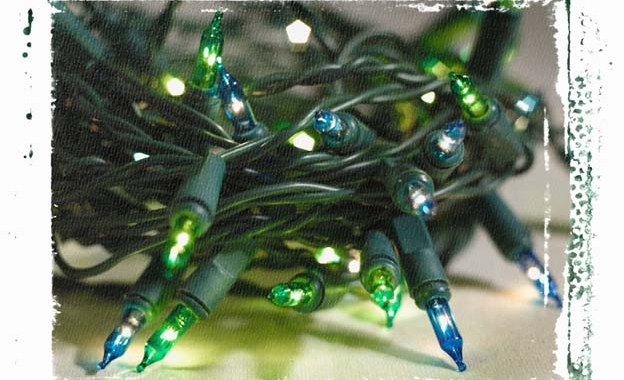
Have you just dragged out the Christmas lights again only to find that you have strands that are only working intermittently or not working at all? (sigh)  Are your lights old and outdated?  Or have you been bitten by the little green bug and decided to purchase energy efficient LED lights this year?  Whatever the reason, you may find yourself in the market for new lights this season.  So, once you’ve greened up your holiday display with more energy efficient lighting, what should you do with the old lights?  Whatever you do, don’t throw them away.  Recycle them.  Unfortunately, having googled this extensively, we haven’t found a lot of options.  But there are two holiday light recycling programs that we’ve identified for repurposing your old lights.   They both give you discount coupons towards the purchase of even more energy efficient LED light sets.

Home Depot
Home Depot runs an “Eco Options Christmas Light Trade In” program through all Home Depot stores every year but it is only available during the Christmas holiday season.   It starts in November and concludes in early December.  Bring your old incandescent Christmas light strings to the Home Depot for recycling and you’ll receive $3 -$5 discount coupon toward the purchase of ENERGY STAR qualified LED Christmas lights for each strand.  (some restrictions apply)

HolidayLeds.com
The other program is run by HolidayLEDs.com and you can participate in it anytime throughout the year.   It was responsible for the recycling of 10,000 pounds of holiday lights during the 2009/2010 holiday season.  It’s easy to participate and all you have to do is send them your old Christmas lights for recycling and they’ll send you a discount coupon.

How does the program work? 
Simply pack up your old lights and send them to them via the least expensive method possible.  They ask that you:

  • Don’t include any packing material or anything other than the lights themselves or send the lights in outer packaging such as retail boxes or include any apparatus used to wind up or store the lights.
  • Use cardboard boxes or other packaging that can easily be recycled.
  • Compact your light sets into the smallest space possible in the smallest box possible without any extra packing or plastic bags.

They are located in Wisconsin so there is no way to do this locally.  They recommend that you coordinate with your friends, neighbors, co-works, social groups, church groups, or other organizations when possible to collect lights and send in one bulk shipment.  This will reduce shipping costs for everyone as well as reducing environmental impact of shipping.

Send to:
Holiday LEDS Recycling
13400 Watertown Plank Rd. Suite 34
Elm Grove, WI 53122

What Happens to the Lights?
Once they are received they are removed them from the package and the box is recycled. The lights are processed and any material that cannot be recycled such as loose bulbs is discarded. Once substantial number of sets has been collected they are taken to a third party recycling facility which puts them through a commercial shredder. The resultant little pieces are then further processed and sorted into the various components that make up the lights (PVC, glass, copper.) The materials are separated and transported to a region center for further processing. In some cases, the PVC cannot be recycled.