Build Your Own Rain Barrel at Our October Workshop and Save Water and Money

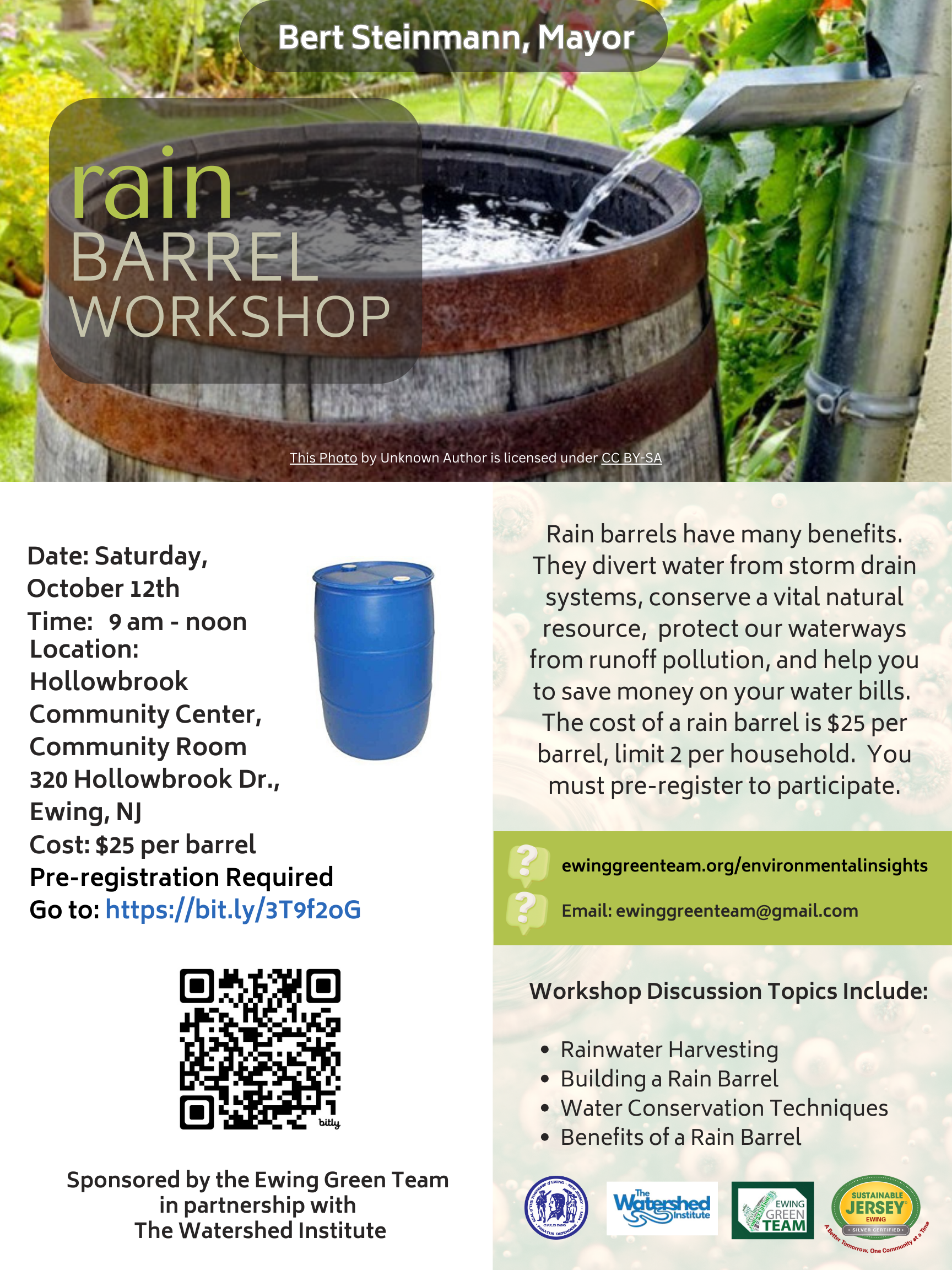
We invite you to learn more about water conservation and how to harvest rainwater from your roof and divert it for on-site usage in the landscape at out October 12th Rain Barrel Workshop.  The Ewing Green Team, in partnership with The Watershed Institute in Pennington, will teach you how to build a rain barrel at the workshop.  The program will be presented by Olivia Spildooren, River-Friendly Coordinator at The Watershed. The fee for the program is $25.  We have obtained 20 free food grade barrels while has enabled us to offer this program at a bargain price.  Registration is limited so be sure to register early.   The workshop will run approximately 2 hours.  Sign up here.

Event: Rain Barrel Workshop
Dates:  Saturday, October 12th
Time: 9 a.m. – Noon
Location: Hollowbrook Community Center, Community Room, 320 Hollowbrook Drive, Ewing, NJ 08638
Cost: $25 per rain barrel
Pre-register: https://bit.ly/3T9f2oG

Installation of rain barrels in your yard will enable you to take an active role in reducing flooding and pollution in local waterways.  Install rain barrels under your gutter’s downspout to harvest rainwater from your roof. Each rain barrel holds approximately 50 gallons. You can install them singly on hook them up in tandem to reserve even more water. Use the water to save money and save water when you irrigate your gardens with it during times of low rain.  In case you miss the workshop or are unable to attend, rain barrels are also for sale at local garden centers for approximately $100, give or take.

Be Water Smart and Learn Strategies for Water Efficient Living

The EGT invites you to save the date and join us for the next session of our Environmental Insights Series at the June meeting on Wednesday, the 28th when we will have a presentation about water conservation  and protection issues and how to become a better steward of nature on your property.  Stony Brook-Millstone Watershed Association representatives Ed DiFiglia, a Municipal Policy Specialist, and Brittany Musolino, the River-Friendly Coordinator, will provide background on the issues and speak about the Watershed’s River Friendly Program

“Water is our most fragile and precious resource. Essential to all forms of life and to our economies, our water supplies face a myriad of threats from pollution to climate change. Keeping our water clean, safe and healthy in the face of these challenges is the heart of the Stony Brook-Millstone Watershed Association’s mission.”1

While much has been done since the passage of the Clean Water Act in 1972 which reduced direct discharges of untreated sewage and industrial pollution into our water bodies to improve the health of our nation’s rivers, the problems facing our waterways are still challenging.  Threats such as pesticides and fertilizers, automobile waste products, pet waste, road salt are just a few sources of pollution.   Too much impervious surface contributes to groundwater run off.  The twin threats of climate change,  deluges or droughts contribute additional stresses on management of our water resources.

The presentation will provide an overview of the following:

  • Overview of current state and local drought conditions
  • How to convert a home landscape to be water smart
  • Plants for water smart landscapes
  • River Friendly program

The Watershed‘s River-Friendly Certification Program is designed to help individuals, businesses, schools and golf courses contribute to a clean water and a healthy environment thru education and improvement of land stewardship practices. The four cornerstone goals of the program are to reduce pollution, conserve water, restore habitat for wildlife and educate the public about becoming better environmental stewards. Please be sure to join us for an evening that will galvanize all into action!

Presenters

Brittany Musolino Biography

Brittany Musolino runs the River-Friendly Certification Programs for the Stony Brook-Millstone Watershed Association, which involves working with landowners to improve their landscape practices and stormwater management. Brittany earned her B.S. in Human Ecology from Rutgers University and completed a term in the AmeriCorps Watershed Ambassador Program before joining the Watershed Association’s Science & Stewardship Department.

Date: Wednesday, June 28
Time: 6:30 pm
Location: ESCC, Community Room, 999 Lower Ferry Road, Ewing

  1. https://thewatershed.org/water/

Save Water and Money at the EGT’s Build Your Own Rain Barrel Workshop

Learn more about water conservation and how to harvest rainwater from your roof and divert it for on-site usage in the landscape.  The Ewing Green Team, in partnership with the AmeriCorps NJ Watershed Ambassador program, will teach area residents how to build a rain barrel at a workshop this spring.  The fee for the program is $10.  We have obtained 30 free food grade barrels and have costed out the hardware for each barrel at $10.  Registration is limited so be sure to register early.    Each workshop will run approximately 2 hours.  Sign up today.

Event: Rain Barrel Workshop
Dates:  Saturday, June 3rd
Time: 9 a.m. – Noon
Location: Ewing Senior and Community Center, Community Room
Cost: $10 per rain barrel

Installation of rain barrels in your yard will enable you to take an active role in reducing flooding and pollution in local waterways.  Install rain barrels under your gutter’s downspout to harvest rain water from your roof. Each rain barrel holds approximately 50 gallons. You can install them singly on hook them up in tandem to reserve even more water. Use the water to save money and save water when you irrigate your gardens with it during times of low rain.  In case you miss the workshop or are unable to attend, rain barrels are also for sale at local garden centers for approximately $100 give or take.

2016 NJ Drought Status Update

In the heels of extremely dry spring and summer seasons and with drinking water reservoirs plummeting to approximately 50 percent capacity in North Jersey, the NJDEP updated the state’s drought status following a public hearing on October 21st with an executive order signed by Commissioner Bob Martin.  Drought warning were issues for 14 counties in northern, central and northern coastal New Jersey including: Bergen, Essex, Hudson, Hunterdon, Mercer, Middlesex, Monmouth, Morris, Ocean, Passaic, Somerset, Sussex, Union and Warren.  In addition, the following counties are under drought watch: Burlington, Camden, Gloucester and Salem.  All but three counties — Atlantic, Cape May and Cumberland — are under a formal drought designation.

The Administrative Order signed by Commissioner Martin establishes a formal process for the DEP to work with water suppliers in affected regions to ensure no single water supplier or region faces a significant shortfall should dry weather and high customer demand continue.

The goal of the drought warning is to preserve and balance available water supplies in an effort to avert more serious water shortages in the future. The warning also elevates the need for residents and businesses in impacted counties to reduce their water use.

The DEP offers the following tips to reduce water use:

  • At this time of year, it is appropriate to let your lawns go dormant.
  • Turn sprinkler systems off automatic timers.
  • Use a hose with a hand-held nozzle to water flowers and shrubs, or let them go dormant.
  • Use a broom to sweep the sidewalk, rather than a hose.
  • Wash vehicles with a bucket and do not run the hose more than necessary, or use a commercial car wash that recycles water.
  • To save water at home, fix leaky faucets and pipes. Consider replacing your toilet with a low-flow version; this can save around 11,000 gallons per year.
  • Upgrade your showerhead to low-flow versions, which can save some 7,700 gallons per year.
  • Upgrade your faucets or install faucet aerators; this can save some 16,000 gallons per year.

For more state water supply status information and to view the Administrative Order, visit: www.njdrought.org

For more detailed information on water conservation technologies and interesting facts, visit: www.nj.gov/dep/watersupply/conserve.htm


With Drought Warning Imminent, Water Groups Urge NJ Environmental Officials to Address Long-Term Drinking Water Needs

SaveH20NJ.org, an alliance of environmental groups committed to preserving and protecting the state’s drinking water supply, expressed growing concern over the diminished levels of New Jersey’s reservoirs on the eve of a drought hearing by the state Department of Environmental Protection (DEP).

On the heels of extremely dry spring and summer seasons and with drinking water reservoirs plummeting to approximately 50 percent capacity in North Jersey, the DEP has scheduled a public hearing on Thursday morning, a necessary step before it can issue a drought warning.

A drought warning for the following 12 counties — in which millions of New Jerseyans rely on the public water supply — could be issued as early as Thursday: Bergen, Essex, Hudson, Hunterdon, Mercer, Middlesex, Monmouth, Morris, Ocean, Passaic, Somerset, and Union. Those counties have been under a DEP-issued drought watch since July. In addition, the DEP has expanded the drought watch to include Burlington, Camden, Gloucester, Monmouth, Ocean, and Salem counties. All but three counties — Atlantic, Cape May and Cumberland — are under a formal drought designation.

A drought watch seeks voluntary water conservation; the more serious drought warning enables the DEP to require water purveyors to take action to conserve and secure drinking water sources.

“The condition of the four largest reservoirs in the state — Round Valley, Wanaque, Spruce Run and Monksville — is absolutely dire. This action to designate a formal drought warning is extremely late, maybe too late. I hope declaring a drought emergency does not happen, but if it does, DEP need look no further for someone to blame than in the mirror,” said Julia Somers, Executive Director of the New Jersey Highlands Coalition.

The last drought warning occurred in 2001. However, this is the second consecutive year that the DEP has issued a drought watch. In addition to drinking water reservoir levels reaching dangerously low levels, the DEP has listed all stream flows and ground water levels for the entire state as moderately, severely or extremely dry for at least the past 90 days. The DEP publishes updates to drought indicators for the state at njdrought.org.

“New Jersey’s dwindling water supply is a growing concern to the millions of families and businesses who rely on an abundant supply of clean and affordable drinking water,” said Ed Potosnak, Executive Director of the New Jersey League of Conservation Voters. “Data and observation over more than a year have pointed to a water system in peril. While we applaud the DEP’s recognition of the worsening drought, we implore the agency to end its decades-long delay in adopting a long-term plan to preserve and sustain a clean drinking water supply.”

The NJ Legislature had the foresight and understanding to require proactive planning and ensure that NJ has enough clean water available to meet all of our needs. In 1981, the Legislature passed the Water Supply Management Act, and it requires that the DEP update the Water Supply Plan at least every five years. However, the last plan update happened in 1996 — 20 years ago.

“New Jersey’s Water Supply Plan is 20 years old and it fails to adequately plan for drinking water supply for NJ’s growing population. We need the DEP and Governor Christie to update and release the Water Supply Plan to ensure we have enough water to drink, grow Jersey Fresh Produce, support healthy habitats, recreation, tourism, and water dependent businesses in our state including Budweiser, Goya, and M&M’s,” Jennifer Coffey, Executive Director, Association of New Jersey Environmental Commissions. “Clean water is essential to life, economy, and a healthy environment in the Garden State. Without the Water Supply Plan, the state government is gambling with our future.”

“The drought in North Jersey is a sign of things to come. Due to improper planning by the DEP, our residential and ecological communities will suffer far greater than if New Jersey released a water supply master plan years ago and implemented provisions to help deal with low supply and high demand. Residents should voice their concerns at the hearing and demand immediate action with a strong plan that protects our most precious resource.” Jaclyn Rhoads, Deputy Director, Pinelands Preservation Alliance.

Tools and tips for water conservation in homes and communities including landscaping, leak detection, and best water practices can be found at: http://www.saveh2onj.org/

“We need to act now to protect our state’s water. Clean and plentiful water is essential for our economy and ecology. Threats to our waters threaten our wildlife, communities and economy,” Tim Dillingham, Executive Director, American Littoral Society

The public hearing is scheduled for 10:00 a.m. Thursday, Oct. 20, in the Millburn Free Public Library auditorium, 200 Glen Avenue in Millburn.

Reprinted with permission from the Association of NJ Environmental Commissions (ANJEC) and SaveH20NJ.org.