The Ecological Benefits of the Not So Perfect Yard

Our annual plea for sustainable fall landscaping care has been recycled below.

by Joanne Mullowney

The first frost has come and gone and today it is sunny, humidity-free and gorgeous.  We love autumn.  We are finally leaving the hot, sticky days of summer behind for the cooler, more breathable days of fall.  Soon the neighborhood trees will blanket the ground with their last gift of the growing season.  This seasonal leaf drop can recharge your landscape and create habitat for wildlife.  So, don’t treat your leaf litter as trash, but rather as the gift that it truly is to the millions of tiny creatures that are a part of our gardens’ ecosystems.

The Benefits of Leaf Litter

Raking up and disposing of our leaves, chopping down dead flower stalks and grasses all contribute to a manicured appearance which we have been conditioned to think of as the norm.  However, in nature, trees don’t drop their bounty at the curb for pick up, but rather they blanket the earth while providing a host of ecological benefits.

Leaves provide an insulating winter cover in the garden for plants and those tiny creatures that sustain life in the garden.   We encourage you to mulch with fallen leaves.  Wherever possible, leave them to decompose where they fall in your garden beds.  Or settle the leaves under the branches of your shrubs. Give it a year or so and your leaf litter will have broken down while providing mulch and increasing the soil’s water retention abilities.

You can also rake out some of the leaves from the beds that are simply too much and might smother tender plants and cause them to rot over the winter. Add them to the compost pile or the leaf pile on the lawn while the rest remain in the beds. Then take your mulching mower and chop them up into small pieces.  Rake up most of the chopped leaves and place them back in the garden around shrubs and plants.   Now that they are greatly reduced in volume they contribute to the more manicured look that suburban mores demand.  The remainder can stay on your lawn and decompose there. Do this as needed until the end of the season and the leaves will break down over the winter providing your soil with valuable nutrients all the while enhancing wildlife habitat.  One incidental benefit is that of reduction of Township resources allotted to fall cleanup, saving taxpayer dollars.

While you might think that this leaves the yard looking a little less than perfect, you are nourishing the landscape and providing valuable resources and habitat for wildlife.

The Benefit of Providing Habitat

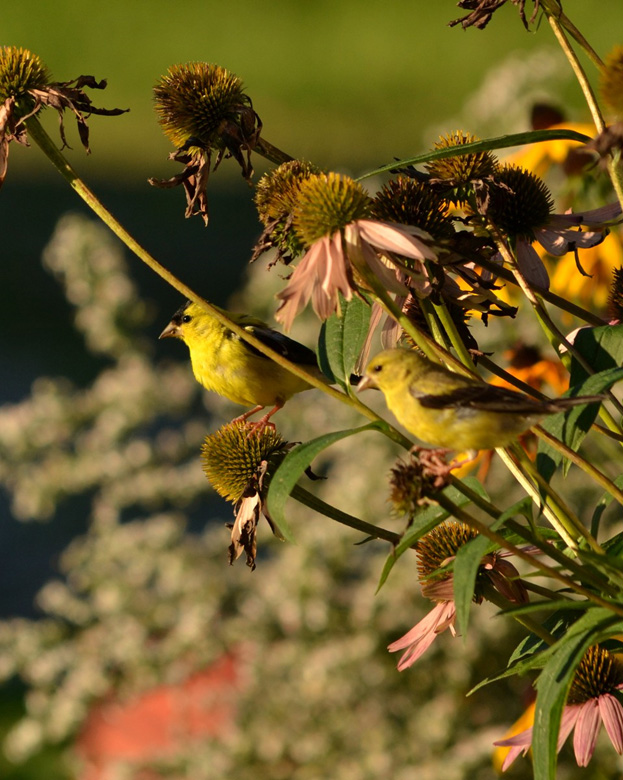
This somewhat messy yard contributes yet another important benefit – habitat.  While not a traditional concern of the average gardener, we believe it should be.  Did you know that despite its not so perfect look, leaf litter provides an important foraging space and shelter for a wide variety of birds, small mammals and insects?  Also providing benefit is the untrimmed garden where ladybugs and lacewings reside in native grasses and pollinating bees settle in hollow plant stems.  Butterflies and moths winter in chrysalides on the ground and baby spiders hide out amid the decaying plant stems. Birds feed from dried seed heads in winter.

Some wildlife use the leaf litter and other dead vegetation to insulate them from winter’s chill, while others, such as earthworms feed on the litter, breaking it into smaller pieces. Bacteria and fungi in turn convert theses smaller pieces into nutrients which then sustain neighboring plants. They in turn help support biodiversity by becoming food themselves. Toads, beetles, ladybugs and much more also live in your backyard’s leaf litter. Each is an integral part of the food web.

Support Wildlife Thru Your Not So Perfect Yard
We recommend the following practices from the Habitat Network to help you in your quest to provide habitat and reduce your ecological impact.  Adopting good practices in the fall also leaves you well set for spring in the garden.

  • Leave your leaves on the property (Leaves are too valuable a resource to dispose of!)
  • Leave them in the garden beds when you can, mow them or compost them.
  • Allow dried flower heads of some of your garden favorites to stay standing in your garden.
  • The dark stems and flower heads of some of our native flowers look gorgeous against the snow and nothing is more exciting than seeing our small winged friends feasting upon the seed heads.
  • Let your ornamental grasses grow tall and seed.
  • Don’t cut down your ornamental grasses. They provide shelter for the insects that pollinate our gardens and feed fledgling birds and other wildlife. Not to mention that they also look fabulous swaying in the wind.  They make a fabulous addition to the fall (and winter) landscape.
  • Build a brush pile with fallen branches instead of removing them.
  • If you build it, they will come. This author no sooner established a small brush pile in a back corner in the yard and it was inhabited.
  • Forget the chemicals. (This one is not hard. Just do it!)
  • Finally, don’t be in a rush to begin your garden cleanup in the spring. Wait until after several 50℉ days to begin, when spring has really arrived, allowing overwintering pollinators to move on first.  You gave them a home all winter; don’t yank it away from them too soon.

Vanishing Habitat

As habitat for wildlife is decreasing, so too is wildlife, and at an alarming rate.  A recent National Wildlife Federation newsletter states:  More than half the world’s wildlife has vanished since 1970.1  This includes mammals, birds, reptiles, amphibians, and fish.  Quite simply, we’re destroying our planet’s ability to support our way of life.

Wildlife needs habitat to survive and we need to do a better job balancing the need to provide habitat for animals’ survival against commercial forces.  Habitat requires food, water and shelter and even a small yard can support birds, butterflies, beneficial insects, and small animals thru proper landscaping and landscaping habits.  They need more than lawn and it is important to provide trees, shrubs, and other plants (particularly native varieties and a topic for another post) that shelter and feed wildlife.

We ask you to adopt a somewhat messy yard and eschew the leaf disposal.  Keep your leaves so that they can decompose naturally in your own yard and support the butterflies and other small insects that live in the leaf litter.  To learn more about how we are promoting gardening for wildlife, take a look at our initiative – the Ewing Community Wildlife Habitat Project.   During this season of renewal so essential to preserving the next generation of wildlife, we invite you to join with us and pledge to garden messy.  Then put your feet up and enjoy the season.

Printable brochure of sustainable fall landscaping tips.

  1. Source:  Living Planet Report 2016 by World Wildlife Fund http://awsassets.panda.org/downloads/lpr_living_planet_report_2016.pdf


EGT Publishes New Recycling Flyer

As we recently posted, we are in the midst of the worst recycling environment which we have seen in the last 20 years and all indications are that the market for recycling materials will not improve in the foreseeable future.  You may have read about the restrictions placed by China on importing recyclable materials from the United States.  China has closed its doors to many types of recycling materials and is requiring that the material be 99.5% free from contamination.  According to the staff at the Mercer County Improvement Authority (MCIA), the contamination rate for recycling collected from Mercer County communities is 11.4%.  This means that we have significant work to do to make our recycling acceptable for the market.

China was also the largest consumer of US recyclable volume and no longer is purchasing the volumes that it did in the past.  This means that there is a glut of supply in the market which is significantly driving down the value of this materials.  As a result, in many cities across the nation, recyclables are ending up in landfills.

What this Means for Us

We must do a better job of recycling or face:

  • Higher taxes because of skyrocketing recycling costs.
  • More landfills to bury contaminated recycling.
  • Risks for wildlife, waterways, oceans and the quality of life on our planet.
  • Imperiled futures for our children and grandchildren.

There is no magic want to wave away our trash!  We are now facing the consequences of thoughtless consumption and waste,  We MUST rethink our disposable lifestyles.   In some of our upcoming posts, we will discuss ways in which each one of us can make a difference in combating this relentless crisis.

The EGT has published the attached recycling flyer, Trash Talk: Recycling in Crisis, for easy reference to answer your recycling questions.

To summarize:  One piece of garbage makes it all garbage!  We advocate that when it doubt, throw it out!  We ask that all residents keep the following do’s and don’ts in mind when recycling:

Recycling Do’s and Don’ts

  • DO remember the first of the 3Rs of recycling: Reduce. Make every effort to reduce the amount of waste that you produce.  Single-use plastics are a significant component of that waste stream because they “don’t go away and essentially, last forever.  Make every effort to eliminate single-use items such as plastic grocery bags, straws, utensils and cups, bottled water, take-out containers…   Use reusable versions of those products instead.
  • DO recycle all empty bottles, cans, paper and cardboard.
  • DO recycle clean materials: i.e. keep foods and liquids out of recycling.
  • DO keep plastic bags out of recycling.
  • DO check out this site for more information about how you can do your share to Reduce | Reuse | Recycle.
  • DON’T bag your recyclables. Plastic bags and film get tangled in the machinery.  (Our local supermarkets have plastic bag collection bins at their entrances.)
  • DON’T include soiled food items. They can turn an entire load of recycling into trash.
  • DON’T add sharp or dangerous materials like needles and electronics. They can cause injury to workers.
  • DON’T include bulky items like propane tanks or construction debris (no wood). The Township Convenience Center at 136 Scotch Road will take a lot of materials that you cannot leave at the curb.  Please check our website or call 609- 882-3382 for accepted materials.
  • DON’T add items that are not on the list of accepted materials. This will contaminate the entire load.


Recycling Double Header Planned for Saturday, Oct 27th.

Ewing Township Plans Final Shred and Drug Recycling Events for 2018

Shred Day

Dispose of your sensitive documents safely and securely at Ewing’s final Shred Day of the year, Saturday, October 27th from 9 – 1 at the Municipal building.  Materials from businesses are not accepted and Ewing residents will be required to provide Proof of Residency. Because this is an extremely popular program please be prepared to spend a few minutes waiting in line. The event will take place rain or shine.  Document shredding will be done on site. The Ewing Green Team will be on hand to assist.

Date: Saturday, October 27th
Time: 9 a.m. – 1 p.m.
Location: Municipal Building, 2 Jake Garzio Drive

For more information call the Department of Public Works at 609-882-3382.

The 2019 Shred Day schedule will be announced early next year.

Dispose of Your Unused Medications Safely on National Take Back Day

If your medicine cabinet is filled with expired drugs or medications that you no longer use, and you are concerned about detrimental environmental effects from improper disposal or eliminating the potential for abuse of medications, here is the information that you need to properly dispose of them.

The Ewing Police Department will be participating in the DEA’s final 2018 National Prescription Drug Take-Back Day which will take place on Saturday, October 27, 2018, from 10:00 a.m. to 2:00 p.m. This is a great opportunity for those who missed the previous events, or who have subsequently accumulated unwanted, unused prescription drugs, to safely dispose of those medications.  Just go to Ewing Municipal Building, 2 Jake Garzio Drive and go to the Ewing Police Department on the lower level.  Ewing Police will have an officer between 10am and 2pm to take the items.

All medications are accepted, prescription and over-the-counter, as well as liquids.  Liquids are accepted in their original prescription bottle only and with the cap tightly secured. Syringes and other sharp instruments should not be turned in at this event.  Hypodermic needles are not accepted.  The disposal is handled completely securely; all accepted medications with any labels that you leave on the containers are placed in a large cardboard box, lined with plastic.  At the end of the day the contents are taken to the prosecutor’s office.  The DEA will pick up and incinerate.

Guidelines for Drug Disposal

Follow any specific disposal instructions on the drug label or patient information that accompanies the medication. Do not flush prescription drugs down the toilet unless this information specifically instructs you to do so.

If no instructions are given on the drug label and no take-back program is available in your area, take them out of their original containers and mix them with an undesirable substance, such as used coffee grounds or kitty litter — to make the medication less appealing and unrecognizable — then put them in a sealable bag, empty can, or other container to prevent the medication from leaking or breaking out of a garbage bag.

You should also remove any identifying information on the label to protect your identity and privacy.

Despite the safety reasons for flushing drugs, some people are questioning the practice because of concerns about trace levels of drug residues found in surface water, such as rivers and lakes, and in some community drinking water supplies. However, the main way drug residues enter water systems is by people taking medications and then naturally passing them through their bodies.  That said, the FDA does not want to add drug residues into water systems unnecessarily. The agency reviewed its drug labels to identify products with disposal directions recommending flushing or disposal down the sink. This continuously revised listing can be found at FDA’s Web page about Disposal of Unused Medicines.

Event Summary

Date: Saturday, October 27, 2018
Time: 10 a.m. – 2 p.m.
Location: Ewing Municipal Building, 2 Jake Garzio Drive

If you are unable to participate in the National Take Back Day event there is a Project Medicine Drop Box outside of Police headquarters where you may drop off medications 24/7.  For more information see Ewing Township’s Project Medicine Drop Box page.


Ewing Township and the Ewing Green Team Want Your Business to Get Funding!

Come to the Ewing Green Team’s October 23rd Seminar and learn how to save up to 70% using the BPU’s Direct Install Program for selected energy efficiency upgrades.

Replace your old furnaces, boilers, air conditioners and lighting systems with energy-efficient technology and the NJ Direct Install program will pay up to 70% up front of the total cost.

Direct Install is an offering of the New Jersey Board of Public Utilities and the Clean Energy Program designed for small commercial, institutional and municipal buildings. It identifies proven measures for reducing utility costs and replaces inefficient equipment with energy efficient alternatives. Direct Install will cover up to 70% of project costs when installed by the exclusive participating contractor for your county.

The program provides a free energy audit detailing annual energy savings and return on investment.  It pays for up to 70% of total cost to replace lighting and HVAC Units; LEDs, including exterior and pole lighting (HVAC units are High-Efficiency).  The exclusive participating contractor, Tri-State Light and Energy, takes care of everything from permits and installation to cleanup.  Minimal paperwork is involved.

Ewing Township and its Green Team support this program and will present a Direct Install workshop at the Ewing Senior and Community Center 999 Lower Ferry Road on October 23 at 7pm. You will hear from members of the Ewing Green Team, a representative of the Direct Install contractor, as well as some Ewing business owners who have already completed the program.

To Learn more

Contact Tri-State Light and Energy today to Schedule Your FREE Energy Audit – 610.789.1900 or contact Sandra Torres directly at 609.306.4980/sandra@TSLE.com.

Some Ewing businesses that have received funding:

  • The Robbins Pharmacy – $49k
  • Heath Lumber Company – $50k
  • Mama Flores, Inc. – $25k
  • Mon Cheri, Inc. – $104k
  • Money Management Associates – $7k


MCIA Hazardous Waste Disposal and Electronics Recycling Event This Saturday, Sept 29th

The final Hazardous Waste Disposal and Electronics Recycling Event sponsored by the Mercer County Improvement Authority (MCIA) for 2018 is scheduled for this Saturday, September 29th from 8 am – 2 pm.  It will be held at John T. Dempster Fire School, Lawrence Station Rd in Lawrence Twp.

Accepted for recycling are the following:

Aerosol Cans | Used Motor Oil |Propane Gas Tanks | Pesticides & Herbicides | Car Batteries | Paint Thinner | Oil Based Paint | Stains & Varnishes | Gasoline | Anti-Freeze | Driveway Sealer | Insect Repellents | Mercury | Fluorescent & CFL Bulbs | Computers | Printers | Copiers | Fax Machines | Stereos | Televisions | Microwaves

Materials Not Accepted:

NO LATEX PAINT | NO Heating Oil | NO Infectious Waste| NO Radioactive Materials NO Explosives or Munitions | NO Railroad Ties | NO Asbestos | NO Tires | NO Wood | NO Fencing | NO Air Conditioners | NO Helium or Oxygen Tanks | NO Unknowns

Accepted Electronics

Computers | Printers | Copiers | Fax Machines | Stereos | Televisions | Microwaves

This event is for Mercer County Residents Only.  Only Residential Waste will be accepted, i.e. no Commercial Business waste. Proof of Residency will be required (Driver’s License). For more information call 609-278-8086 or visit http://WWW.MCIANJ.ORG.