It All Adds Up to Cleaner Air

The Ewing Green Team Launches It All Adds Up to Cleaner Air” Campaign Challenging Ewing Residents to Reduce Vehicle Idling

Vehicle exhaust is the leading source of hazardous air pollution in New Jersey, adding to rising rates of childhood asthma

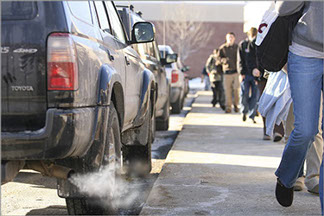
Parents who idle their cars while dropping off and picking up their children at school probably aren’t aware that they may be putting their children at serious health risk.  With their “It All Adds Up to Cleaner Air” campaign, part of a nationwide effort to educate the public about the dangers of vehicle exhaust, the Ewing Green Team is asking parents to help keep Ewing kids healthy by turning off their car engines.

Did You Know?

Vehicle emissions are a major cause of air pollution, which contributes to increased rates of asthma, cancer, as well as other respiratory problems, reproductive effects, birth defects and other serious health effects.   Our kids are exposed to some of the most excessive exhaust fumes in their daily trips to and from school.  A February 2001 study, No Breathing in the Aisles, by the Natural Resources Defense Council (NRDC) and the Coalition for Clean Air found that “children who ride a diesel school bus may be exposed to up to four times more toxic diesel exhaust than someone traveling in a car directly in front of it.  The study found that excess exhaust levels on school buses were 23 to 46 times higher than levels considered to be a significant cancer risk according to the U.S Environmental Protection Agency and federal guidelines.”

Why Not Idle?

Protect yourself and your passengers.  Exposure to your vehicle’s exhaust is much higher inside your vehicle than outside and is especially true when the car is idling. So if you are sitting idling in your car in a line at your Bank’s drive up teller or drive thru or whatever, Turn It Off!

Protect your vehicle.  Another little known fact is that excessive idling can actually damage your engine, so turning your engine off might help you avoid expensive engine repairs.  Idling more than 10 seconds also uses more fuel than restarting the engine.  Manufacturers assure that frequent restarting won’t harm an engine.

Protect the Environment.  By turning off your engines you can reduce pollutants that contribute to climate change and cause smog.  Each gallon of gas produces 19 pounds of carbon dioxide which is the principal greenhouse gas that contributes to climate change and pollution.

Save Money.  Vehicles that idle 10 minutes per day waste more than 29 gallons of fuel each year. Do the math. At $3.50 per gallon, that’s over $101 wasted per year.[1]

It’s the law.  Idling more than 3 minutes is against the law in NJ.[2] Ewing Township has also adopted an anti-idling resolution to protect our citizens.  You can help us keep our town clean, improve local air quality, and save money by conserving fuel and reducing health care costs.

“The health of our kids rests on all of our shoulders,” said Peter Boughton, Chairman of the Ewing Green Team. “It is estimated that in just one month, the average driver picking up and dropping off their child generates three pounds of emissions.  Just by turning off the ignition, we can make a huge difference in the quality of air we breathe.”

The Ewing Green Team asks that Ewing residents join in our efforts to promote a healthier Ewing by adhering to the following guidelines: (1) if you are going to wait more than 10 seconds, turn your vehicle off, (2) educate others about the effects of idling and (3) report diesel vehicles idling more than 3 minutes by calling (877) WARNDEP.    Take the Green Team‘s anti-idling pledge at https://ewinggreenteam.wordpress.com/pledge/

If you are interested in promoting a more sustainable Ewing, join the Ewing Green Team at our meetings on the 4th Wednesday of each month at 7 p.m. at the Ewing Senior and Community Center, 999 Lower Ferry Road, Ewing Twp.   If you would like to learn more about us, please check out our website at https://ewinggreenteam.wordpress.com/.   Contact the Green Team at ewinggreenteam@gmail.com.

[1]http://www.epa.gov/region8/air/rmcdc/IdleFreeSchoolsPresentation.pdf

[2] http://www.state.nj.us/dep/aqm/Sub15v2002-12-26.pdf

Monthly Green Team Meeting Wednesday, August 28th

The monthly meeting of the Ewing Township Sustainable Green Team will be this week on Wednesday night.

All Ewing residents who wish to participate in planning for Ewing’s sustainable future are welcome.

Green Team members, please read the July minutes prior to attending so that they can be approved.

Date: Wednesday, August 28th
Time: 6:30 – 9 p.m. (Note the early time)
Location: Ewing Senior and Community Center, 999 Lower Ferry Road, Ewing, NJ 08628

Ewing’s Sustainable Future – Dot Poll Results

National Night Out – Tuesday, August 6th at the Ewing Senior and Community Center

surveyportraitThe skies threatened, but fortunately held off, allowing Ewing residents to enjoy an evening of community food and fun at the National Night Out event on Tuesday, August 6th.  And once again, the Ewing Green Team was on site promoting actions for a more sustainable community including two of their current campaigns – grass-cycling and anti-idling.   Residents were invited to pledge their support for these worthwhile initiatives.

A highlight of the Green Team presence was the Dot Survey which invited the public to weigh in with their top priorities for a sustainable future in Ewing.  The board was a hit as attendees gathered round to vote for their top choices for sustainable actions.

About the Poll

Priority Choices

  • ENERGY ALTERNATIVES –  energy efficiency, renewable energy
  • FOOD AND GARDENING- community gardens, local food markets
  • HEALTHY COMMUNITIES – lead and anti-idling education, obesity reduction initiatives
  • LOCAL ECONOMIC DEVELOPMENT- buy local campaigns, green businesses
  • OPEN SPACE – preserve land for natural areas and parks
  • RECYCLING – reduce  waste, reuse and recycling programs
  • WALKING & BIKING- sidewalks, bike lanes and trails, transportation alternatives
  • WILDLIE & NATURAL RESOURCES – healthy habitats, trees, clean air and water

Each participant received 3 “dot stickers” and put them in the blank space next to their top three (3) priorities for sustainability actions.   Green was for 1st choice, blue for 2nd and yellow for 3rd.

The voting was not easy as participants tried to determine their top three choices of all of the all worthwhile actions.  Some remarked that they needed all three of their dots to be green.  Others made the choices with rapid assurance.

Overview of Results

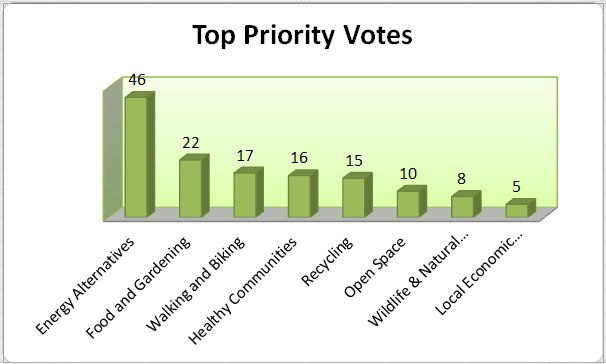
toppriorityresultsThirty-three per cent (33%) of the voting Ewing residents selected Energy Alternatives as their first priority action. And it was in first place by a sizeable margin as the chart on the left indicates.

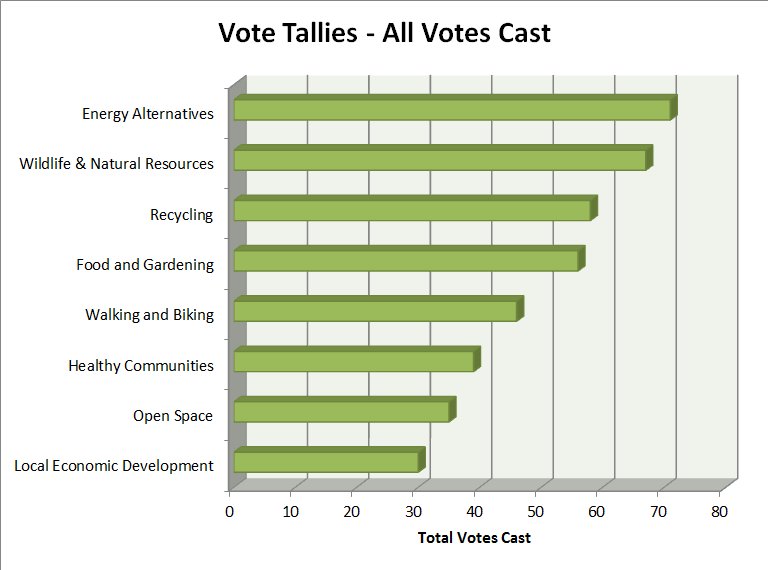
However, if you add the tallies together for each voter, the scores became much closer.  Energy Alternatives was still the residents’ top vote getter, but the 2nd and 3rd choices, Wildlife and Natural Resources and Recycling narrowed the gap.  Of the total 402 votes cast, green, blue and yellow, Energy Alternatives was the top with 71 total votes, followed by 67 and 58 for the 2nd and third choices respectively.

all votes cast survey

Do the sustainable priorities selected by Ewing Residents match yours? Tell us what you think with the poll below.  You may choose 3, and only 3, choices.  If you would like more information about the results of this poll please contact us at Ewinggreenteam@gmail.com.

Shred Day this Saturday in Ewing from 9 – 1

recycleimageDispose of your sensitive documents safely and securely at Ewing’s second Shred Day of the year, Saturday, July 20th from 9 – 1 and the municipal building.  Document shredding will be done on site.  This service is for Ewing residents only and proof of residency is required.

In addition, in a one-time special visit, Goodwill Industries will also be present to collect unwanted household items, small electronics, shoes, clothing medical equipment and more.   So cleanup your household and make a donation to a good cause at the same time.

Date: Saturday, July 20th
Time: 9 a.m. – 1 p.m.
Location: Municipal Building

The final Shred Day for 2013 will be on November 30th.  Check back here for details.

See Photos from this Saturday’s Shred Date

This slideshow requires JavaScript.

Volcanoes Killing Local Trees

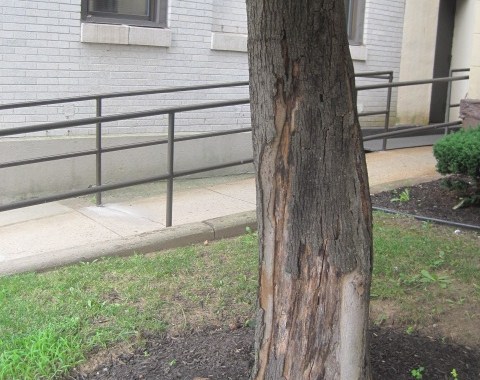
I was walking with my dog Maddie in the Mountainview section of Ewing when we noticed a landscaper placing mulch around the trees in a nearby yard. In particular he was piling the mulch high and deep around the base of a beautiful, large (perhaps 75 years old) oak tree. These mulch structures are known by tree experts as “volcanoes” because of their obvious shape.

I see this far too often nowadays; almost achieving the status of a fad. I can certainly see why. Volcanoes look neat and orderly. People see them and want them for their property and landscapers are happy to oblige; sells a lot of mulch too. It has to be good for the trees right?

Well it isn’t. And, as a member of the Ewing Environmental Commission and Sustainable Ewing Green Team, I want you to know better.

I spoke to the gentlemen doing the tree mulching. He shrugged and pointed me to the foreman in charge. I explained briefly that heavy mulching at the base of trees can kill them. The foreman gave me a mischievous smile and nodded affirmatively as if he understood and would take mitigating measures. I hoped for the best. Sadly, a week later I was again walking alongside Maddie past the same property and there were volcanoes around all the trees in the yard. My heart sank.

Worse yet, all around Ewing I am seeing “volcano imprisoned trees” – some even dying from a cancerous looking decay slowly creeping up their bark. Eventually owners are forced to cut them down long before their time, but, they’re clueless as to why their treasured trees perished.

The majesty and sheer size of trees make them seem invulnerable.  But, the truth is quite the opposite. Trees are gentle but vulnerable giants. It’s tough enough fending off insects, disease, heavy rains, high winds and drought but we humans routinely abuse them by improperly cutting off their limbs, driving in nails, digging, weed whacking, mowing, dumping waste, riding cars and heavy equipment on their roots or worse. All of these things can over time do in the sturdiest of trees. They may look healthy for a time but slowly die years later making cause and effect seem oddly disconnected.

Now add to that the recent epidemic of tree mulching volcanoes and there is trouble afoot. The problem is that, according to the New Jersey Division of Parks and Forestry and the New Jersey Shade Tree Federation, mulch softens the bark. Mice, insects, and fungus then feed on the living parts of the tree, killing tissue, cutting off water and nutrient supply as well as causing other serious problems that can greatly damage and kill a tree.

That’s not to say that mulching isn’t beneficial to trees – it is, if done properly. It helps retain moisture, keep down weeds, prevents soil erosion and moderates temperatures. It is particularly good at helping young trees survive. But, here are a couple simple recommendations:

  1. Mulch should never be piled against the bark but kept 6 inches from the trunk, 2 to 4 inches deep;
  2. Use of bark chunks or shredded bark that is at least 3/8 inch in size, pine bark, pine needles, one-year old wood chips or leaves that are shredded and composted for at least 3 months is encouraged.  DO NOT use fresh grass clippings, fresh wood chips, fresh organic mulch, bad smelling mulch, peat moss, sawdust, pebbles, rocks, cobble stones, bricks, pavement, plastic sheets or ground up rubber tires. And, DO NOT mix mulch with soil;
  3. Use only one layer of woven landscape fabric if needed for weed control; and
  4. If your tree is already engulfed in a mulch volcano don’t remove it all at once. It is recommended that you contact a NJ Certified Tree Expert. A free directory is available from the Forest Service, listed below.

I think of trees as stoic old friends. They add beauty and esthetics to our lives silently watching over our children as they grow, providing cool UV protected shade, filtering the air we breathe, reducing noise, moderating winds, controlling moisture and erosion, providing a home for various critters, increase property values and establish a sense of hometown community. If they occasionally fall in a severe storm and cause damage, they don’t mean to. When they are old and frail we take them down, their remains providing dry glowing heat and flickering comfort on cold, damp winter nights. It is in all our interests to educate ourselves on how to properly care for our tall green companions or at least do them no harm. Maddie agrees.

Joseph-Mark Mirabella

For more information contact:

NJ Division of parks and Forestry Forest Service – Community Forestry Program
PO Box 404
Trenton, NJ 08625-0404
(609) 292-2532
Fax: (609) 984-0378
www.state.nj.us/dep/forestry/community

New Jersey Shade Tree Federation
93 Lipman Dr.
New Brunswick, NJ 08901
(732) 246-3210
www.njstf.org