Winter De-Icing Choices: An Eco-Dilemma

by Mark Wetherbee

Snow and ice storms have been making their way across the country with regularity this winter.  We’ve been impacted here in NJ only slightly compared to other areas of the country, but when needed, the state, county and local road crews have been out doing great jobs keeping us safe on the roads.

Sodium chloride, or rock salt, is the typical de-icing chemical used on our roads and highways. It lowers the freezing point of water, letting it remain as a liquid at colder temperatures and its large granules help provide traction for vehicles and pedestrians alike, often with the addition of sand.  However, while salt does an excellent job of de-icing and keeping us safer on our roads, the long term damage to the environment from excess road salts causes a perennial tension.  Like the practice of using too much plastic in our daily lives, this is another practice the results of which don’t just “go away.”  Salt on the roadways and sidewalks washes off into lakes and streams and seeps into groundwater supplies making a salty home for aquatic plants and wild animals and adversely affecting the quality and taste our drinking water.  Our pets too, are adversely affected by the big, jagged granules of rock salt between their paw pads.  They can irritate the area around the paw pads and cause the animals to lick the area.  The ingested salts and other contaminants can irritate their digestion or worse still, poison them.

Home Landscape Considerations

Excess salt in the landscape is toxic to plants.

  • “When the salt dissolves in water, the elements separate and the sodium the sodium ions in the salt replace the other nutrients in the soil that plants need (potassium, calcium, and magnesium), so these nutrients are unavailable to the plant.
  • Rock salt also absorbs the water that would normally be available to roots, which dehydrates the roots, changes their physiology, and causes additional plant stress. Meanwhile, roots absorb the chloride ions and transport them to the leaves, where they accumulate and interfere with chlorophyll production and photosynthesis.” [3]
  • Salt spray also damages a plant’s leaves, buds and small twigs, reducing cold hardiness and making its tissue more susceptible to freeze damage.

Protect your landscape from salt damage. The Ewing Green Team recommends you use coarse sand and/or clean clay kitty litter to provide traction on your sidewalks and driveways. If you must use salt, try to limit its use as much as possible.  You might erect fencing to protect sensitive plants and minimize their contact with the salt product.   After icy winters where a number of salt applications were necessary, irrigation of the soil prior to spring green up to leach out the sodium and chloride has also been shown to be effective.

Alternatives

There are a number of alternatives to sodium chloride for both residential and government usage that have cropped up due to environmental concerns. These include increased use of sand, calcium magnesium acetate, calcium chloride, magnesium chloride, cheese and pickle brine (Bergen County in NJ has experimented with pickle brine), beet or corn solution,  potassium acetate, and an idea for the future – solar roads.[1] Calcium Chloride is the alternative that is most readily available to homeowners at your local hardware store or home improvement store and our comparison follows.

Sodium Chloride (Rock Salt) vs. Calcium Chloride

Rock Salt is the number 1 enemy of concrete. While effective at melting snow and ice at temperatures as low as 20 °F, during colder weather it allows melt-off to refreeze. This leads to a long series of alternating freezing and thawing, which will erode your concrete driveway and sidewalk surface.  Additionally, rock salt has the highest quantity of chloride ions in it of any deicer, and these ions can dissolve in water and pollute local lakes and rivers and cause potential harm to vegetation and animals.  It is also very corrosive and harms certain metals such as rebar in your concrete structures and the underbody of vehicles.  A vehicle that has spent time on salted roadways should have the underbody washed frequently to reduce the corrosion of the steel structure.

Calcium Chloride is effective to as low as -20 deg. F. It is noncorrosive and will not harm concrete or other surfaces.  It is more expensive than rock salt as a product, but in the long run of its use does not cause the need for the repairs that the damage that Rock Salt causes and, if used as directed, will not harm vegetation.[2] It also works much faster and pound for pound it melts twice as much ice.[3]

Summary

Anyone who has been through an ice-storm will justifiably applaud the de-icing benefits that rock salt provides for our road crews and around our homes. However, its long term environmental impacts call for inclusion of more environmentally friendly and unfortunately, more expensive options.  We hope that a combination of these options will make us safer in both the short and the long term.

[1] http://www.mnn.com/earth-matters/translating-uncle-sam/stories/de-icing-dilemma-do-streets-need-salt

[2] http://www.peterschemical.com/calcium-chloride-vs-rock-salt-which-do-you-use/ Peters Chemical Company.

[3] https://www.extension.purdue.edu/extmedia/id/id-412-w.pdf, “Salt Damage in Landscape Plants,” Janna Beckerman and B. Rosier Lerner, Purdue University Extension publication HO-142-W Table 1. De-icing Alternatives


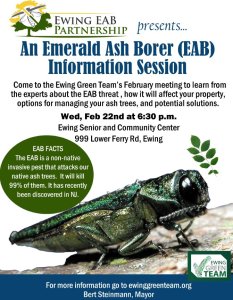
An Emerald Ash Borer Information Session

Come to the Ewing Green Team’s February meeting to learn from the experts about the Emerald Ash Borer (EAB) threat, how it will affect your property, options for managing your ash trees, and potential solutions.

The Emerald Ash borer has been found in Ewing Township.  (See the Rutgers  EAB Rapid Ash Survey Report and Management Options, Prepared for the Township of Ewing, Mercer County , NJ, By The Rapid Ash Survey Team (RAST) October 2015.)  As this invasive pest can easily spread to neighboring trees, all residents should check their ash trees for symptoms of infestation.

“The emerald ash borer will kill 99 percent of all ash trees within the next few years,” said Bill Brash, the NJ State Certified Tree Expert with whom the EGT has been working about the EAB threat to the municipal tree canopy. “Residents should identify ash trees on their property and monitor for signs of damage or decline such as unusual woodpecker activity or missing bark.”

EAB Facts

eabinfosessionSince the discovery of emerald ash borer in Michigan in 2002, the beetle has killed hundreds of millions of ash trees in North America. In May 2014, the New Jersey Department of Agriculture confirmed New Jersey’s first detection of the emerald ash borer in Bridgewater in Somerset County, NJ.

The emerald ash borer is a small, metallic green, non-native invasive pest. Trees can be infested for years before the tree begins to show symptoms of infestation. Symptoms include canopy dieback, woodpecker activity, missing bark, D-shaped exit holes, shoots sprouting from the trunk, and S-shaped larval galleries under the bark.

Ash Tree Management

If a tree is already infested or in poor health, it may be best to remove the tree before it becomes infested and poses a hazard to people and surrounding structures. But for those residents with high-value ash in good health, trees can be treated before they become infested.

A Certified Tree Expert can help residents evaluate, then treat or remove ash trees. Contact the Board of Certified Tree Experts at 732-833-0325 or njtreeexperts@gmail.com for a list of professionals serving your area.

Report any signs. If any signs of the EAB beetle are found, call the New Jersey Department of Agriculture at 609-406-6939. Visit http://www.emeraldashborer.nj.gov for more information and check out our own EAB resource page.


untitled-5This program is being provided by the Ewing EAB Partnership, a coalition composed of Ewing Green Team  and Environmental Commission members and representatives from Mercer County, Rutgers University and PSE&G under the direction of NJ State Certified Tree Expert Bill Brash.  It is funded by a 2016 PSE&G grant Partnering for the Restoration of the Community Forest: The 3P Plan, Partnerships-Plan-Planting which funded development of partnerships  to manage the spread and removals of trees infected with the Emerald Ash Borer on Ewing municipal lands.

Date: Wednesday, February, 22nd, 2017
Time: 6:30 p.m.
Location: Ewing Senior and Community Center, 999 Lower Ferry Road, Ewing
Details:  Free and open to the public. No registration is required.
Additional Information: Contact EGT Co-Chair, Joanne Mullowney at 609-883-0862 or email: ewinggreenteam@gmail.com

The Sustainable State of Ewing’s Public Schools

A Report by Ewing Public Schools Administrator Dennis Nettleton

Come to the January meeting of the Ewing Green Team on January 25th to receive an update on the many improvements and plans for improvement ongoing in the Ewing School District.

The schools in Ewing Township registered in the Sustainable Jersey for Schools program  in the fall of 2015.   Their approach to certification is a three year one, and each year the district schools plans to address a different aspect of the “people, planet and prosperity” tenet of Sustainable Jersey mantra.  In their first year in the program they began with Sustainable Jersey actions in the “people” category.  In 2016-2017 they are focusing on activities that promote “prosperity” in our schools and then move on to actions that promote the planet in subsequent years.   Their approach to participating in the Sustainable Jersey for Schools program is methodical and prototypical.

Initiatives so far include:

  • formation of a district “green team”
  • an accessible communications strategy that is paperless and web-based
  • School gardens at each of the five schools in the district
  • pedestrian and bicycle safety initiatives
  • health and wellness initiatives including fitness activities

We invite all parents with children in the Ewing School system to learn how the district is initiating sustainability initiatives and the current status of their approach to certification.

Date: Wednesday, Jan 25
Time: 6:30 pm
Location: Ewing Senior and Community Center, Community Room
Details: Free and open to the public

EGT Annual Planning Meeting This Saturday, Jan 14th

The Green Team remains focused on making Ewing an even better place to live than it is now. The public is welcome to join us at our annual retreat to plan for our initiatives for the coming year. Please reference our Strategic Plan for additional information.

Date: January 14th
Time: 9 am – noon
Location: Ewing Senior and Community Center, Board Room, 999 Lower Ferry Road

Meet Garry Keel : New 2017 EGT Appointee

The Ewing Green Team is pleased to announce that it has recently added a new member to its roster of sustainability advocates in Ewing Township.  Garry Keel is a New Jersey native and long term Ewing resident.  He is the owner and founder of a small business in town, Money Management Associates, which has specialized in tax preparation and financial services since 1984.   Money Management Associates recently received recognition for its sustainable business practices and commitment to the environment  with one of our first Ewing Green Business awards.

Garry KeelDr. Keel received a bachelor’s degree from Rider College (now Rider University), a master’s degree from Trenton State College (now The College of New Jersey), and a doctoral degree from Fordham University.  After working in higher education for many years he is now retired and focusing on his business, giving back to his community and “lots of fun stuff.”  He particularly enjoys biking for fun and exercise.   This is, in fact, where we first met up with Garry.  He joined the EGT for its first Ewing Fall Spin in 2015 and was hooked by both the ride itself and the engagement with members of his community.  He participated in planning the 2016 ride and was a ride sponsor.  Now that he has been appointed to the green team, promoting the ride will be an area of focus for him.

Besides his numerous other volunteer activities, Garry has focused on establishing practices to make his business more sustainable.  He has set up his own “Shred Day” for his customers and community members, where they can bring their important and confidential paper documents to his business to be shredded and recycled.  He is also a new advocate for the State of New Jersey’s Clean Energy Program’s Direct Install program for small and medium-sized businesses.   This program offers grants of up to 70% of the costs for energy saving building upgrades.   He is currently in process with his own building upgrades and will report back to us on his satisfaction with the program.  He states that he initially had a hard time believing that the state really pays for 70% of the costs, but seeing is believing as he has recently just written his check for only 30% of the planned upgrades!

The EGT is delighted that Garry has decided to join us in promoting sustainability in our Township. We welcome the perspective a small business owner and biking advocate will bring to our efforts. The EGT asks you too to join with us in our work.  Come to a meeting and find a way that you can help us influence others to make needed positive changes for a better tomorrow for our town, our state, our country and our world.