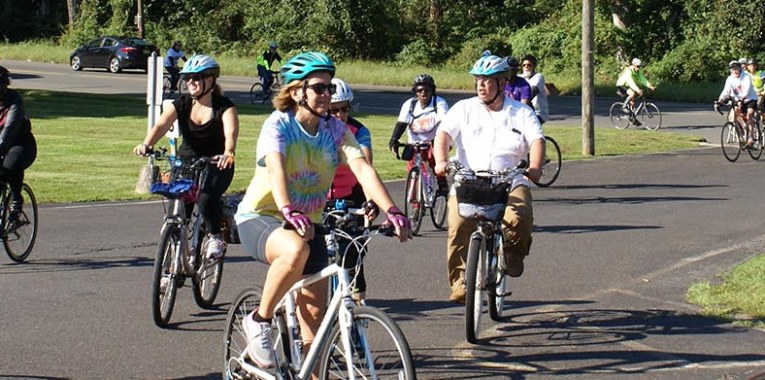
Mayor Bert Steinmann, the Ewing Green Team, and the Ewing Recreation Department are pleased to announce that Ewing’s annual Fall Spin bike tour will be held on Saturday, September 30, 2023, starting at 8:15am.

We invite you to join your fellow Ewingites and pedal your way through town on a 12-mile leisurely ride with a guided Police escort, and enjoy a morning of exercise, fun and camaraderie. There will be rest stops with refreshments and free bike inspections, provided by Hart’s Cyclery, will be available.
The event, now in its 9th year, has been a hit with area residents who enjoy taking a leisurely tour of the town with their friends and family members. It’s also a great opportunity to meet fellow residents from across Ewing.
This event kicks off Ewing’s annual Community Fest Celebration at TCNJ, starting and ending at Campus Town.
Each year the proceeds are donated to a different charity. The selected charity for 2023 is Meals on Wheels of Mercer County, a local nonprofit dedicated to providing nutritious meals and related services, while easing the social isolation of our senior and homebound participants. The goal of the services is to assist participants, who wish to remain in their homes, maintain independence, dignity, health, and well-being.
The Ewing Fall Spin is open to individuals or teams, ages 18 years and older. You are encouraged to register early as there is a maximum number of 60 riders allowed. “We would love participants to sign up as individuals or come as a team of friends, family members or co-workers,” says EGT Member and Bike Tour Chairperson, Garry Keel. The Fall Spin registration fee is $25 prior to September 23rd and $30 thereafter. All persons registering by September 23rd will receive a T-shirt. Day-of-event registration will begin at 7:45am.
Ride Details
Date: September 30th (Rain or shine). In case of really inclement weather and the event has to be cancelled, we will try to contact you by phone and/or email. (So please fill out the form with your computer or sign up using CommunityPass)
Meet Up: 7:45 a.m. at Campus Town
Ride Start: 8:15 a.m.
Cost: $25 per person (includes a free tee shirt if your registration is received by September 17th.) $30 per person if received after Sept 23rd.
Police Escort: The Ewing police will once again escort us through intersections.
Registration
- Online: You must create a user account (a one-time requirement for all Ewing programs) and fill out all required information. This will populate our registration form and waiver. There is an additional $3 fee to cover processing costs. Do not use this system if you are being comped for the ride.
- In Person: Register and pay at the ESCC Recreation Department Office, temporarily located at the Hollowbrook Community Center, 320 Hollowbrook Drive, Ewing, NJ 08638.
- Phone in registration by Credit Card Call 609-883-1776 Ext. 2
- By mail Fill out the registration form and mail it along with your check made out to the Ewing Twp. Recreation Department to:
Ted Forst (Director)
Ewing Recreation Department
Hollowbrook Community Center
320 Hollowbrook Drive
Ewing, NJ 08638
More Things Biking at Community Fest!
Bike Rodeo
Kids ages 4 -12 are invited to the 2023 Community Fest Bike Rodeo. Aimed at teaching the rules of the road, as well as some safety tips for both the rider and their cycle, the event is still in the planning stages but will be held in conjunction with Community Fest, Saturday, September 30th at the parking lot near the Food Trucks. More information to come.
Recycle Your Bicycle!
Help put a smile on the face of a child when you donate your used bicycle to help kids from low-income families enjoy the freedom and delight of biking! Drop off your used bicycle at the Bike Rodeo. This Bike Drive is being held in collaboration with the Boys and Girls Club Bike Exchange located at Capitol Plaza.